NY Social Studies 2.7a
The Standard
Cause-and-effect relationships help us to understand the changes in communities.
New York State K–12 Social Studies Framework
Key Idea 2.7
Cause-and-effect relationships help us recount events and understand historical development.
Teacher's field guide
What This Standard Means
What Students Need to Do
- Students identify why a community change happened and what happened as a result. They sort events into causes and effects, then explain how the events are connected.
What Mastery Looks Like
- Given a short community example, students correctly label the cause and effect. They explain the connection using words such as because, so, or as a result.
Common Misconceptions
- Students may reverse the cause and effect. They may think that any two events happening together are connected. They may also name a change without explaining why it happened.
How to Assess It
- Exit ticket: “More families move to a town, and builders replace a farm with houses. Circle the cause, underline the effect, and explain the link.”
Lesson moves
Ways to Teach It
Give pairs picture cards of farms, roads, cars, homes, and stores; students connect causes to effects with yarn and explain each link.
Ask, “Why might more homes lead to fewer farms?” Students draw and write one cause-and-effect sentence.
Play Cause or Effect: read community change cards, and students hold up C or E cards before defending their choice.
Compare two local photographs from different years, then identify one possible reason for a visible change and one result.
Free download
Printable 2.7a Worksheet
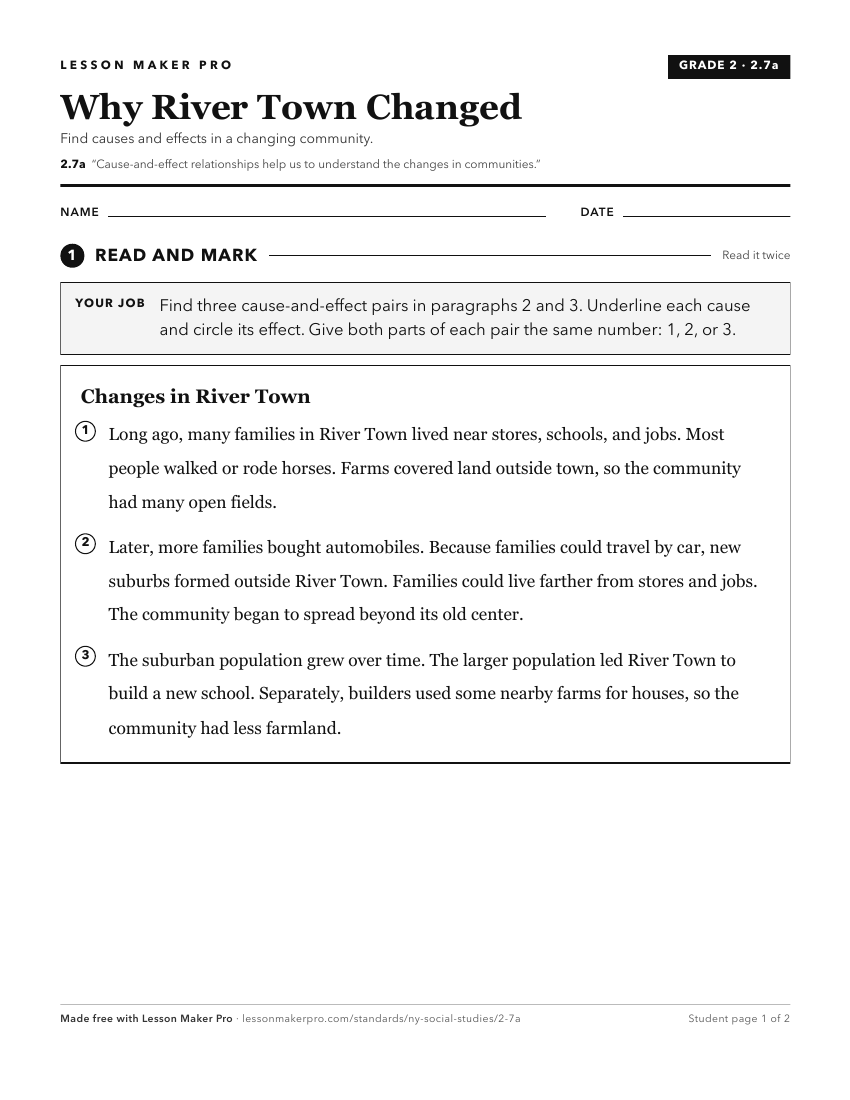
A ready-to-print activity worksheet aligned to 2.7a, with an answer key for the teacher on its own page. No account needed.
PDF, US Letter, prints cleanly in black and white.
Download the worksheetTurn this exact standard into a lesson
Grade, subject, topic, and the complete standard are prefilled. Create one free, no account needed.
Also for this standard:Make a WorksheetMake a QuizMake a Sub Lesson