NY Social Studies 12.G4b
The Standard
Allowing citizens to vote does not ensure that a system is a democracy. Open, safe, and honest elections are essential to a democratic system. Engaged and informed citizens should know the mechanics associated with voting, including when major local, state, and national elections are held, how to register to vote, who currently holds each office, who is running for office, and what the central issues are pertaining to that election.
New York State K–12 Social Studies Framework
Key Idea 12.G4
POLITICAL AND CIVIC PARTICIPATION: There are numerous avenues for engagement in the political process, from exercising the power of the vote, to affiliating with political parties, to engaging in other forms of civic participation. Citizens leverage both electoral and non-electoral means to participate in the political process.
Teacher's field guide
What This Standard Means
What Students Need to Do
- Students judge election quality by checking access, safety, transparency, accurate counting, and meaningful choice. They find reliable information about registration, election dates, officeholders, candidates, and issues. They explain how informed participation supports fair elections.
What Mastery Looks Like
- Given an election scenario, a student can identify strengths and warning signs and support each judgment with evidence. The student can use official sources to complete an accurate voter information sheet. They can separate verified facts from unsupported claims or partisan messages.
Common Misconceptions
- Students may assume any election with voting is democratic or that fraud is the only threat to fairness. They may think registration rules and election dates are the same everywhere. They may also treat campaign advertisements or social media posts as reliable election sources.
How to Assess It
- Give students two short election scenarios and ask: Which election is more democratic, and what three details support your judgment? Then have them name one official source for registration or candidate information.
Lesson moves
Ways to Teach It
Set up a mock polling place with voter rolls, privacy screens, ballots, and observers, then have students audit the process for fairness.
Write: Which safeguards make an election democratic, and what evidence would show that each safeguard is working?
Run an election mechanics card sort matching offices with election dates, registration steps, candidate sources, and issue sources.
Use the county Board of Elections website to build a one-page voter guide for the next local, state, or national election.
Free download
Printable 12.G4b Worksheet
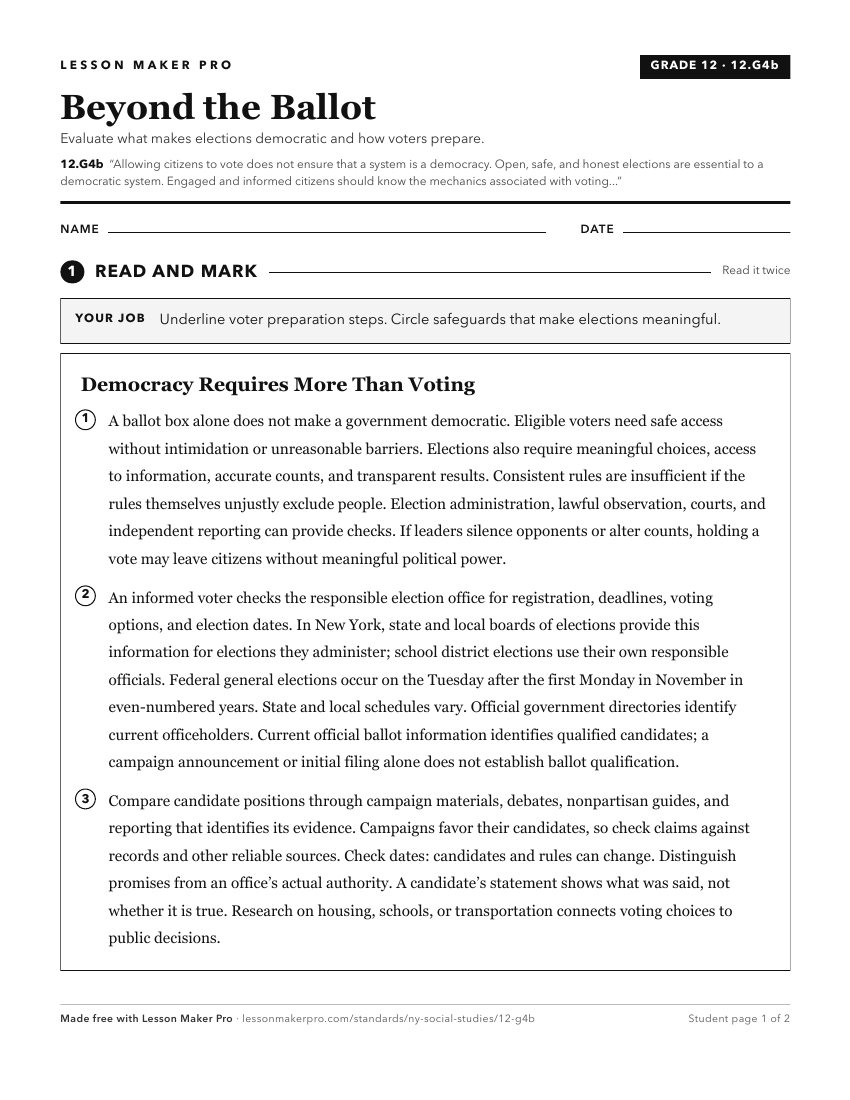
A ready-to-print activity worksheet aligned to 12.G4b, with an answer key for the teacher on its own page. No account needed.
PDF, US Letter, prints cleanly in black and white.
Download the worksheetTurn this exact standard into a lesson
Grade, subject, topic, and the complete standard are prefilled. Create one free, no account needed.
Also for this standard:Make a WorksheetMake a QuizMake a Sub Lesson