NY Social Studies 12.G4a
The Standard
Depending on the level of government and type of election, there are different processes and mechanisms within the United States electoral and representational systems, including the electoral college and winner-take all systems. Advantages and drawbacks of election processes and mechanisms continue to be an issue of ongoing debate in the United States.
New York State K–12 Social Studies Framework
Key Idea 12.G4
POLITICAL AND CIVIC PARTICIPATION: There are numerous avenues for engagement in the political process, from exercising the power of the vote, to affiliating with political parties, to engaging in other forms of civic participation. Citizens leverage both electoral and non-electoral means to participate in the political process.
Teacher's field guide
What This Standard Means
What Students Need to Do
- Students identify how rules differ in presidential, congressional, state, and local elections. They calculate how winner-take-all and proportional allocation can produce different results. They explain tradeoffs using evidence.
What Mastery Looks Like
- Given vote totals, students can determine winners and show how seats or electoral votes are assigned. They can compare popular-vote and electoral outcomes, then defend a claim about fairness or representation with accurate evidence.
Common Misconceptions
- Students often think the national popular vote directly elects the president. They may assume every state must use winner-take-all, or that electoral votes are assigned proportionally. They also confuse congressional districts, statewide races, and Electoral College votes.
How to Assess It
- Exit ticket: In a fictional two-candidate election, A wins 60% in a 10-elector state and 25% in an 8-elector state. Calculate A’s electors under winner-take-all and exact proportional allocation. Name one representational tradeoff.
Lesson moves
Ways to Teach It
Give groups colored vote tokens and state cards, then tally the same fictional presidential election using winner-take-all and proportional allocation.
Write a six-sentence recommendation to a state legislature choosing winner-take-all or proportional allocation, citing two effects on voters and candidates.
Pairs draw state-result cards, assign electoral votes, and race to identify whether the popular-vote and electoral-vote winners match.
Use certified results from one presidential race and one New York mayoral race to compare electorates, winning rules, and representation.
Free download
Printable 12.G4a Worksheet
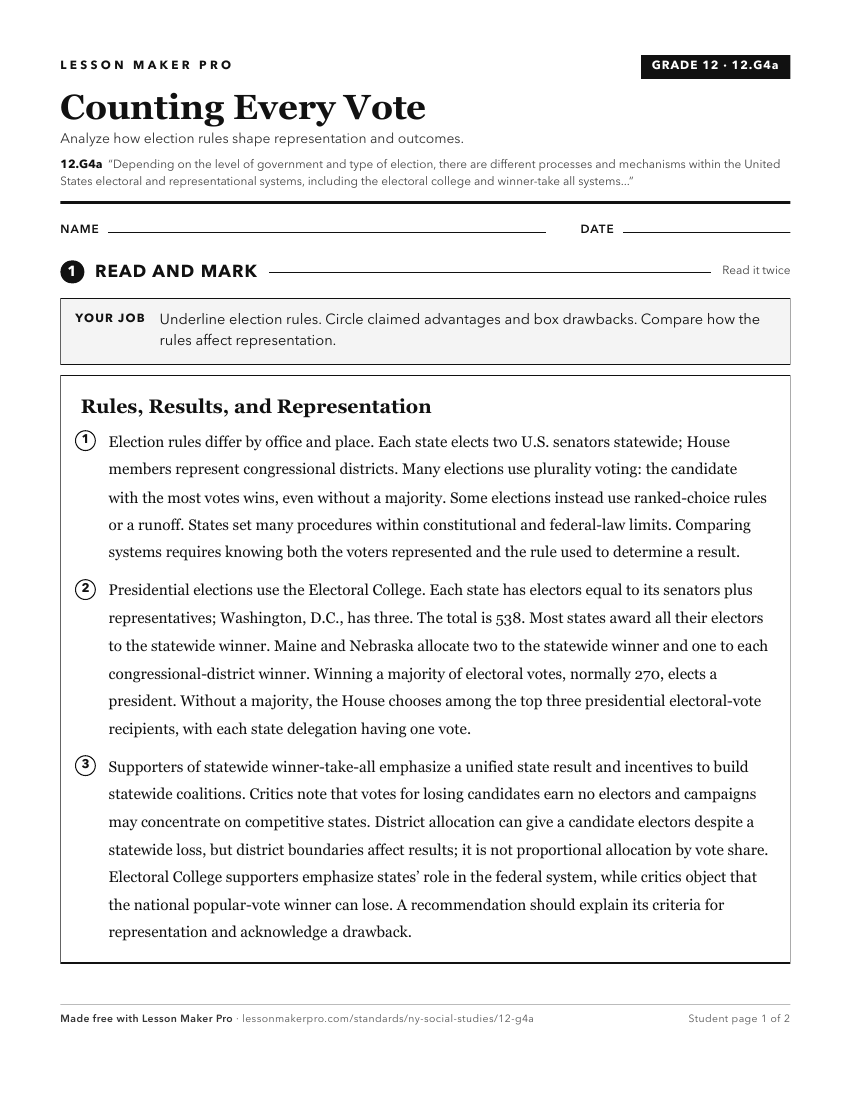
A ready-to-print activity worksheet aligned to 12.G4a, with an answer key for the teacher on its own page. No account needed.
PDF, US Letter, prints cleanly in black and white.
Download the worksheetTurn this exact standard into a lesson
Grade, subject, topic, and the complete standard are prefilled. Create one free, no account needed.
Also for this standard:Make a WorksheetMake a QuizMake a Sub Lesson