NY Social Studies 12.E4d
The Standard
Trade policies and agreements (tariffs, quotas, embargoes) set the rules for trade between the United States and other nations. Agreeing on such rules is very difficult because each nation has different interests, and each nation has special interest groups trying to influence the negotiations.
New York State K–12 Social Studies Framework
Key Idea 12.E4
THE TOOLS OF ECONOMIC POLICY IN A GLOBAL ECONOMY: Globalization and increased economic interdependence affect the United States economy significantly. The tools that the policy makers have available to address these issues are fiscal policy, monetary policy, and trade policy.
Teacher's field guide
What This Standard Means
What Students Need to Do
- Students distinguish tariffs, quotas, and embargoes and explain how each can change prices, imports, domestic production, and consumer choice. They compare national goals and stakeholder pressures during trade negotiations.
What Mastery Looks Like
- Given a trade dispute, students identify the policy tool, predict likely winners and losers, and support each prediction with economic reasoning. They can negotiate terms while explaining which interests they accepted or rejected.
Common Misconceptions
- Students often confuse tariffs, which tax imports, with quotas, which limit import amounts, and embargoes, which prohibit trade. They may assume trade restrictions help everyone within a country or that governments negotiate without pressure from industries, workers, and consumers.
How to Assess It
- Exit ticket: Country A places a 25 percent tariff on imported steel. Identify two likely winners or losers, explain one price effect, and name one group likely to lobby for or against it.
Lesson moves
Ways to Teach It
Give teams country and industry cards, then have them negotiate tariff rates while tracking gains, losses, and political pressure.
Write a response to this prompt: Should consumer interests outweigh domestic industry demands when governments negotiate trade rules?
Run a sorting race where students match policy scenarios to tariff, quota, or embargo and justify each match.
Choose an imported classroom item and model a hypothetical 20 percent tariff using an assumed customs value. State an explicit pass-through assumption before estimating any retail-price change.
Free download
Printable 12.E4d Worksheet
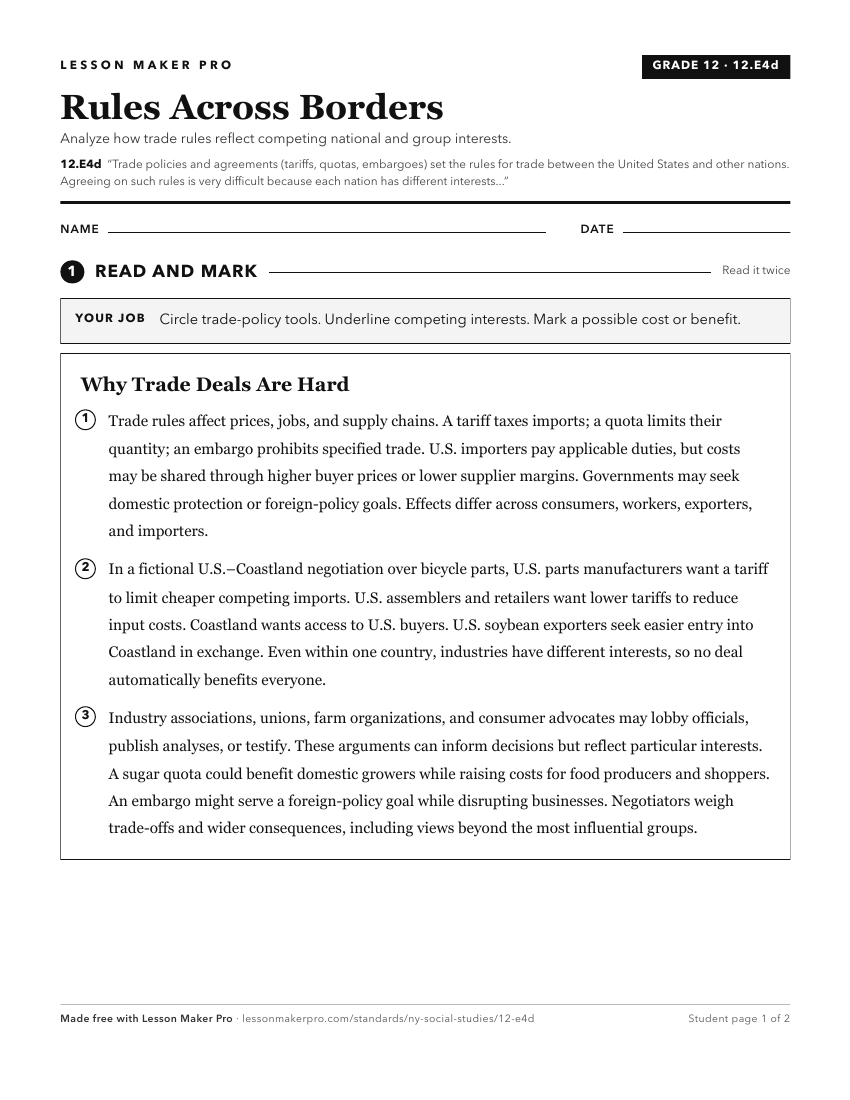
A ready-to-print activity worksheet aligned to 12.E4d, with an answer key for the teacher on its own page. No account needed.
PDF, US Letter, prints cleanly in black and white.
Download the worksheetTurn this exact standard into a lesson
Grade, subject, topic, and the complete standard are prefilled. Create one free, no account needed.
Also for this standard:Make a WorksheetMake a QuizMake a Sub Lesson