NY Social Studies 12.E3e
The Standard
The degree to which economic inequality reflects social, political, or economic injustices versus individual choices is hotly debated. The role that the government should play in decreasing this gap, including the variety of government programs designed to combat poverty, is debated as well.
New York State K–12 Social Studies Framework
Key Idea 12.E3
THE IMPACT OF AMERICAN CAPITALISM IN A GLOBAL ECONOMY: There are various economic systems in the world. The United States operates within a mixed, free market economy that is characterized by competition and a limited role of government in economic affairs. Economic policy makers face considerable challenges within a capitalist system, including unemployment, inflation, poverty, and environmental consequences. Globalization increases the complexity of these challenges significantly, and has exerted strong and transformative effects on workers and entrepreneurs in the United States economy.
Teacher's field guide
What This Standard Means
What Students Need to Do
- Students weigh evidence about how personal decisions, labor markets, education, discrimination, taxes, and inherited wealth shape economic inequality. They compare government programs and debate how much government should act to reduce poverty and inequality.
What Mastery Looks Like
- A student can distinguish income, wealth, and poverty and accurately read data about each. The student can make a supported claim about inequality and judge a government program by its benefits, costs, and tradeoffs.
Common Misconceptions
- Students often treat income and wealth as the same measure. They may assume inequality has one cause or that unequal outcomes always prove unfair treatment. They may also confuse programs that reduce poverty with policies that reduce the overall wealth gap.
How to Assess It
- Give students a graph showing income shares by quintile and a short description of the Earned Income Tax Credit. Ask: "Use one detail from each source to explain inequality and judge whether this policy is a suitable response."
Lesson moves
Ways to Teach It
Give groups job, rent, child care, health, and benefit cards, then have them build a monthly budget after drawing one emergency.
Hold a structured discussion: Which matters more for economic mobility, personal choices or public conditions, and what evidence supports your claim?
Run a policy matching game where students pair poverty problems with SNAP, EITC, housing aid, Medicaid, or job training, then justify matches.
Use county income and poverty data to compare two nearby communities and propose one targeted policy response with a likely tradeoff.
Free download
Printable 12.E3e Worksheet
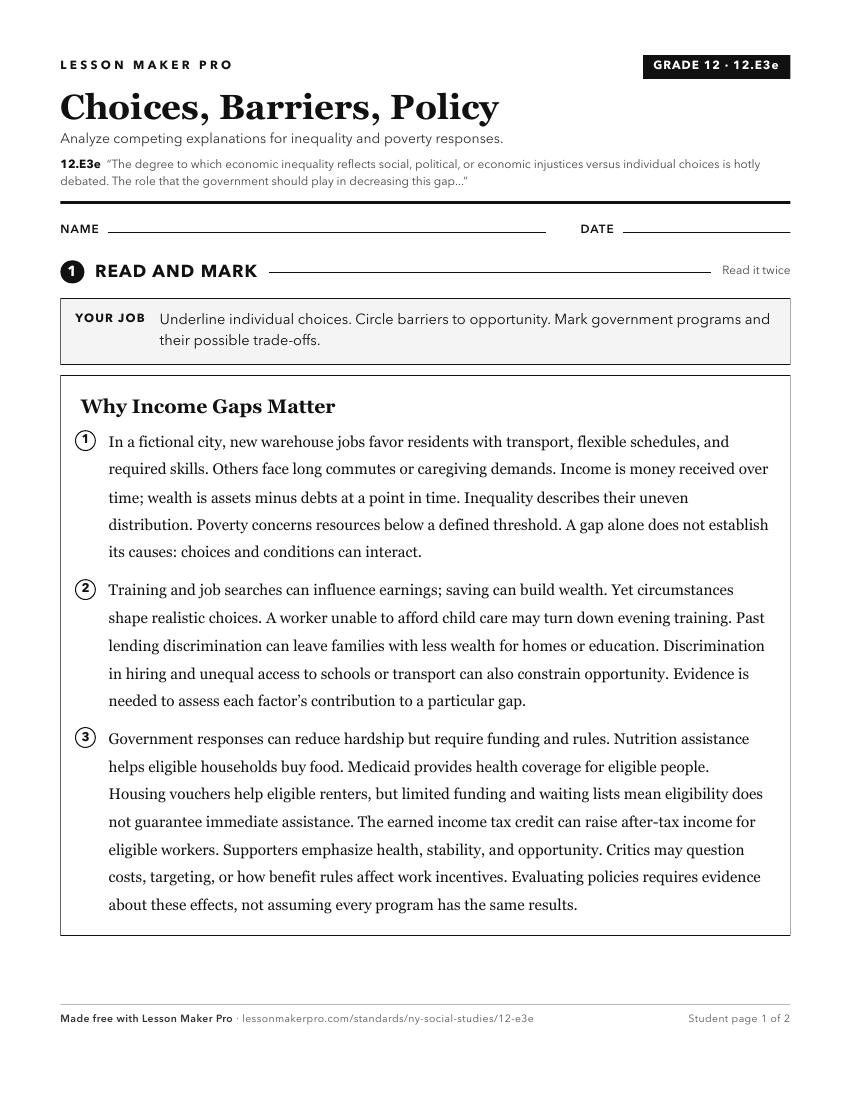
A ready-to-print activity worksheet aligned to 12.E3e, with an answer key for the teacher on its own page. No account needed.
PDF, US Letter, prints cleanly in black and white.
Download the worksheetTurn this exact standard into a lesson
Grade, subject, topic, and the complete standard are prefilled. Create one free, no account needed.
Also for this standard:Make a WorksheetMake a QuizMake a Sub Lesson