NY Social Studies 12.E3d
The Standard
A degree of regulation, oversight, or government control is necessary in some markets to ensure free and fair competition and to limit unintended consequences of American capitalism. Government attempts to protect the worker, ensure property rights, and to regulate the marketplace, as well as to promote income equality and social mobility, have had varied results.
New York State K–12 Social Studies Framework
Key Idea 12.E3
THE IMPACT OF AMERICAN CAPITALISM IN A GLOBAL ECONOMY: There are various economic systems in the world. The United States operates within a mixed, free market economy that is characterized by competition and a limited role of government in economic affairs. Economic policy makers face considerable challenges within a capitalist system, including unemployment, inflation, poverty, and environmental consequences. Globalization increases the complexity of these challenges significantly, and has exerted strong and transformative effects on workers and entrepreneurs in the United States economy.
Teacher's field guide
What This Standard Means
What Students Need to Do
- Students explain why government may intervene in markets and trace the effects on workers, consumers, businesses, and competition. They compare policies and judge results using evidence, including unintended effects.
What Mastery Looks Like
- Given a policy or case, students identify the market problem, government response, affected groups, and measurable results. They make a supported judgment while recognizing costs, benefits, and tradeoffs.
Common Misconceptions
- Students may assume regulation always helps or always harms the economy. They may overlook government protection of contracts and property rights, or confuse equal opportunity with equal income.
How to Assess It
- Use an exit ticket: “A city raises its minimum wage from $15 to $18. Name the goal, one likely benefit, one unintended effect, and evidence needed to judge the policy.”
Lesson moves
Ways to Teach It
Give groups role cards and tokens to simulate an unregulated factory labor market, then repeat with a minimum wage and safety rule.
Ask, “Should government break up a dominant online marketplace?” Students cite effects on prices, innovation, workers, and small businesses.
Run a policy sorting game: students match antitrust laws, patents, pollution limits, and tax credits to goals, stakeholders, and tradeoffs.
Students annotate a recent news article about an FTC case or local wage law, then summarize its goal, results, and disputed effects.
Free download
Printable 12.E3d Worksheet
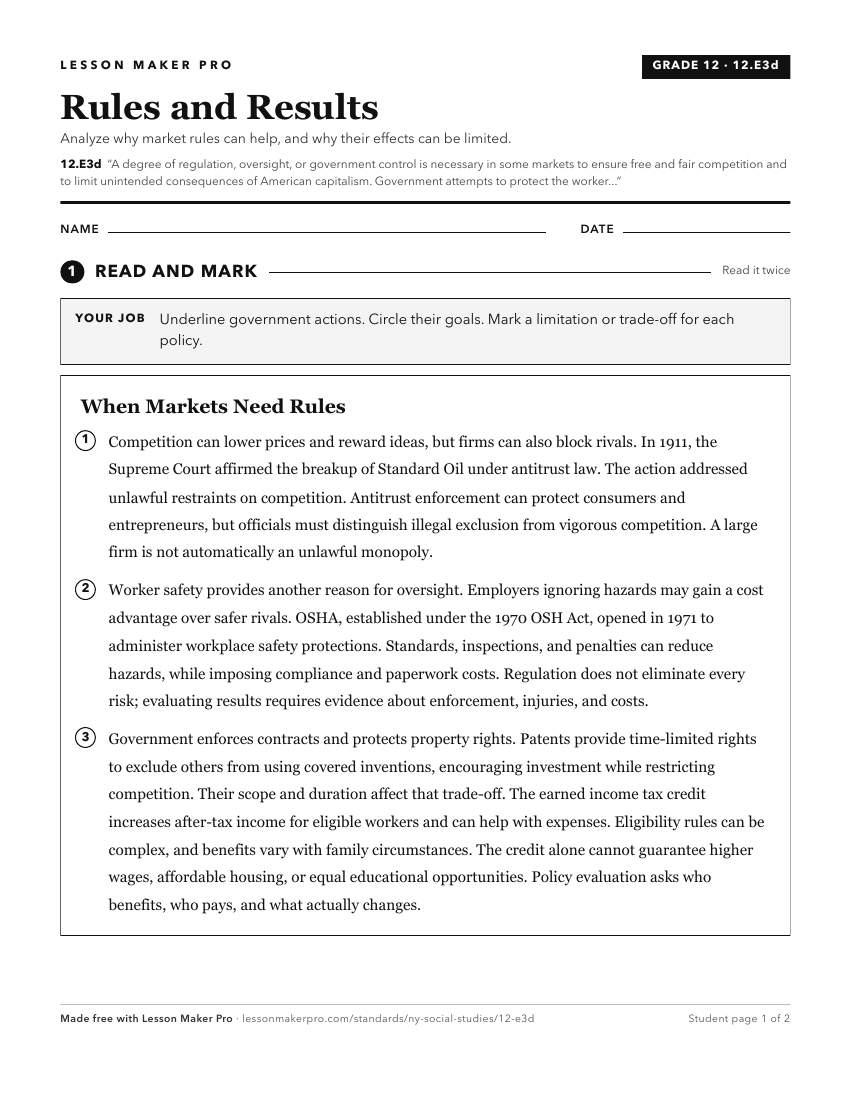
A ready-to-print activity worksheet aligned to 12.E3d, with an answer key for the teacher on its own page. No account needed.
PDF, US Letter, prints cleanly in black and white.
Download the worksheetTurn this exact standard into a lesson
Grade, subject, topic, and the complete standard are prefilled. Create one free, no account needed.
Also for this standard:Make a WorksheetMake a QuizMake a Sub Lesson