NY Social Studies 12.E3c
The Standard
The freedom of the United States economy encourages entrepreneurialism. This is an important factor behind economic growth that can lead to intended consequences (e.g., growth, competition, innovation, improved standard of living, productivity, specialization, trade, outsourcing, class mobility, positive externalities) and unintended consequences (e.g., recession, depression, trade, unemployment, outsourcing, generational poverty, income inequality, the challenges of class mobility, negative externalities.).
New York State K–12 Social Studies Framework
Key Idea 12.E3
THE IMPACT OF AMERICAN CAPITALISM IN A GLOBAL ECONOMY: There are various economic systems in the world. The United States operates within a mixed, free market economy that is characterized by competition and a limited role of government in economic affairs. Economic policy makers face considerable challenges within a capitalist system, including unemployment, inflation, poverty, and environmental consequences. Globalization increases the complexity of these challenges significantly, and has exerted strong and transformative effects on workers and entrepreneurs in the United States economy.
Teacher's field guide
What This Standard Means
What Students Need to Do
- Students explain how market incentives can encourage people to start businesses, invest, and develop new products. They trace how those choices can produce benefits and costs for workers, consumers, communities, and the environment.
What Mastery Looks Like
- Given a business case, students can build a clear cause-and-effect chain from an entrepreneurial decision to several economic outcomes. They support claims with evidence and distinguish intended results from unintended effects.
Common Misconceptions
- Students may assume business growth always benefits everyone or that profit proves an outcome is socially beneficial. They may treat outsourcing, trade, or technology as entirely positive or negative instead of examining effects on different groups.
How to Assess It
- Exit ticket: A firm automates to lower costs, knowingly replacing 100 jobs. Identify an intended outcome and a possible unintended effect, name affected groups, and explain why harmful does not necessarily mean unintended.
Lesson moves
Ways to Teach It
Give teams tokens, index cards, and labor choices to run a small paper-product company, then track profits, jobs, waste, and consumer prices.
Write a response to this prompt: When does a successful business decision create an unfair cost for workers or communities?
Sort outcome cards into intended, unintended, or both, then defend disputed choices using a cause-and-effect statement.
Examine a local business expansion and identify effects on jobs, prices, nearby businesses, tax revenue, traffic, and pollution.
Free download
Printable 12.E3c Worksheet
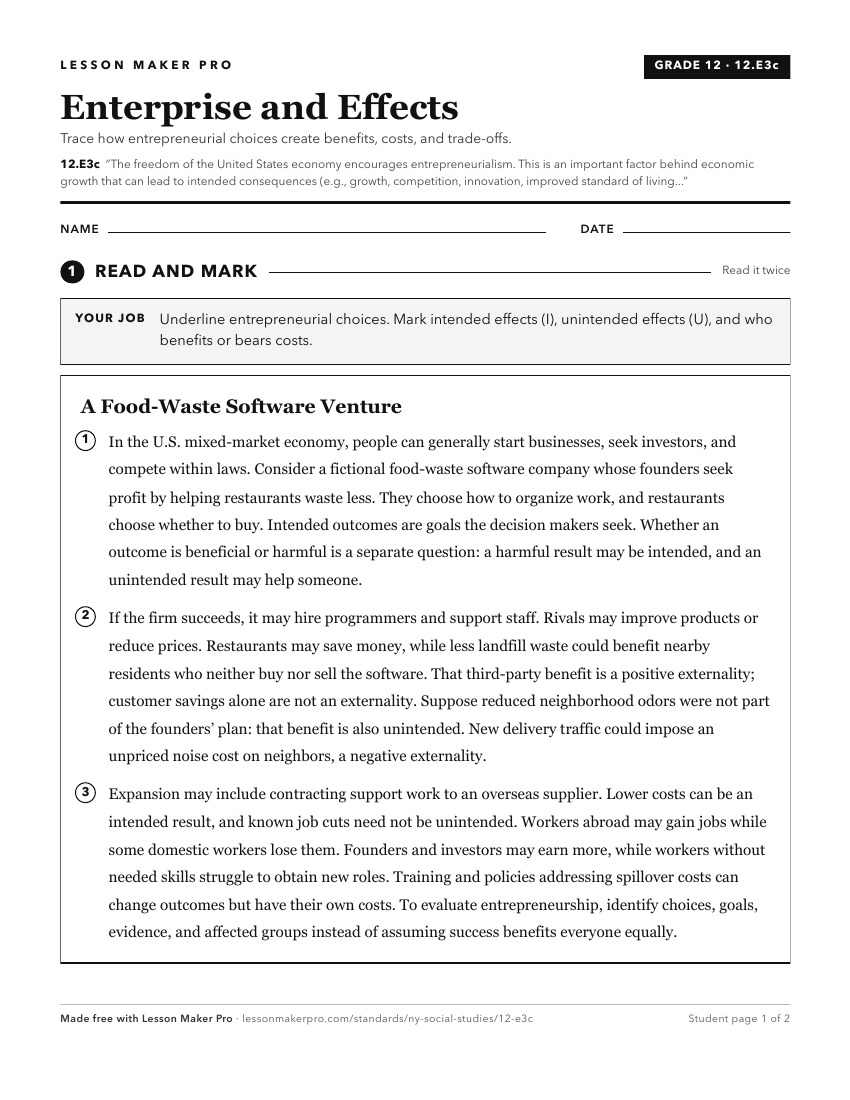
A ready-to-print activity worksheet aligned to 12.E3c, with an answer key for the teacher on its own page. No account needed.
PDF, US Letter, prints cleanly in black and white.
Download the worksheetTurn this exact standard into a lesson
Grade, subject, topic, and the complete standard are prefilled. Create one free, no account needed.
Also for this standard:Make a WorksheetMake a QuizMake a Sub Lesson