NY Social Studies 12.E2c
The Standard
Businesses choose what to supply in the product market, based on product market prices, available technology, and prices of factors of production. The prices of those factors are determined based on supply and demand in the factor market. The supply and demand of each factor market is directly related to employment. Debates surround various ways to minimize unemployment (frictional, structural, cyclical).
New York State K–12 Social Studies Framework
Key Idea 12.E2
INDIVIDUALS AND BUSINESSES IN THE PRODUCT AND FACTOR MARKETS: Free enterprise is a pillar of the United States economy and is based on the principle that individuals and businesses are free to make their own economic choices as they participate in these markets. Individuals buy the goods and services that they desire from businesses in the product markets, and they contribute to producing these goods and services by supplying the resources that they own to businesses in the factor markets.
Teacher's field guide
What This Standard Means
What Students Need to Do
- Students explain how product prices, technology, wages, and other input costs shape a firm's output and hiring decisions. They connect factor market supply and demand to employment, distinguish three types of unemployment, and compare policy responses.
What Mastery Looks Like
- Given a business scenario, students can predict changes in production, wages, and hiring with clear economic reasoning. They can classify unemployment as frictional, structural, or cyclical and defend a fitting response.
Common Misconceptions
- Students often confuse product markets with factor markets or reverse who supplies labor and who demands it. They may assume all unemployment has the same cause, or that one policy can eliminate unemployment completely.
How to Assess It
- Exit ticket: A nationwide recession reduces furniture demand, and a company cuts production and lays off workers. Explain the output/hiring link, classify the unemployment, and propose a response. Explain why falling sales at one firm alone would not establish cyclical unemployment.
Lesson moves
Ways to Teach It
Give teams wage, rent, technology, and product-price cards, then have them choose output and hiring levels for a mock bakery.
Ask students to defend which policy, job training, unemployment benefits, or government spending, best addresses one unemployment scenario.
Run a matching relay where students pair worker shortages, wage changes, technology shifts, and demand changes with likely employment effects.
Use local job postings to compare wages and skill demands, then predict how a new technology might change hiring.
Free download
Printable 12.E2c Worksheet
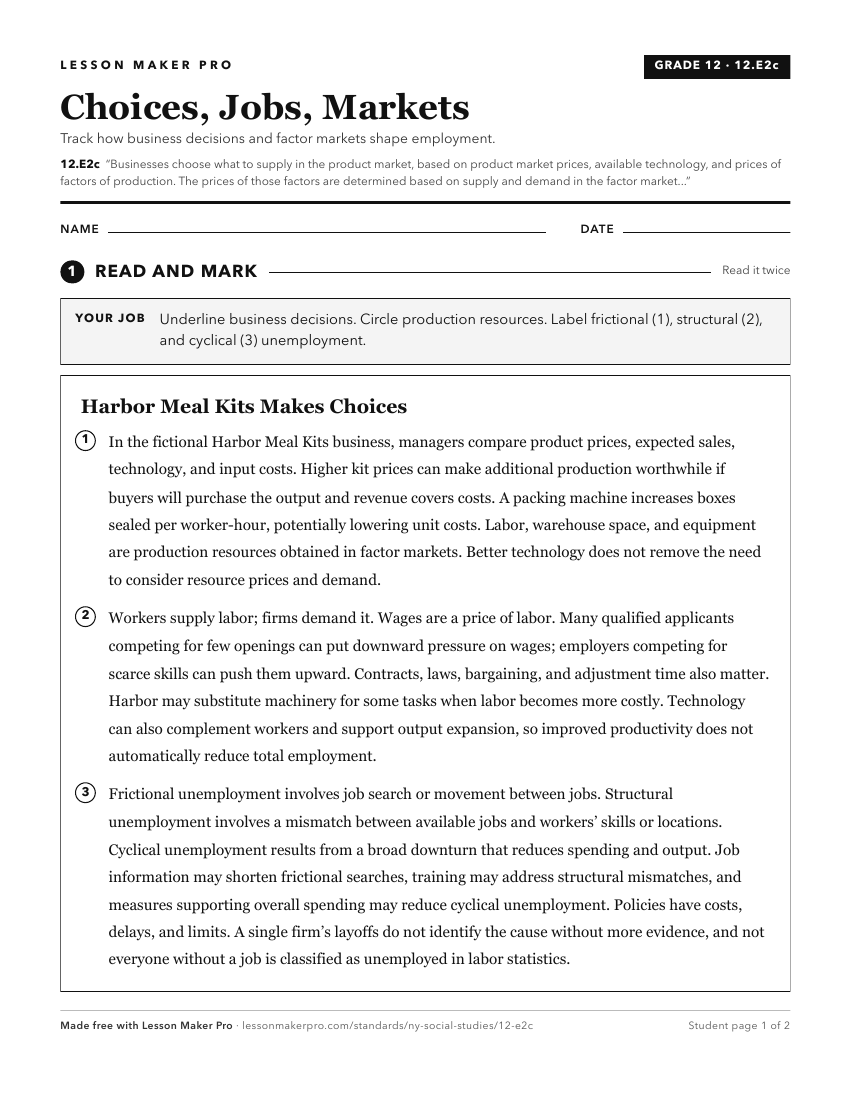
A ready-to-print activity worksheet aligned to 12.E2c, with an answer key for the teacher on its own page. No account needed.
PDF, US Letter, prints cleanly in black and white.
Download the worksheetTurn this exact standard into a lesson
Grade, subject, topic, and the complete standard are prefilled. Create one free, no account needed.
Also for this standard:Make a WorksheetMake a QuizMake a Sub Lesson