NY Social Studies 12.E1c
The Standard
Managing personal finance effectively requires an understanding of the forms and purposes of financial credit, the effects of personal debt, the role and impact of interest, and the distinction between nominal and real returns. Predatory lending practices target and affect those who are least informed and can least afford such practices. Interest rates reflect perceived risk, so maintaining a healthy credit rating lowers the cost of borrowing.
New York State K–12 Social Studies Framework
Key Idea 12.E1
INDIVIDUAL RESPONSIBILITY AND THE ECONOMY: Individuals should set personal financial goals, recognize their income needs and debt obligations, and know how to utilize effective budgeting, borrowing, and investment strategies to maximize well-being.
Teacher's field guide
What This Standard Means
What Students Need to Do
- Students compare credit types and decide which fits a stated need. They calculate interest, fees, total debt, and inflation-adjusted investment returns. They identify predatory loan terms and explain how credit history affects borrowing rates.
What Mastery Looks Like
- Students can read a loan disclosure, calculate total repayment, and explain why different borrowers may receive different rates. They can estimate a real return and point out fees, penalties, or repayment terms that make a loan harmful.
Common Misconceptions
- A low monthly payment does not always mean a loan costs less overall. Students may confuse nominal returns with gains in buying power or think income alone determines credit scores. They may also assume any legal loan is fair.
How to Assess It
- Exit ticket: Two $1,000 loans are repaid in full after one year with no earlier payments. A charges 12% simple annual interest plus a $50 fee; B charges 16% simple annual interest with no fee. Calculate costs, choose the cheaper loan, and name a lending warning sign.
Lesson moves
Ways to Teach It
Give pairs three mock loan disclosures, calculators, and highlighters to mark APR, fees, penalties, and total repayment before choosing an offer.
Ask students to write whether lenders should charge higher rates for greater risk, then discuss when risk pricing becomes predatory lending.
Play a credit profile game where teams draw payment-history cards, update scores, and compare the loan rates their profiles receive.
Compare a local car loan advertisement with its disclosure box, calculating total cost and listing terms that could trap a borrower.
Free download
Printable 12.E1c Worksheet
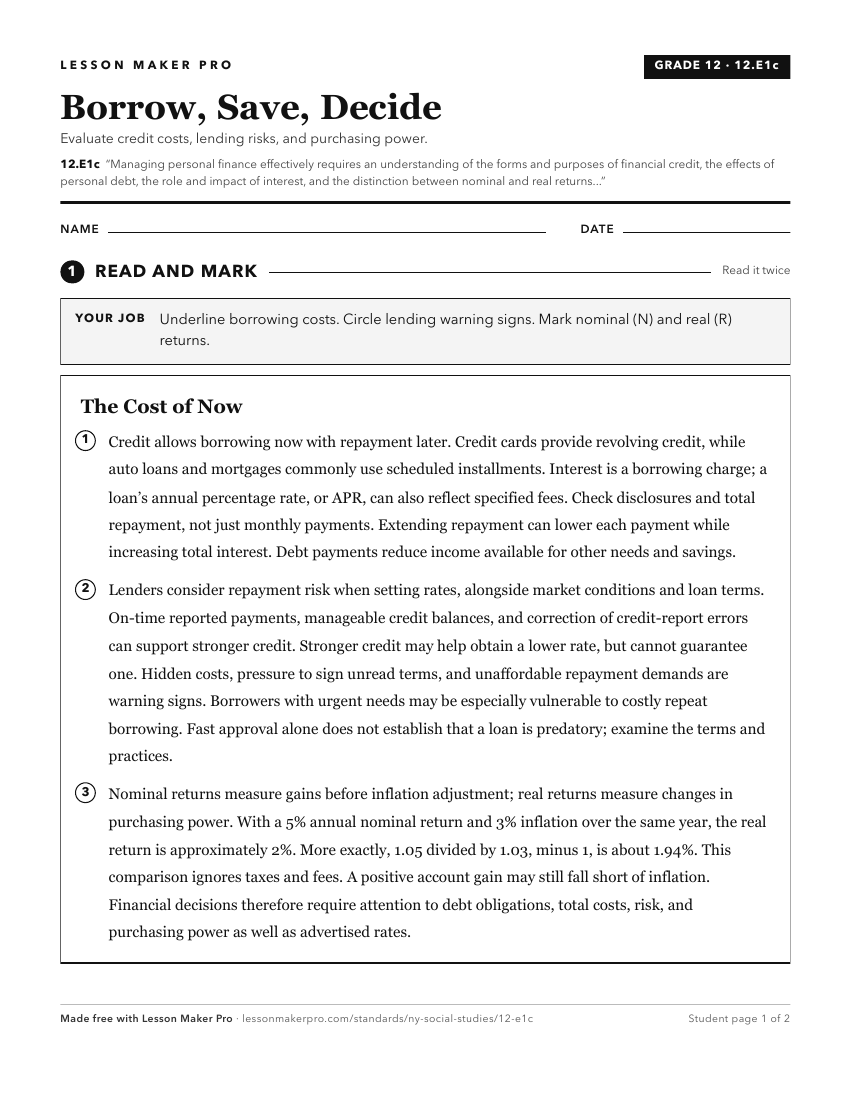
A ready-to-print activity worksheet aligned to 12.E1c, with an answer key for the teacher on its own page. No account needed.
PDF, US Letter, prints cleanly in black and white.
Download the worksheetTurn this exact standard into a lesson
Grade, subject, topic, and the complete standard are prefilled. Create one free, no account needed.
Also for this standard:Make a WorksheetMake a QuizMake a Sub Lesson