NY Social Studies 12.E1b
The Standard
Sound personal financial (money management) practices take into account wealth and income, the present and the future, and risk factors when setting goals and budgeting for anticipated saving and spending. Cost-benefit analysis is an important tool for sound decision making. All financial investments carry with them varying risks and rewards that must be fully understood in order to make informed decisions. Greater rewards generally come with higher risks.
New York State K–12 Social Studies Framework
Key Idea 12.E1
INDIVIDUAL RESPONSIBILITY AND THE ECONOMY: Individuals should set personal financial goals, recognize their income needs and debt obligations, and know how to utilize effective budgeting, borrowing, and investment strategies to maximize well-being.
Teacher's field guide
What This Standard Means
What Students Need to Do
- Students create budgets that account for net income, assets, debts, current expenses, and future goals. They compare financial choices by weighing costs, benefits, time, and possible losses.
What Mastery Looks Like
- Students can build a balanced monthly budget that includes bills, debt payments, emergency savings, and a long-term goal. They can compare investments and explain why the best choice depends on timing and tolerance for loss.
Common Misconceptions
- Students may confuse income with wealth or treat gross pay as spendable income. They may assume higher returns are guaranteed, overlook fees, or ignore emergencies and short-term needs.
How to Assess It
- Give students a $2,400 monthly net income, $1,850 in required expenses, and two investment choices with different risks. Ask them to allocate the remaining money and justify their choice in three sentences.
Lesson moves
Ways to Teach It
Give pairs a mock paycheck, bills, savings envelopes, and investment cards, then have them allocate funds and explain each choice.
Ask students to write which matters more for a five-year goal, possible return or protection from loss, and defend their answer.
Run a risk card game where groups choose portfolios, draw market event cards, and track gains or losses across five rounds.
Have students compare a bank savings account and an index fund using published rates, fees, past returns, and risk statements.
Free download
Printable 12.E1b Worksheet
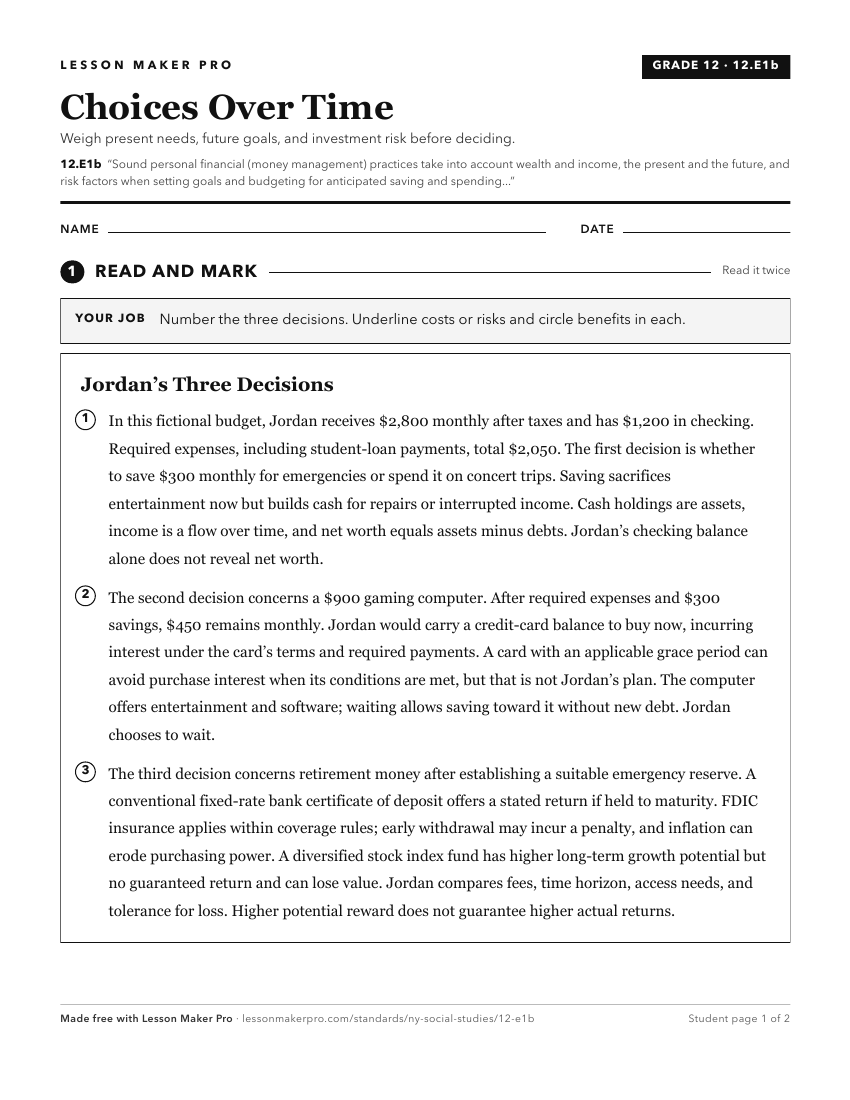
A ready-to-print activity worksheet aligned to 12.E1b, with an answer key for the teacher on its own page. No account needed.
PDF, US Letter, prints cleanly in black and white.
Download the worksheetTurn this exact standard into a lesson
Grade, subject, topic, and the complete standard are prefilled. Create one free, no account needed.
Also for this standard:Make a WorksheetMake a QuizMake a Sub Lesson