NY Social Studies 11.7c
The Standard
For many Americans, the 1920s was a time of prosperity. However, underlying economic problems, reflected in the stock market crash of 1929, led to the Great Depression. President Franklin D. Roosevelt’s responses to the Great Depression increased the role of the federal government.
New York State K–12 Social Studies Framework
Key Idea 11.7
PROSPERITY AND DEPRESSION (1920 – 1939): The 1920s and 1930s were a time of cultural and economic changes in the nation. During this period, the nation faced significant domestic challenges, including the Great Depression.
Teacher's field guide
What This Standard Means
What Students Need to Do
- Students explain why the 1920s economy grew and identify weaknesses in consumer credit, banking, farming, wealth distribution, and stock speculation. They connect the crash to the wider Depression, compare Hoover’s and Roosevelt’s responses, and trace the Dust Bowl’s human and environmental causes. They judge New Deal programs, expanded federal power, Roosevelt’s leadership, and the court-packing plan using evidence.
What Mastery Looks Like
- Students can build an evidence-based causal chain from 1920s growth to collapse without treating the crash as the only cause. They can compare specific Hoover and Roosevelt policies, explain how two New Deal programs changed federal responsibility, and weigh constitutional objections. They can use migration, farm, and climate evidence to explain the Dust Bowl’s causes and effects.
Common Misconceptions
- Students often assume everyone prospered in the 1920s and that the stock market crash alone caused the Depression. They may claim Hoover did nothing, Roosevelt immediately ended the Depression, or every New Deal program had the same purpose. Some blame the Dust Bowl only on drought and miss how farming practices worsened erosion.
How to Assess It
- Use a four-box exit ticket: name one source of 1920s prosperity, one economic weakness, one contrast between Hoover and Roosevelt, and one federal power gained. Under the boxes, students write one sentence linking drought and farming practices to Dust Bowl migration.
Lesson moves
Ways to Teach It
Give groups source cards on credit, farming, banking, stocks, and jobs; have them build and defend a cause-and-effect chain.
Ask students to write: Did New Deal relief justify expanded federal power? Use two programs and address one counterclaim.
Run a policy sort: teams classify Hoover and Roosevelt actions, then earn points by explaining each action’s view of government.
Have students inspect an FDIC bank sign or Social Security statement and trace its link to Depression-era policy.
Free download
Printable 11.7c Worksheet
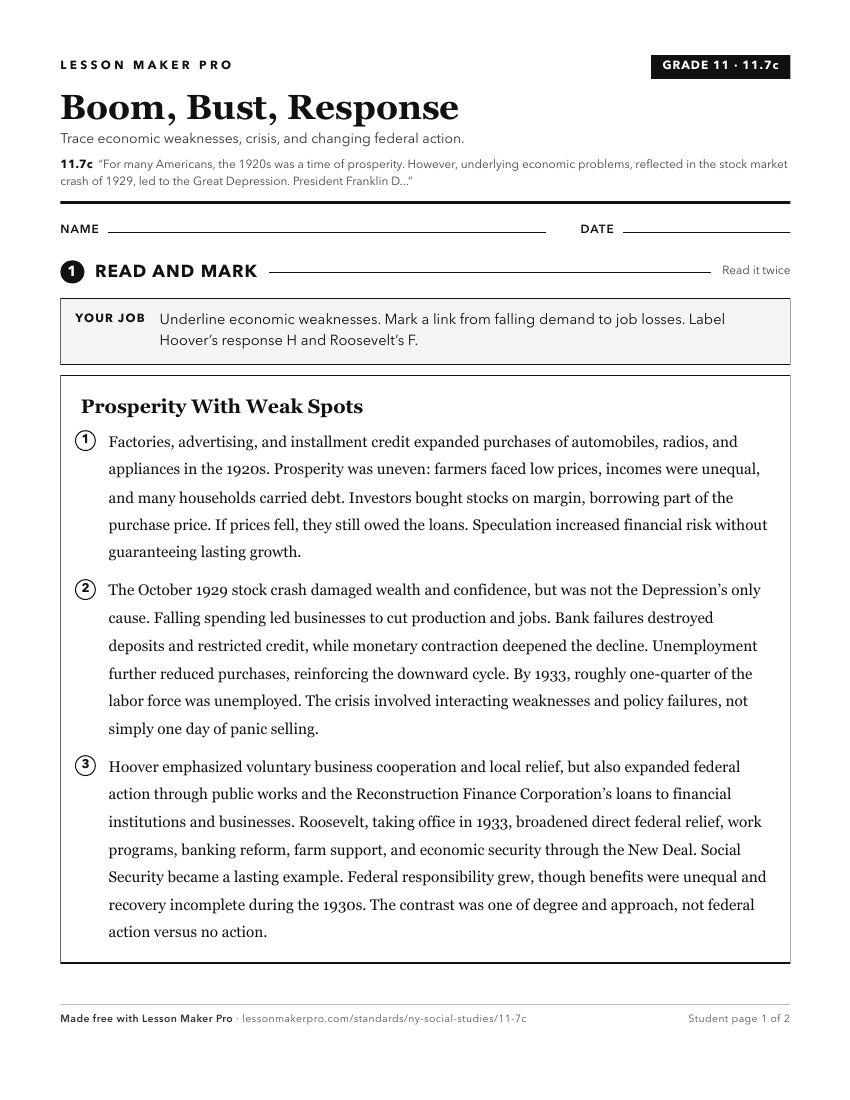
A ready-to-print activity worksheet aligned to 11.7c, with an answer key for the teacher on its own page. No account needed.
PDF, US Letter, prints cleanly in black and white.
Download the worksheetTurn this exact standard into a lesson
Grade, subject, topic, and the complete standard are prefilled. Create one free, no account needed.
Also for this standard:Make a WorksheetMake a QuizMake a Sub Lesson