NY Social Studies 11.6a
The Standard
In the late 1800s, various strategic and economic factors led to a greater focus on foreign affairs and debates over the United States’ role in the world.
New York State K–12 Social Studies Framework
Key Idea 11.6
THE RISE OF AMERICAN POWER (1890 – 1920): Numerous factors contributed to the rise of the United States as a world power. Debates over the United States’ role in world affairs increased in response to overseas expansion and involvement in World War I. United States participation in the war had important effects on American society.
Teacher's field guide
What This Standard Means
What Students Need to Do
- Students explain why business and military leaders wanted overseas markets, resources, ports, and coaling stations. They compare Spanish, Cuban, and American goals, then evaluate arguments over Hawaii, the Philippines, the Panama Canal, and the Roosevelt Corollary.
What Mastery Looks Like
- Students use maps and primary sources to connect economic and strategic motives to specific actions. They explain causes and effects of the Spanish-American War and defend a claim about expansion using evidence from imperialists and anti-imperialists.
Common Misconceptions
- Students often reduce expansion to one motive, such as spreading democracy, and overlook business and naval interests. They may treat Cubans and Filipinos as passive or assume the war immediately gave both groups independence. They also confuse the Monroe Doctrine with the Roosevelt Corollary.
How to Assess It
- Exit ticket: Choose Hawaii, the Spanish-American War, the Philippines, or the Panama Canal. Name one motive, one affected group's interest, and one consequence.
Lesson moves
Ways to Teach It
Place market, resource, naval base, and coaling station cards on an 1898 world map, then justify each placement with one evidence note.
Hold a Treaty of Paris hearing where students speak as an imperialist, anti-imperialist, Filipino nationalist, Cuban revolutionary, or business owner.
Run a cause-and-effect card sort linking yellow journalism, the Maine explosion, war, territorial gains, Philippine resistance, and new overseas power.
Compare a Panama Canal shipping route with a route around South America, then calculate distance saved and discuss who gains control.
Free download
Printable 11.6a Worksheet
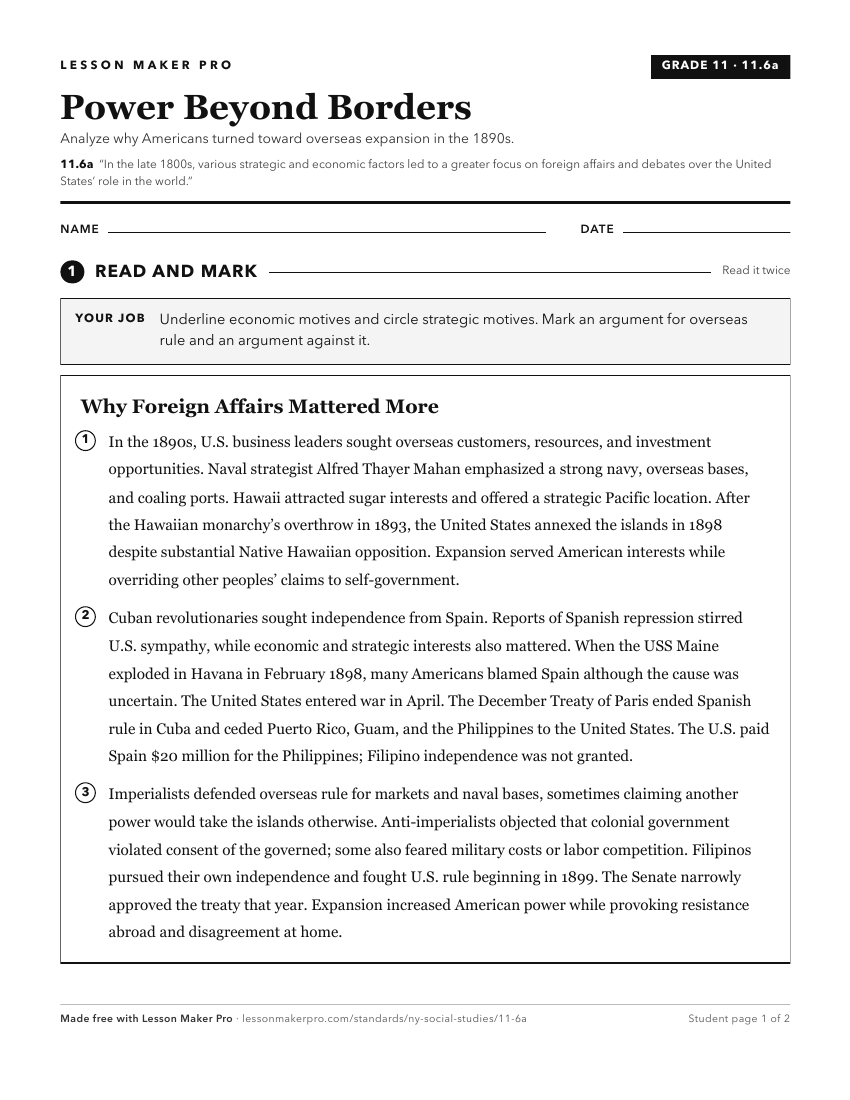
A ready-to-print activity worksheet aligned to 11.6a, with an answer key for the teacher on its own page. No account needed.
PDF, US Letter, prints cleanly in black and white.
Download the worksheetTurn this exact standard into a lesson
Grade, subject, topic, and the complete standard are prefilled. Create one free, no account needed.
Also for this standard:Make a WorksheetMake a QuizMake a Sub Lesson