NY Social Studies 11.5a
The Standard
New technologies and economic models created rapid industrial growth and transformed the United States.
New York State K–12 Social Studies Framework
Key Idea 11.5
INDUSTRIALIZATION AND URBANIZATION (1870 – 1920): The United States was transformed from an agrarian to an increasingly industrial and urbanized society. Although this transformation created new economic opportunities, it also created societal problems that were addressed by a variety of reform efforts.
Teacher's field guide
What This Standard Means
What Students Need to Do
- Students explain how energy, resources, transportation, and communication helped factories and national markets grow. They analyze how major business leaders built large companies through strategies such as vertical integration, horizontal integration, consolidation, and mass production. They use laws and court cases to judge whether government regulation limited corporate power.
What Mastery Looks Like
- Students can connect a specific innovation, such as the railroad or telephone, to lower costs, faster production, or wider markets. They can compare Carnegie, Rockefeller, Morgan, and Ford using accurate evidence about their methods. They can explain why early regulation often had limited results and support that judgment with a law or court ruling.
Common Misconceptions
- Students may treat every large company as a monopoly or confuse vertical integration with buying competitors. They may assume inventors alone caused industrial growth while ignoring capital, resources, labor, and transportation. They may also think the Sherman Antitrust Act immediately ended trusts or that the Wabash ruling strengthened state regulation.
How to Assess It
- Exit ticket: Choose one industrial leader and explain how one business strategy helped his company grow, then name one government response and judge its effectiveness.
Lesson moves
Ways to Teach It
Run a paper car assembly line, then compare production totals, error rates, and worker experiences with individual construction.
Ask students to write: Were Rockefeller and Carnegie builders of growth, threats to competition, or both? Use three specific facts.
Use a card sort matching innovations, resources, business strategies, industrial leaders, laws, and court decisions to their effects.
Compare a modern technology platform or utility company with a Gilded Age corporation, focusing on market power and government oversight.
Free download
Printable 11.5a Worksheet
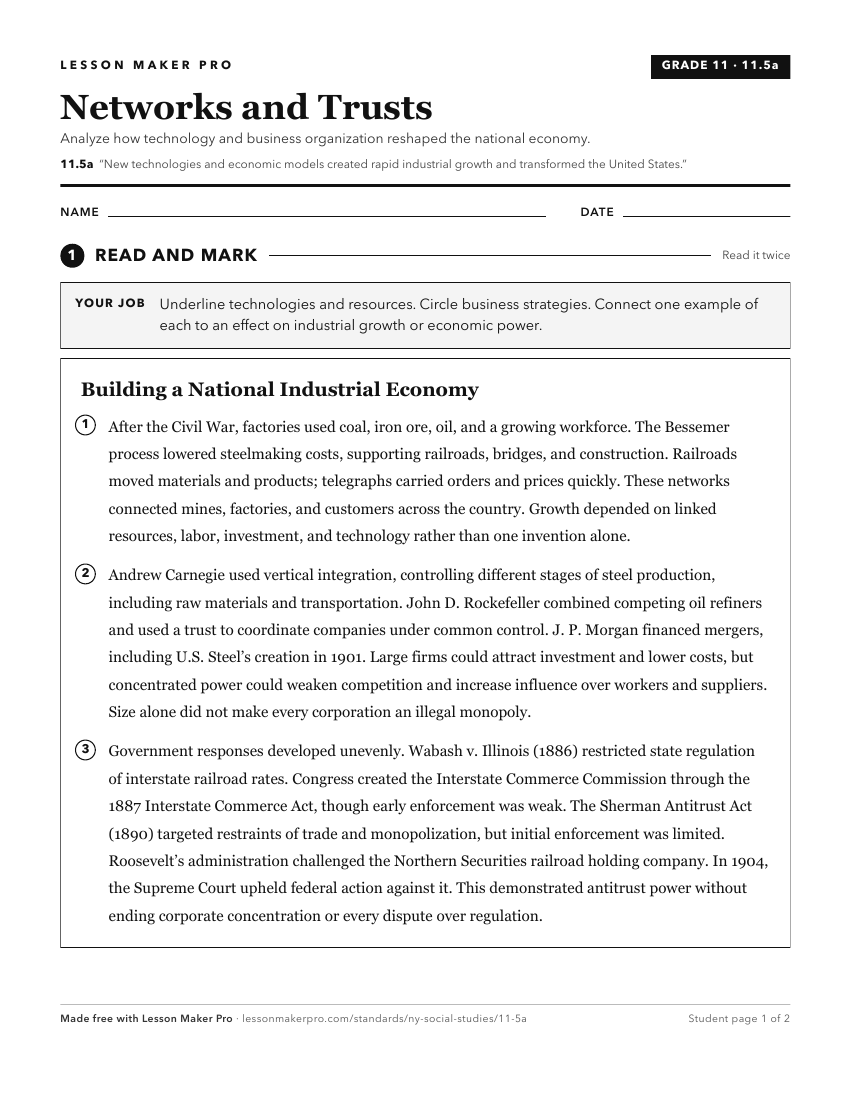
A ready-to-print activity worksheet aligned to 11.5a, with an answer key for the teacher on its own page. No account needed.
PDF, US Letter, prints cleanly in black and white.
Download the worksheetTurn this exact standard into a lesson
Grade, subject, topic, and the complete standard are prefilled. Create one free, no account needed.
Also for this standard:Make a WorksheetMake a QuizMake a Sub Lesson