NY Social Studies 11.3c
The Standard
Long-standing disputes over States rights and slavery and the secession of Southern states from the Union, sparked by the election of Abraham Lincoln, led to the Civil War. After the issuance of the Emancipation Proclamation, freeing the slaves became a major Union goal. The Civil War resulted in tremendous human loss and physical destruction.
New York State K–12 Social Studies Framework
Key Idea 11.3
EXPANSION, NATIONALISM, AND SECTIONALISM (1800 – 1865): As the nation expanded, growing sectional tensions, especially over slavery, resulted in political and constitutional crises that culminated in the Civil War.
Teacher's field guide
What This Standard Means
What Students Need to Do
- Students explain how slavery, sectional conflict, Lincoln’s election, and secession led to war. They compare Union and Confederate resources, explain Union victory, and trace changing war aims. They also evaluate expanded federal power, the Gettysburg Address, and the war’s human and physical costs.
What Mastery Looks Like
- Students use maps, statistics, and primary sources to support a clear explanation of Union victory. They explain the limits and effects of the Emancipation Proclamation and suspension of habeas corpus. They connect the Gettysburg Address to later debates about freedom, equality, and national purpose.
Common Misconceptions
- Students may treat states’ rights as separate from slavery or assume Lincoln’s election immediately ended slavery. They may think the Emancipation Proclamation freed every enslaved person at once. They may also assume the Union’s larger population and industry made victory quick or certain.
How to Assess It
- Give students a table of Union and Confederate resources. Ask: “Choose one Union advantage, explain how it aided victory, and explain why it did not guarantee victory.”
Lesson moves
Ways to Teach It
Give groups railroad, factory, population, and military leader cards, then have them build and defend a ranking of wartime advantages.
Ask students to write whether Lincoln’s wartime actions were justified, using excerpts about habeas corpus and emancipation as evidence.
Play a cause-and-effect card match with secession, major battles, emancipation, Union strategy, casualties, destruction, and surrender.
Use a New York Civil War archive to trace one local soldier’s service, then compare that record with national casualty data.
Free download
Printable 11.3c Worksheet
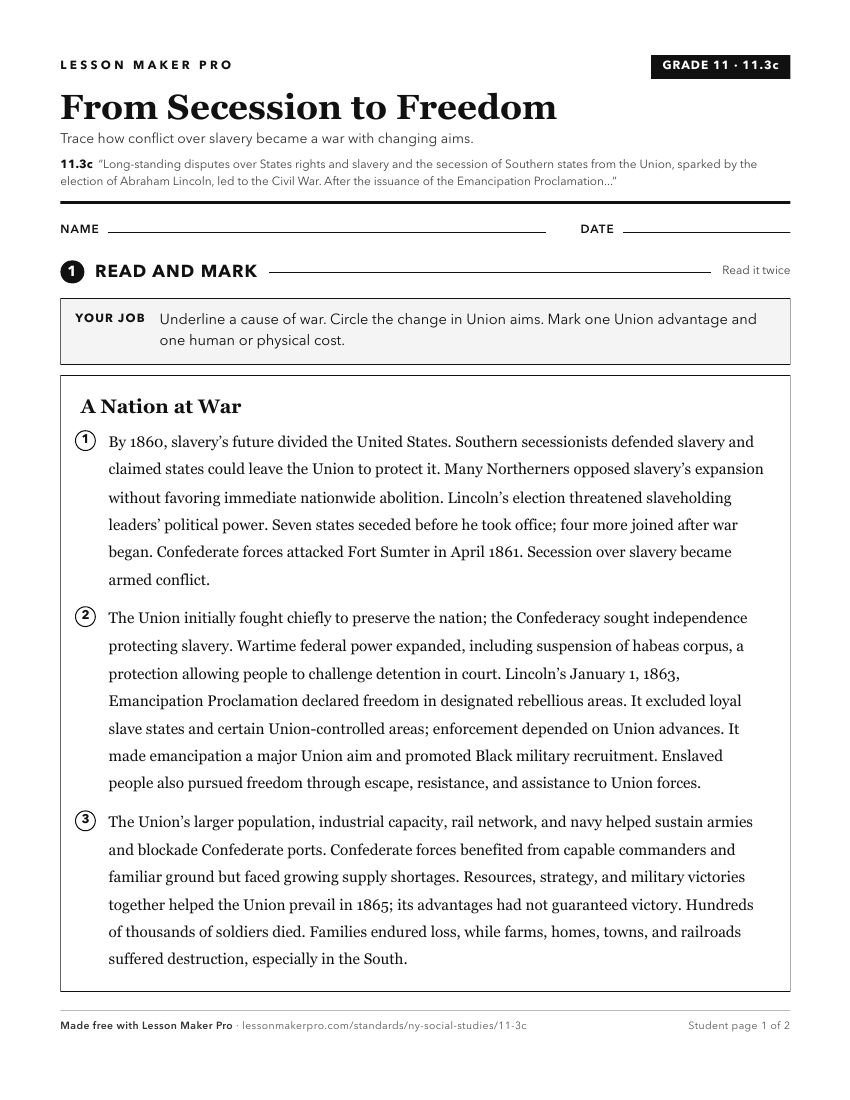
A ready-to-print activity worksheet aligned to 11.3c, with an answer key for the teacher on its own page. No account needed.
PDF, US Letter, prints cleanly in black and white.
Download the worksheetTurn this exact standard into a lesson
Grade, subject, topic, and the complete standard are prefilled. Create one free, no account needed.
Also for this standard:Make a WorksheetMake a QuizMake a Sub Lesson