NY Social Studies 11.3b
The Standard
Different perspectives concerning constitutional, political, economic, and social issues contributed to the growth of sectionalism.
New York State K–12 Social Studies Framework
Key Idea 11.3
EXPANSION, NATIONALISM, AND SECTIONALISM (1800 – 1865): As the nation expanded, growing sectional tensions, especially over slavery, resulted in political and constitutional crises that culminated in the Civil War.
Teacher's field guide
What This Standard Means
What Students Need to Do
- Students compare regional viewpoints on federal power, states' rights, slavery, abolition, and women's rights. They use speeches, laws, court decisions, and reform writing to explain how these disputes deepened sectional divisions before the Civil War.
What Mastery Looks Like
- A student can explain each side of a dispute and support the explanation with evidence from a named source or event. The student can trace how territorial expansion, failed compromises, antislavery activism, and reform movements pushed sections farther apart.
Common Misconceptions
- Students may treat states' rights as a fixed principle rather than an argument used differently during specific conflicts. They may assume all abolitionists agreed on methods, or that women's rights developed separately from abolition. They may also say each compromise ended the slavery dispute instead of delaying and reshaping it.
How to Assess It
- Exit ticket: Choose one states' rights conflict and one dispute over slavery's expansion. For each, name the opposing views, cite one specific source or event, and explain how the conflict increased sectional tension.
Lesson moves
Ways to Teach It
Have pairs arrange event cards from the Kentucky and Virginia Resolutions through John Brown's raid, then color-code each as constitutional, political, economic, or social.
Ask students to explain in writing how abolitionist work shaped the Seneca Falls demands, using one quotation from each movement.
Run a compromise ranking game where teams score the Missouri Compromise, Compromise of 1850, and Kansas-Nebraska Act for short-term stability.
Students compare nullification arguments with conflicting federal and state marijuana laws, identifying who claims authority and which constitutional language supports each side.
Free download
Printable 11.3b Worksheet
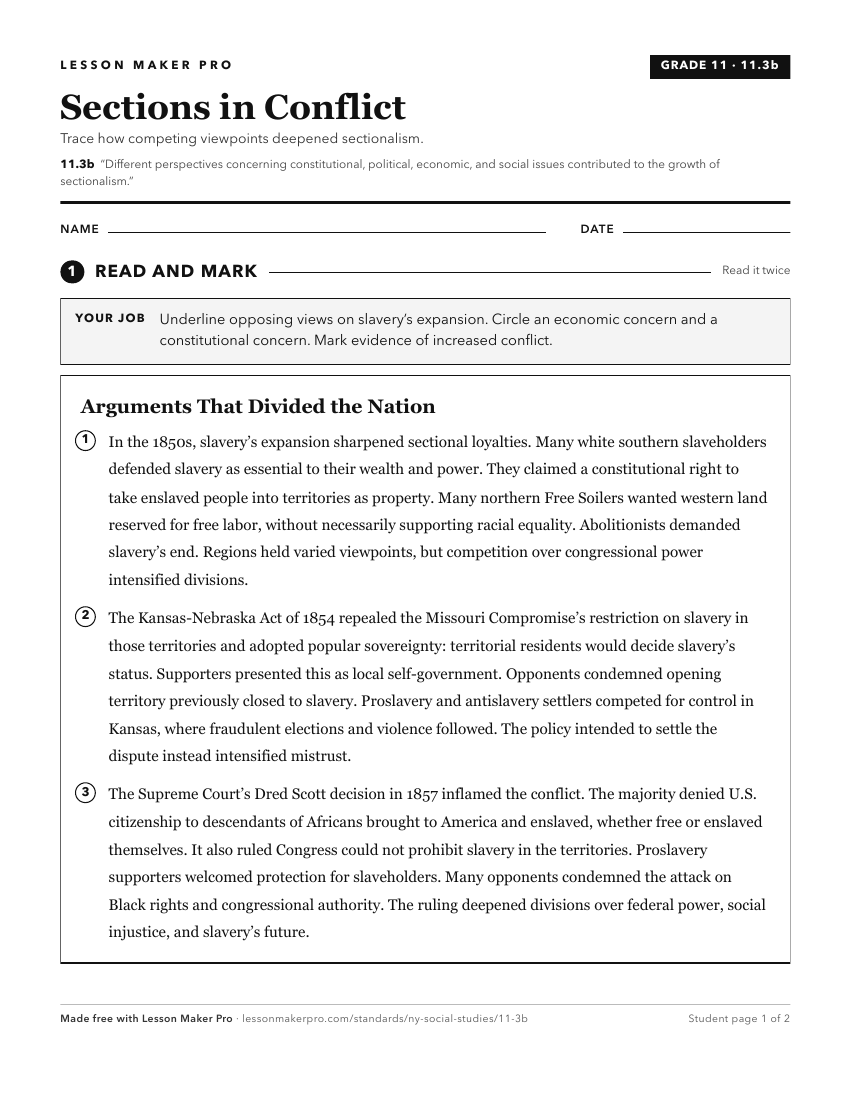
A ready-to-print activity worksheet aligned to 11.3b, with an answer key for the teacher on its own page. No account needed.
PDF, US Letter, prints cleanly in black and white.
Download the worksheetTurn this exact standard into a lesson
Grade, subject, topic, and the complete standard are prefilled. Create one free, no account needed.
Also for this standard:Make a WorksheetMake a QuizMake a Sub Lesson