NY Social Studies 11.2c
The Standard
Weaknesses of the Articles of Confederation led to a convention whose purpose was to revise the Articles of Confederation but instead resulted in the writing of a new Constitution. The ratification debate over the proposed Constitution led the Federalists to agree to add a bill of rights to the Constitution.
New York State K–12 Social Studies Framework
Key Idea 11.2
CONSTITUTIONAL FOUNDATIONS (1763 – 1824): Growing political and economic tensions led the American colonists to declare their independence from Great Britain. Once independent, the new nation confronted the challenge of creating a stable federal republic.
Teacher's field guide
What This Standard Means
What Students Need to Do
- Students explain how problems under the Confederation government shaped specific powers and structures in the Constitution. They analyze convention compromises, federalism, separated powers, checks and balances, popular sovereignty, and judicial independence. They compare Federalist and Antifederalist arguments and explain why a bill of rights was added.
What Mastery Looks Like
- Given a source excerpt, the student identifies a Federalist or Antifederalist claim and cites words as evidence. The student connects an Articles problem to a constitutional solution and explains one compromise, one check on power, and the Bill of Rights' original federal scope.
Common Misconceptions
- Students often say the Confederation government had no power, overlooking its diplomacy, war powers, and the Northwest Ordinance. They may assume the Constitution passed unanimously or included the Bill of Rights from the start. They may also think slavery compromises ended slavery or that the Bill of Rights originally limited state governments.
How to Assess It
- Give this exit ticket: Choose one Articles weakness, explain the Constitution's response, and name one Antifederalist concern addressed by the Bill of Rights.
Lesson moves
Ways to Teach It
Sort event cards into Articles successes, Articles weaknesses, and pressures for constitutional change, then defend two placements.
Write a six-sentence exchange between a Federalist and an Antifederalist about republic size, federal power, and a bill of rights.
Play a checks-and-balances challenge where teams match government actions to branches, limits, and possible responses by another branch.
Compare a current federal-state policy dispute with the Constitution's division of power, naming one federal claim and one state claim.
Free download
Printable 11.2c Worksheet
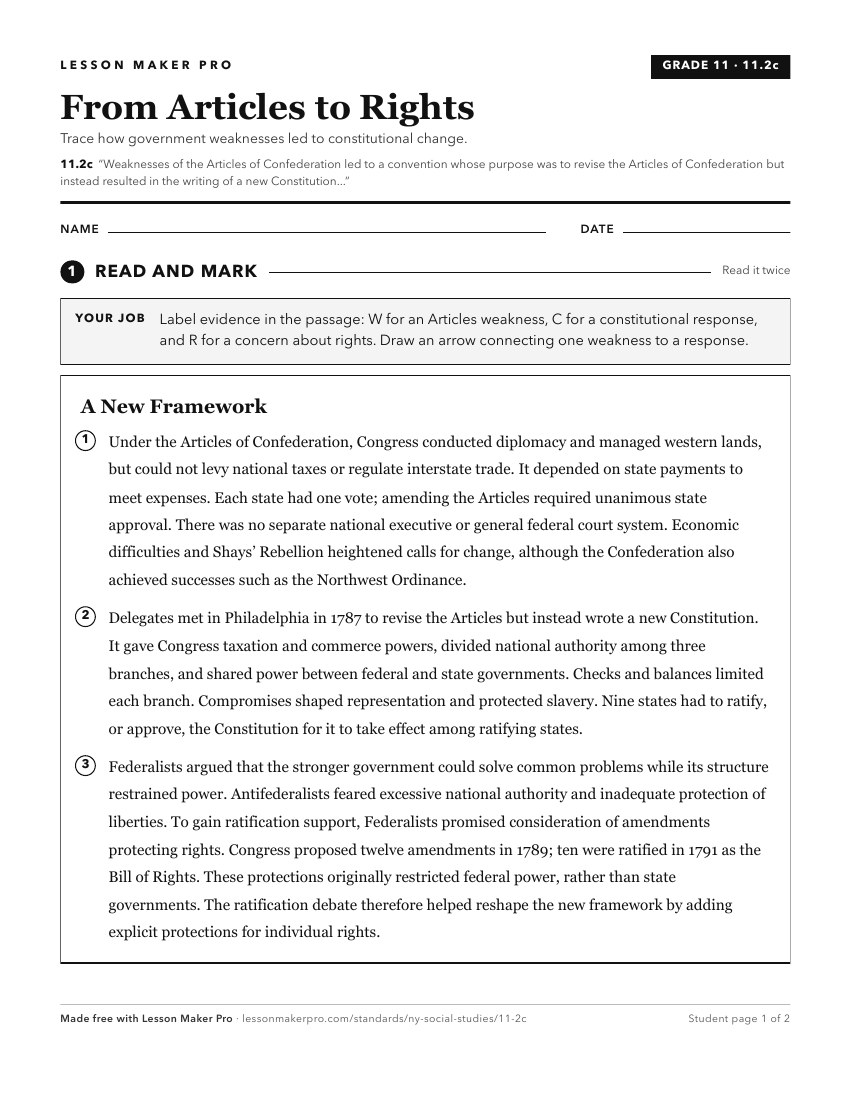
A ready-to-print activity worksheet aligned to 11.2c, with an answer key for the teacher on its own page. No account needed.
PDF, US Letter, prints cleanly in black and white.
Download the worksheetTurn this exact standard into a lesson
Grade, subject, topic, and the complete standard are prefilled. Create one free, no account needed.
Also for this standard:Make a WorksheetMake a QuizMake a Sub Lesson