NY Social Studies 11.1a
The Standard
Contact between Native American∗ groups and Europeans occurred through cultural exchanges, resistance efforts, and conflict.
New York State K–12 Social Studies Framework
Key Idea 11.1
COLONIAL FOUNDATIONS (1607– 1763): European colonization in North America prompted cultural contact and exchange between diverse peoples; cultural differences and misunderstandings at times led to conflict. A variety of factors contributed to the development of regional differences, including social and racial hierarchies, in colonial America.
Teacher's field guide
What This Standard Means
What Students Need to Do
- Students trace interactions among Dutch, English, French, and Spanish colonists and specific Native nations. They explain how trade, cultural exchange, alliances, resistance, disease, warfare, and land seizure shaped those relationships.
What Mastery Looks Like
- Students can compare contact in different colonial regions using maps and sources. They can connect colonization to Native population loss and land loss while distinguishing disease, warfare, and displacement.
Common Misconceptions
- Students may treat Native peoples as one group with a single response to Europeans. They may assume every encounter was immediately violent or equally harmful. They may also overlook disease and focus only on warfare as a cause of population decline.
How to Assess It
- Give students a map showing one colonial region and ask: Identify the European power and one Native nation, then explain two contact outcomes with evidence.
Lesson moves
Ways to Teach It
Give pairs a blank North America map and contact cards to place European powers, Native nations, trade goods, conflicts, and land losses.
Write: Why did one contact relationship shift between exchange and conflict? Support your claim with two details from short primary sources.
Run a timeline relay where teams order disease, trade, alliance, resistance, war, and land-loss cards, then explain two cause-and-effect links.
Compare a current New York map with a historical Native territory map, then research one local place name linked to Indigenous history.
Free download
Printable 11.1a Worksheet
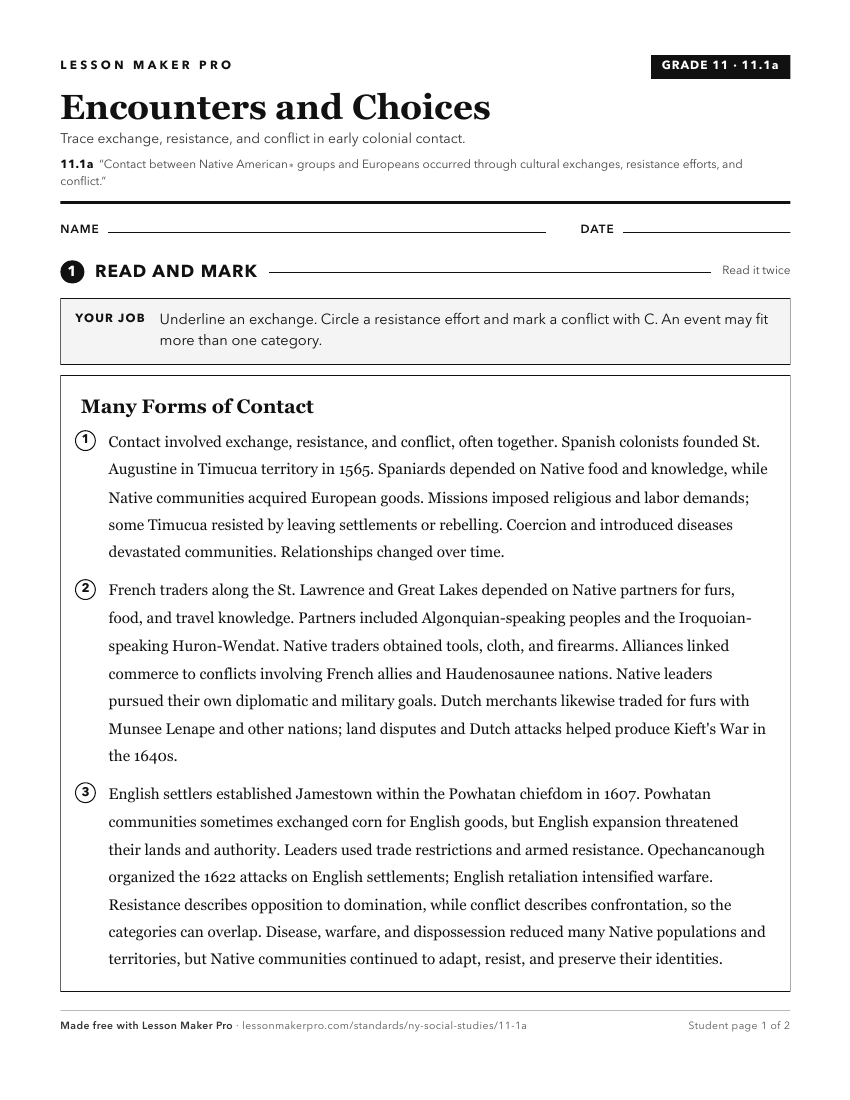
A ready-to-print activity worksheet aligned to 11.1a, with an answer key for the teacher on its own page. No account needed.
PDF, US Letter, prints cleanly in black and white.
Download the worksheetTurn this exact standard into a lesson
Grade, subject, topic, and the complete standard are prefilled. Create one free, no account needed.
Also for this standard:Make a WorksheetMake a QuizMake a Sub Lesson