NY Social Studies 11.10a
The Standard
After World War II, long-term demands for equality by African Americans led to the civil rights movement. The efforts of individuals, groups, and institutions helped to redefine African American civil rights, though numerous issues remain unresolved.
New York State K–12 Social Studies Framework
Key Idea 11.10
SOCIAL AND ECONOMIC CHANGE/DOMESTIC ISSUES (1945 – present): Racial, gender, and socioeconomic inequalities were addressed by individuals, groups, and organizations. Varying political philosophies prompted debates over the role of the federal government in regulating the economy and providing a social safety net.
Teacher's field guide
What This Standard Means
What Students Need to Do
- Students compare how activists and organizations pursued racial equality through court cases, boycotts, mass protests, voter organizing, and federal action. They explain how major events, laws, and rulings changed civil rights and identify limits that remained.
What Mastery Looks Like
- A student can connect a leader or group to a specific goal, strategy, event, and result using evidence. They can explain differences among nonviolence, Black Power, legal challenges, and grassroots organizing without treating the movement as one unified effort.
Common Misconceptions
- Students may reduce the movement to Martin Luther King Jr., assume all activists shared the same methods, or confuse SNCC, SCLC, and the NAACP. They may also assume federal laws and court rulings immediately ended segregation, discrimination, and voter suppression.
How to Assess It
- Exit ticket: Choose one leader or group and one law, court case, or protest. In four sentences, explain the strategy, government response, result, and one unresolved limit.
Lesson moves
Ways to Teach It
Give pairs event, leader, organization, strategy, and outcome cards, then have them build and defend a chronological cause-and-effect chain.
Ask: Which created more lasting change, grassroots protest, court action, or federal law? Require evidence from three named examples.
Run a matching relay with organizations, leaders, events, strategies, and achievements, then have teams explain and correct each mismatch.
Compare a 1965 voter registration map with current turnout or voting access data, then write one continuity and one change.
Free download
Printable 11.10a Worksheet
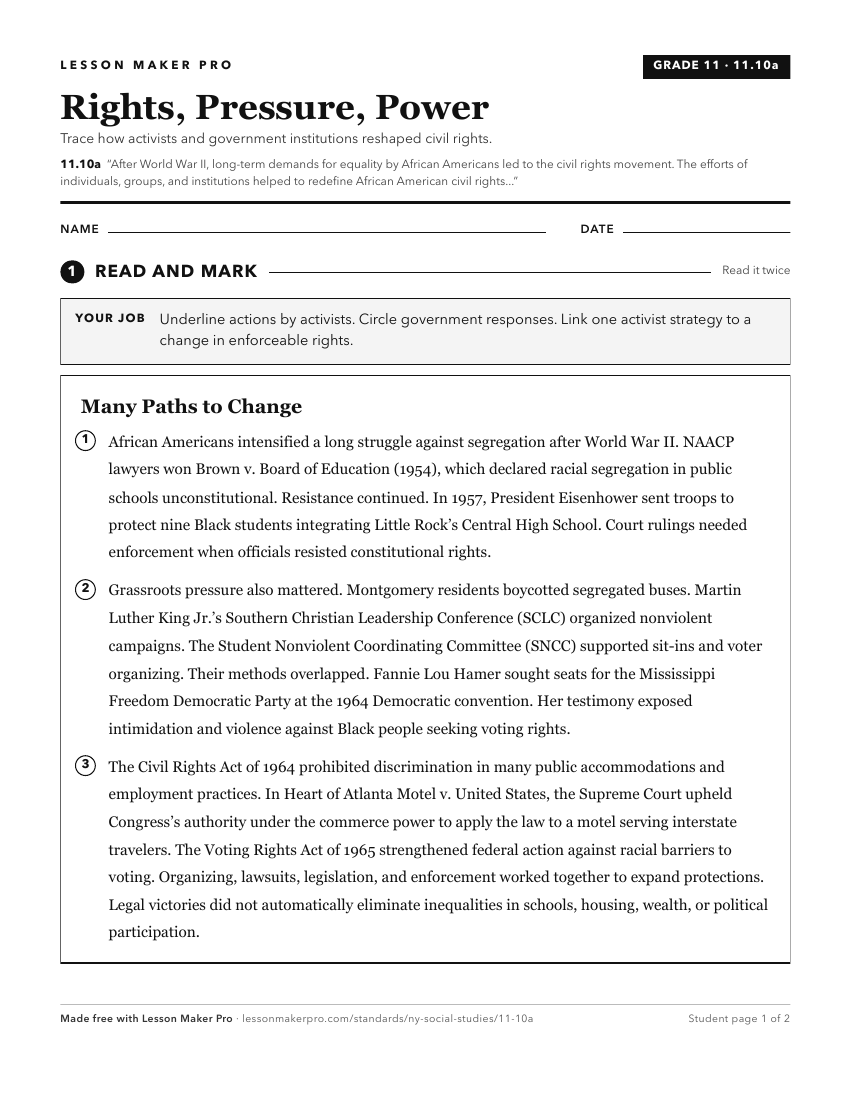
A ready-to-print activity worksheet aligned to 11.10a, with an answer key for the teacher on its own page. No account needed.
PDF, US Letter, prints cleanly in black and white.
Download the worksheetTurn this exact standard into a lesson
Grade, subject, topic, and the complete standard are prefilled. Create one free, no account needed.
Also for this standard:Make a WorksheetMake a QuizMake a Sub Lesson