NY Social Studies 10.9c
The Standard
Population pressures, industrialization, and urbanization have increased demands for limited natural resources and food resources, often straining the environment.
New York State K–12 Social Studies Framework
Key Idea 10.9
GLOBALIZATION AND A CHANGING GLOBAL ENVIRONMENT (1990–PRESENT): Technological changes have resulted in a more interconnected world, affecting economic and political relations and in some cases leading to conflict and in others to efforts to cooperate. Globalization and population pressures have led to strains on the environment.
Teacher's field guide
What This Standard Means
What Students Need to Do
- Students read population maps and graphs to explain why growth and density vary by region. They connect population growth, cities, and industry to rising demand for food, water, land, and energy. They assess how farming methods increase food supplies while also causing environmental damage.
What Mastery Looks Like
- Students can build a clear cause-and-effect chain from population change to resource demand and environmental strain. They use evidence to explain benefits and costs of irrigation, fertilizers, pesticides, and genetic modification.
Common Misconceptions
- Students may confuse population size with density or assume growth is uniform. Exponential growth means a constant proportional rate, not a constant numerical increase; actual population growth rates change. Students may overlook differences in consumption or assume industrial farming has only benefits or only costs.
How to Assess It
- Use this exit ticket: A fast-growing city expands factories and irrigated farms. Name two resources under pressure, predict two environmental effects, and explain one possible response.
Lesson moves
Ways to Teach It
Place 100 counters on a world population density map, then compare crowded regions with their available water and farmland.
Write a claim answering: Does industrial agriculture solve food shortages, or move the environmental costs elsewhere?
Sort scenario cards into desertification, deforestation, water pollution, habitat loss, or air pollution, then identify each cause.
Compare satellite images of a growing city from two different years, then mark lost farmland, forest, and new industrial areas.
Free download
Printable 10.9c Worksheet
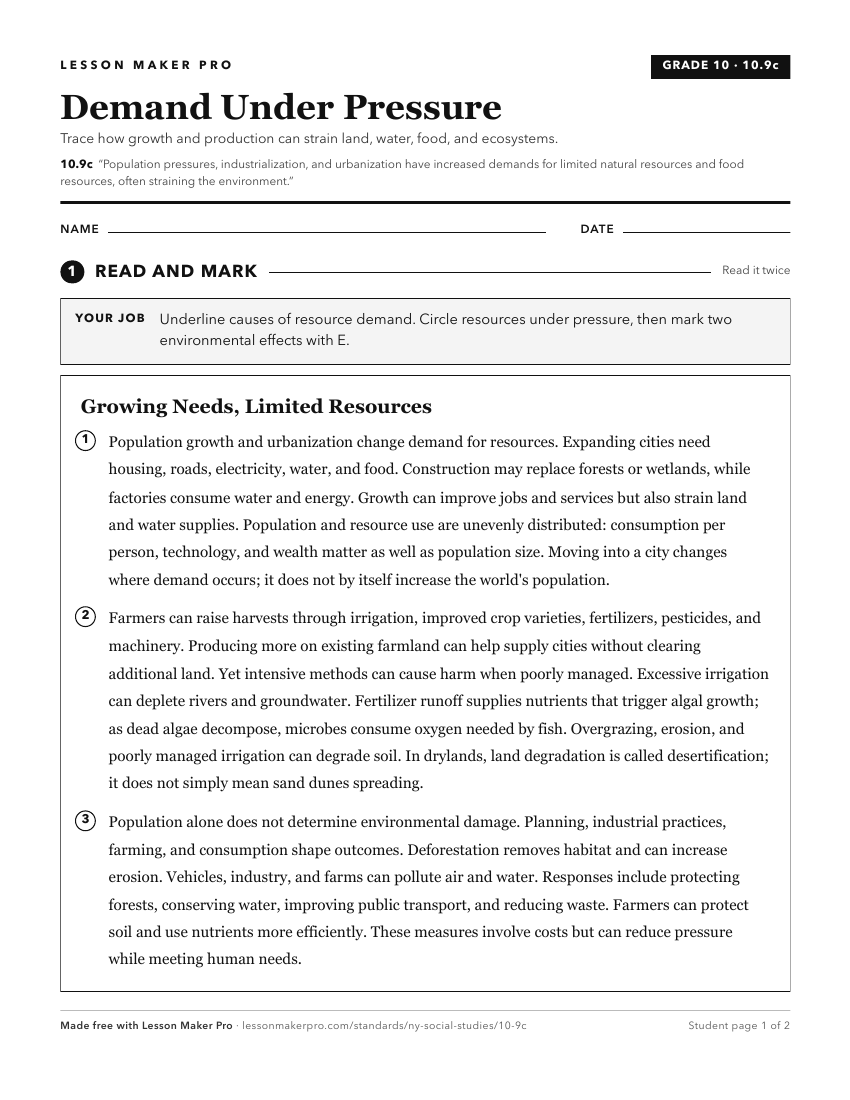
A ready-to-print activity worksheet aligned to 10.9c, with an answer key for the teacher on its own page. No account needed.
PDF, US Letter, prints cleanly in black and white.
Download the worksheetTurn this exact standard into a lesson
Grade, subject, topic, and the complete standard are prefilled. Create one free, no account needed.
Also for this standard:Make a WorksheetMake a QuizMake a Sub Lesson