NY Social Studies 10.5d
The Standard
Nationalism and ideology played a significant role in shaping the period between the world wars.
New York State K–12 Social Studies Framework
Key Idea 10.5
UNRESOLVED GLOBAL CONFLICT (1914–1945): World War I and World War II led to geopolitical changes, human and environmental devastation, and attempts to bring stability and peace.
Teacher's field guide
What This Standard Means
What Students Need to Do
- Students explain how revolution, nationalism, militarism, and economic crisis helped authoritarian leaders gain power between the wars. They compare Lenin, Stalin, Hitler, and Japanese military leaders, including their ideas, goals, and methods of control. They connect the Great Depression to political instability and support for dictators.
What Mastery Looks Like
- Students can use evidence from speeches, laws, posters, and economic data to explain why authoritarian movements gained support. They can identify shared methods such as propaganda, censorship, scapegoating, political violence, and one-party rule while noting differences among countries.
Common Misconceptions
- Students may treat communism, fascism, and militarism as identical because each produced authoritarian rule. They may assume dictators gained power only through force, overlooking elections, popular support, economic fear, and promises of national recovery.
How to Assess It
- Give students an exit ticket with three columns labeled Soviet Union, Germany, and Japan. For each, they name one condition that aided authoritarian rule and one method leaders used to maintain control.
Lesson moves
Ways to Teach It
Give groups source cards with speeches, posters, laws, and photographs, then have them sort each by country, ideology, and method of control.
Ask students to write: How did economic hardship make promises of national strength more appealing in Germany, the Soviet Union, or Japan?
Run a matching game pairing Lenin, Stalin, Hitler, and Japanese military leaders with policies, beliefs, propaganda claims, and methods of control.
Have students compare an interwar propaganda poster with a current political message, identifying emotional appeals, symbols, targeted fears, and missing information.
Free download
Printable 10.5d Worksheet
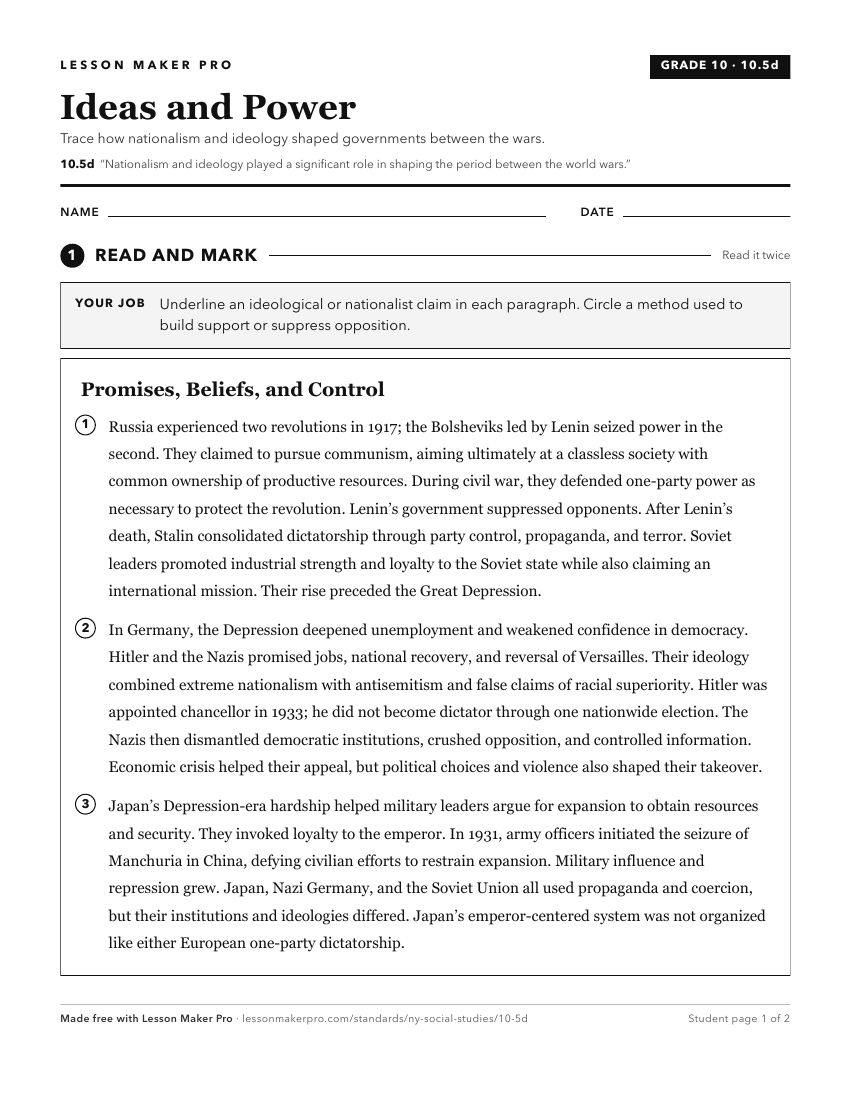
A ready-to-print activity worksheet aligned to 10.5d, with an answer key for the teacher on its own page. No account needed.
PDF, US Letter, prints cleanly in black and white.
Download the worksheetTurn this exact standard into a lesson
Grade, subject, topic, and the complete standard are prefilled. Create one free, no account needed.
Also for this standard:Make a WorksheetMake a QuizMake a Sub Lesson