NY Social Studies 10.4b
The Standard
Those who faced being colonized engagedin varying forms of resistance and adaptation to colonial rule with varying degrees of success.
New York State K–12 Social Studies Framework
Key Idea 10.4
IMPERIALISM: Western European interactions with Africa and Asia shifted from limited regional contacts along the coast to greater influence and connections throughout these regions. Competing industrialized states sought to control and transport raw materials and create new markets across the world.
Teacher's field guide
What This Standard Means
What Students Need to Do
- Students explain how colonized peoples resisted or adjusted to foreign control. They investigate one African case and one Chinese rebellion, then compare why each succeeded or failed. They also explain how Japan used reform and industrialization to avoid colonization.
What Mastery Looks Like
- A student can describe actions taken in Ethiopia, Zululand, or Sudan and during either the Taiping or Boxer Rebellion, using accurate evidence. The student can connect leadership, weapons, alliances, or state reform to outcomes and explain Japan’s different response.
Common Misconceptions
- Students may treat all resistance as armed rebellion or assume every movement sought the same goal. They may say Japan simply rejected the West, overlook its selective adoption of Western systems, or confuse Cixi’s support for the Boxers with direct leadership.
How to Assess It
- Exit ticket: Compare one African resistance movement with the Boxer or Taiping Rebellion, then explain how one factor shaped each outcome. Add one sentence on how Japan adapted to Western pressure.
Lesson moves
Ways to Teach It
Students sort source cards on Ethiopia, the Boxer Rebellion, and Meiji Japan into resistance, adaptation, outcome, and evidence columns.
Ask students why Ethiopia retained independence while the Boxer Rebellion failed, and how leadership, weapons, and alliances shaped each result.
Run a matching game linking leaders, actions, and outcomes, including Menelik II, Empress Dowager Cixi, the Boxers, and Meiji reformers.
Have students compare Meiji military and school reforms with a modern country changing policies in response to outside pressure.
Free download
Printable 10.4b Worksheet
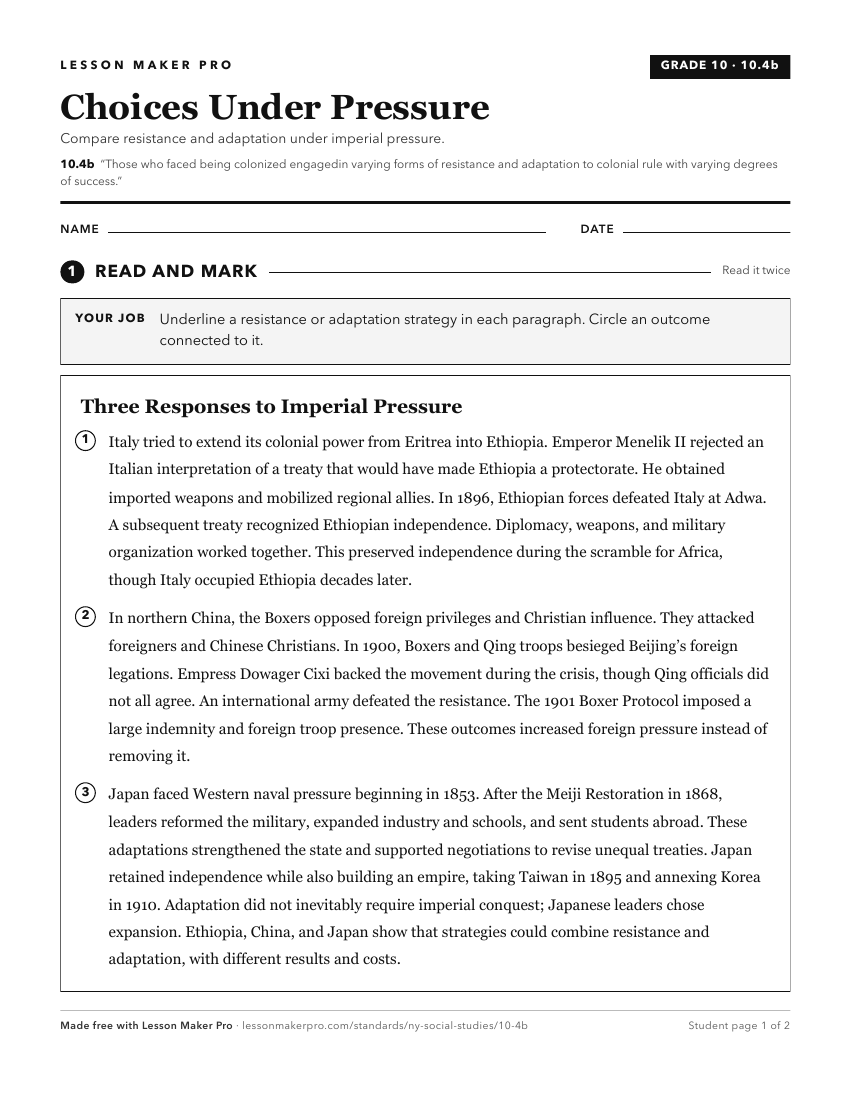
A ready-to-print activity worksheet aligned to 10.4b, with an answer key for the teacher on its own page. No account needed.
PDF, US Letter, prints cleanly in black and white.
Download the worksheetTurn this exact standard into a lesson
Grade, subject, topic, and the complete standard are prefilled. Create one free, no account needed.
Also for this standard:Make a WorksheetMake a QuizMake a Sub Lesson