NY Social Studies 10.3d
The Standard
Social and political reform, as well as new ideologies, developed in response to industrial growth.
New York State K–12 Social Studies Framework
Key Idea 10.3
CAUSES AND EFFECTS OF THE INDUSTRIAL REVOLUTION: Innovations in agriculture, production, and transportation led to the Industrial Revolution, which originated in Western Europe and spread over time to Japan and other regions. This led to major population shifts and transformed economic and social systems.
Teacher's field guide
What This Standard Means
What Students Need to Do
- Students connect factory conditions, political exclusion, and social inequality to campaigns for suffrage, public education, and labor rights. They compare reform movements with Marxism and explain how agricultural and industrial changes shaped the Irish potato famine.
What Mastery Looks Like
- Students use evidence to link a specific industrial problem with a proposed reform or ideology. They distinguish gradual reform from Marxist calls for class-based economic change. They explain how crop failure, landholding, British policy, and potato dependence deepened the Irish crisis.
Common Misconceptions
- Students may assume reforms happened quickly or benefited all groups equally. They may treat Marxism and labor unions as identical. They may explain the Irish famine only as a natural disaster and overlook economic systems and government decisions.
How to Assess It
- Give this exit prompt: Choose one industrial-era problem and explain how one reform or ideology addressed it, using two specific facts. Then name one limit of that response.
Lesson moves
Ways to Teach It
Give groups source cards on factory rules, voting laws, school acts, union demands, Marx, and famine testimony to sort by problem and response.
Ask students to write: Which response most changed industrial society, suffrage, schooling, unions, or Marxism, and what evidence supports your choice?
Run a cause-and-effect relay where teams match industrial conditions to reforms, ideologies, or famine outcomes, then defend one disputed match.
Have students compare a current workplace or voting debate with one nineteenth-century reform, naming one similarity and one limit to the comparison.
Free download
Printable 10.3d Worksheet
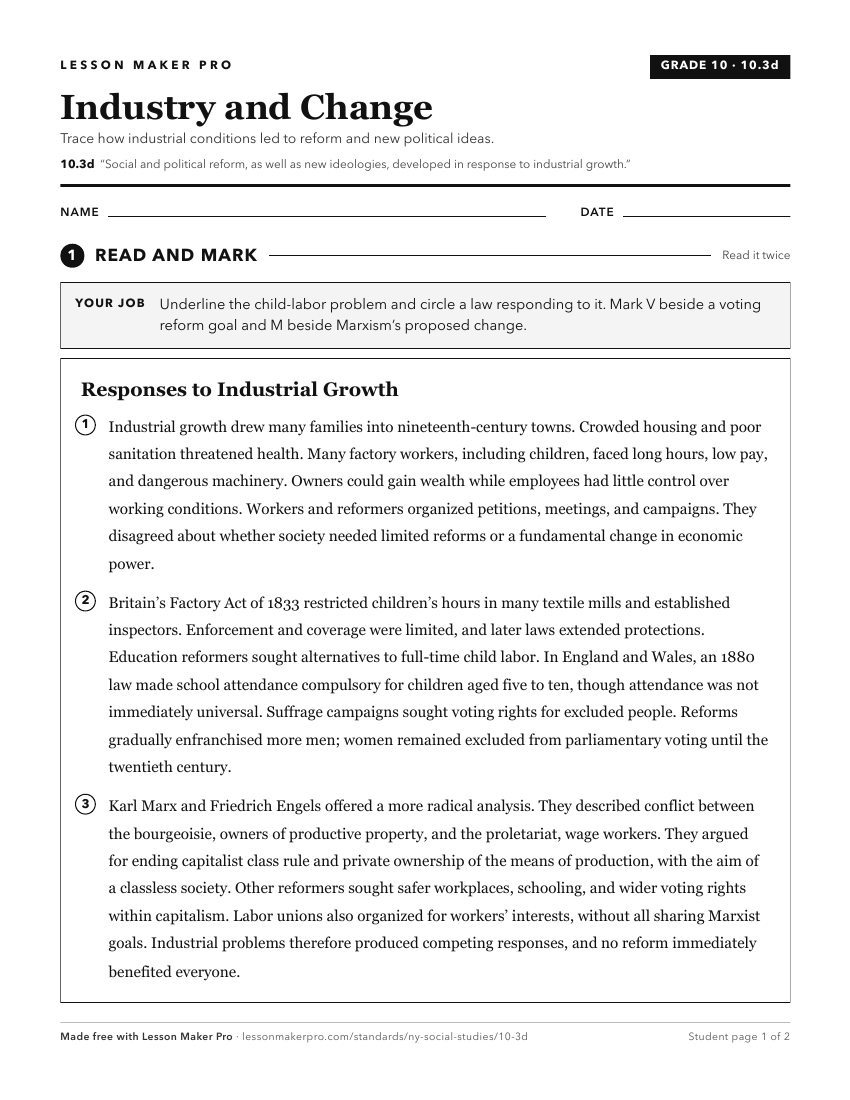
A ready-to-print activity worksheet aligned to 10.3d, with an answer key for the teacher on its own page. No account needed.
PDF, US Letter, prints cleanly in black and white.
Download the worksheetTurn this exact standard into a lesson
Grade, subject, topic, and the complete standard are prefilled. Create one free, no account needed.
Also for this standard:Make a WorksheetMake a QuizMake a Sub Lesson