NY Social Studies 10.3b
The Standard
Factors including new economic theories and practices, new sources of energy, and technological innovations influenced the development of new communication and transportation systems and new methods of production. These developments had numerous effects.
New York State K–12 Social Studies Framework
Key Idea 10.3
CAUSES AND EFFECTS OF THE INDUSTRIAL REVOLUTION: Innovations in agriculture, production, and transportation led to the Industrial Revolution, which originated in Western Europe and spread over time to Japan and other regions. This led to major population shifts and transformed economic and social systems.
Teacher's field guide
What This Standard Means
What Students Need to Do
- Students identify the resources, capital, labor, markets, energy sources, and technologies that allowed industrial production to grow. They explain Adam Smith’s ideas about self-interest, competition, division of labor, and limited government. They connect innovations to changes in production, transportation, communication, and society.
What Mastery Looks Like
- Given a source or diagram, students can trace a clear chain from a condition or innovation to industrial growth and then to an effect. They use evidence to explain how coal, steam power, factories, railroads, telegraphs, or market practices increased production and trade.
Common Misconceptions
- Students may treat one invention as the sole cause of industrialization or assume every country industrialized under the same conditions. They may confuse Smith’s free-market arguments with government ownership or list inventions without explaining their effects.
How to Assess It
- Exit ticket: Choose one industrial innovation or economic practice. In four sentences, name a condition it required, explain how it expanded production or trade, and identify one effect.
Lesson moves
Ways to Teach It
Give groups coal, capital, labor, invention, railroad, and factory cards, then have them build and explain an industrial production chain.
Write a claim explaining whether steam power or free-market ideas did more to expand industrial production, using two pieces of evidence.
Play a cause-and-effect relay where teams match innovation cards to production, transportation, communication, and social effect cards, then defend one disputed match.
Trace a delivered smartphone backward through factories, energy, investment, shipping, and communication, then compare that network with a nineteenth-century textile system.
Free download
Printable 10.3b Worksheet
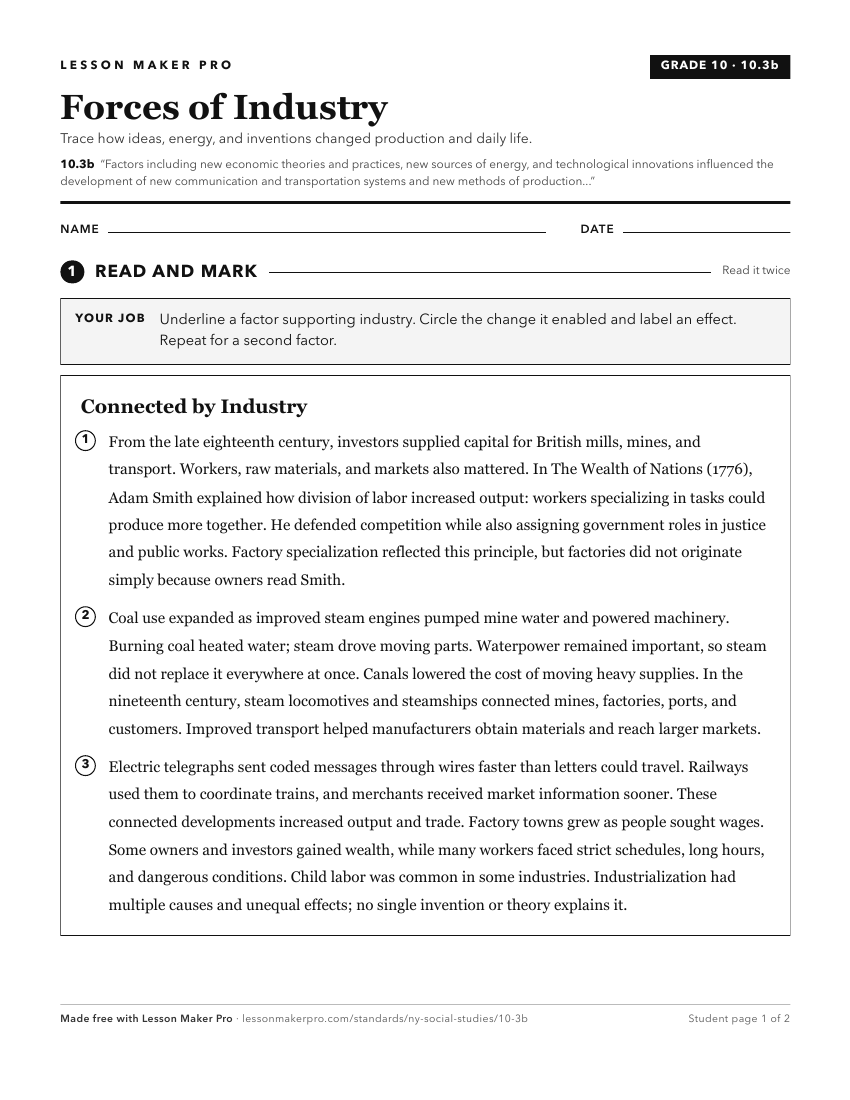
A ready-to-print activity worksheet aligned to 10.3b, with an answer key for the teacher on its own page. No account needed.
PDF, US Letter, prints cleanly in black and white.
Download the worksheetTurn this exact standard into a lesson
Grade, subject, topic, and the complete standard are prefilled. Create one free, no account needed.
Also for this standard:Make a WorksheetMake a QuizMake a Sub Lesson