NY Social Studies 10.2a
The Standard
Enlightenment thinkers developed political philosophies based on natural laws, which included the concepts of social contract, consent of the governed, and the rights of citizens.
New York State K–12 Social Studies Framework
Key Idea 10.2
: ENLIGHTENMENT, REVOLUTION, AND NATIONALISM: The Enlightenment called into question traditional beliefs and inspired widespread political, economic, and social change. This intellectual movement was used to challenge political authorities in Europe and colonial rule in the Americas. These ideals inspired political and social movements.
Teacher's field guide
What This Standard Means
What Students Need to Do
- Students read excerpts from Locke's Two Treatises, Montesquieu's The Spirit of the Laws, and Rousseau's The Social Contract. They explain each writer's ideas about rights, government power, and political authority, then compare their views.
What Mastery Looks Like
- A student can identify the thinker behind an unfamiliar excerpt and support the choice with textual evidence. The student can explain how these ideas challenged absolute monarchy and shaped later governments.
Common Misconceptions
- Students may treat the social contract as a document people physically signed. They may confuse natural law with laws passed by governments. They also may assume Locke, Montesquieu, and Rousseau agreed on every political question.
How to Assess It
- Give students short excerpts from each thinker. Ask them to identify the writer and key idea, explain how it challenges arbitrary rule, and distinguish individual rights, separated powers, or collective sovereignty.
Lesson moves
Ways to Teach It
Give groups thinker, idea, quotation, and book-title cards to sort into three matched sets, then require evidence for each match.
Ask students to write which thinker would most strongly oppose absolute monarchy and support their choice with two specific ideas.
Play a quotation challenge where teams identify Locke, Montesquieu, or Rousseau and earn a second point by explaining the clue.
Have students evaluate a school rule through each thinker's ideas, then propose how authority and student rights should be balanced.
Free download
Printable 10.2a Worksheet
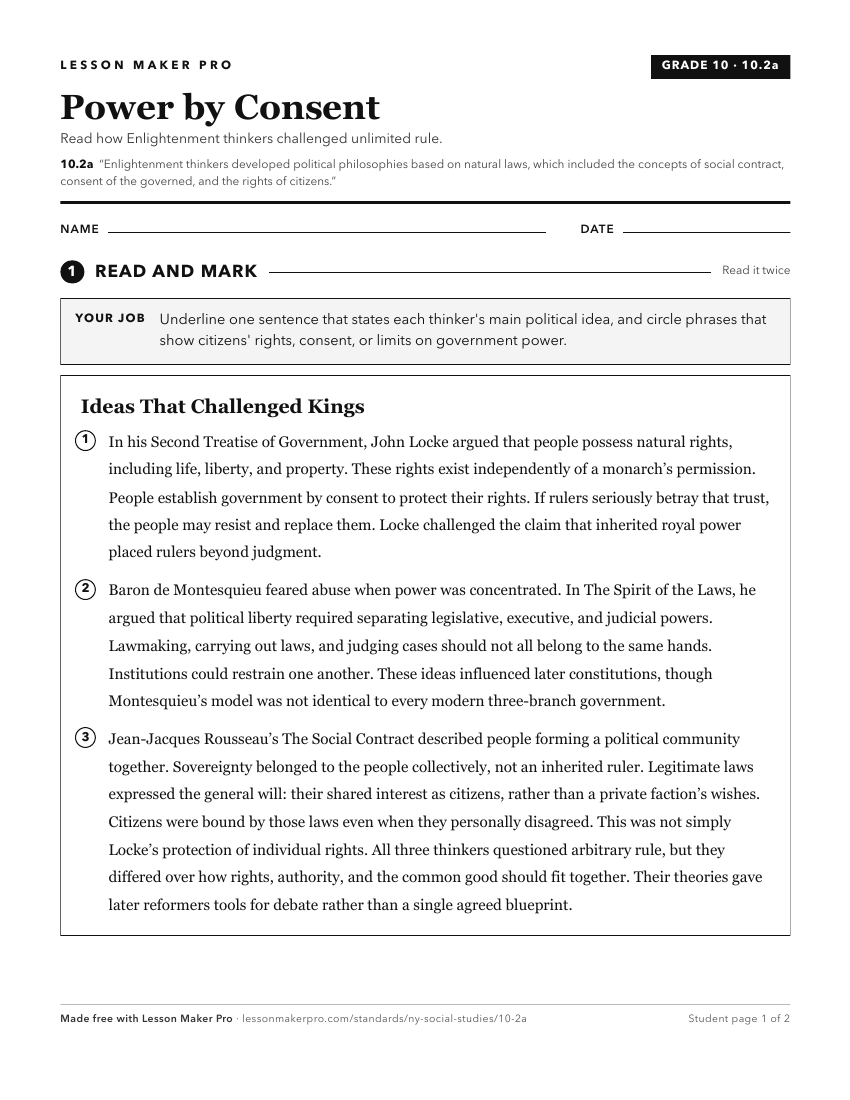
A ready-to-print activity worksheet aligned to 10.2a, with an answer key for the teacher on its own page. No account needed.
PDF, US Letter, prints cleanly in black and white.
Download the worksheetTurn this exact standard into a lesson
Grade, subject, topic, and the complete standard are prefilled. Create one free, no account needed.
Also for this standard:Make a WorksheetMake a QuizMake a Sub Lesson