NY Social Studies 1.6c
The Standard
People interact with their physical environment in ways that may have a positive or a negative effect.
New York State K–12 Social Studies Framework
Key Idea 1.6
People and communities depend on and modify their physical environment in order to meet basic needs.
Teacher's field guide
What This Standard Means
What Students Need to Do
- Students identify ways people change land, water, plants, and animal habitats. They decide whether each change helps or harms the surroundings and explain why.
What Mastery Looks Like
- Students can sort examples such as planting trees, dropping litter, cleaning a stream, and wasting water. They support each choice with a clear cause and effect statement.
Common Misconceptions
- Students may think every human change is harmful or that nature quickly repairs all damage. They may also confuse what helps people with what helps the surroundings.
How to Assess It
- Show pictures of a planted tree and trash beside a pond. Ask students to label each effect positive or negative and explain one choice.
Lesson moves
Ways to Teach It
Have pairs sort picture cards showing planting, littering, recycling, tree cutting, water waste, and stream cleanup into helps or harms groups.
Ask students to draw one way people help the schoolyard and write a sentence explaining the result.
Play Environment Charades, where students act out an action and classmates identify whether it helps or harms the surroundings.
Take a schoolyard walk and tally examples of care or damage, such as recycling bins, healthy plants, litter, or trampled grass.
Free download
Printable 1.6c Worksheet
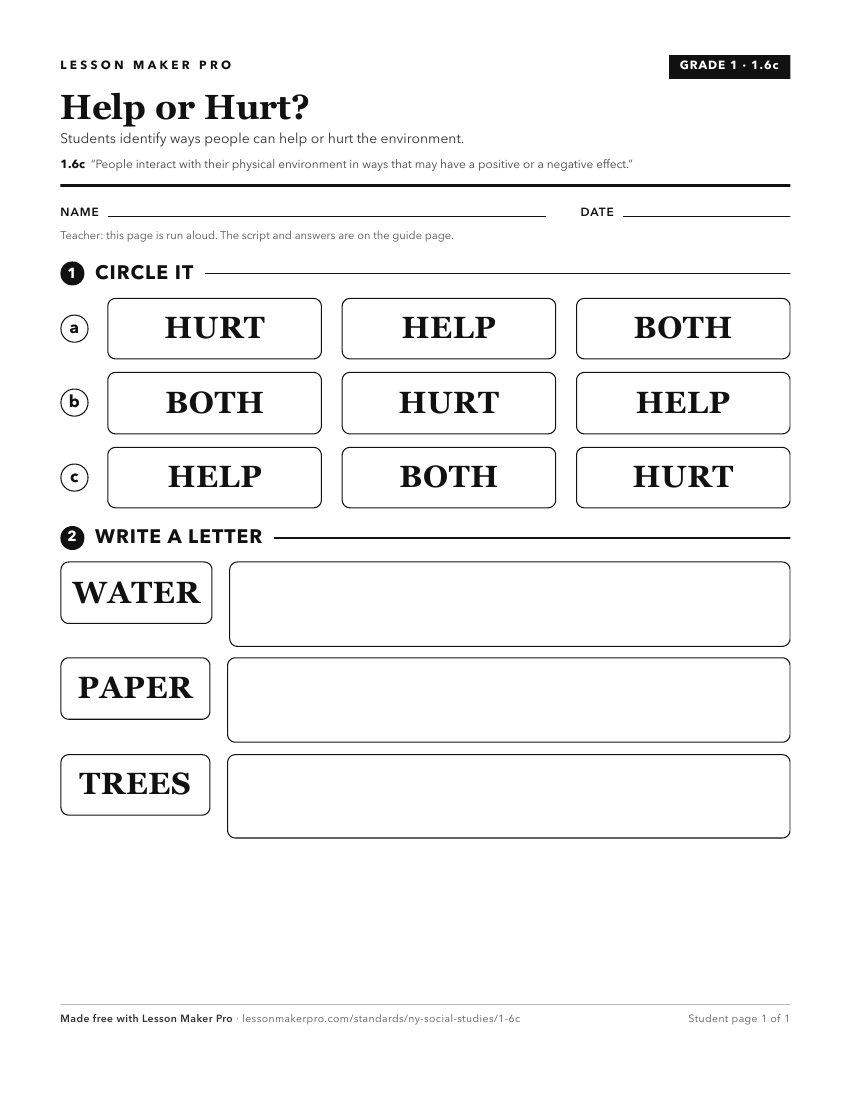
A ready-to-print activity worksheet aligned to 1.6c, with an answer key for the teacher on its own page. No account needed.
PDF, US Letter, prints cleanly in black and white.
Download the worksheetTurn this exact standard into a lesson
Grade, subject, topic, and the complete standard are prefilled. Create one free, no account needed.
Also for this standard:Make a WorksheetMake a QuizMake a Sub Lesson