NY Next Generation Math NY-K.G.2
The Standard
Name shapes regardless of their orientation or overall size.
New York State Next Generation Mathematics Learning Standards
Teacher's field guide
What This Standard Means
What Students Need to Do
- Students name familiar flat and solid shapes even when the shapes are turned, enlarged, or reduced. They recognize that orientation and overall size do not change a shape’s name.
What Mastery Looks Like
- A student names a tilted triangle, a long rectangle, a tiny circle, and a sideways cylinder correctly. The student does not rename a shape merely because it looks different from a familiar classroom example.
Common Misconceptions
- Students may call a tilted square a diamond or reject a narrow triangle because it does not point upward. They may also use size words instead of the shape name.
How to Assess It
- Show several circles, triangles, rectangles, cubes, and cylinders in varied sizes and orientations. Ask the student to name each one and explain why turning it does not change its name.
Lesson moves
Ways to Teach It
Rotate and resize shape cards, asking students to name each shape before and after every change.
Ask, "Is a square still a square when one corner points up, and how do you know?"
Play shape bingo with varied orientations and sizes rather than matching only one familiar example of each shape.
Find turned and differently sized shapes on signs, packages, and playground equipment, then name each one.
Free download
Printable NY-K.G.2 Worksheet
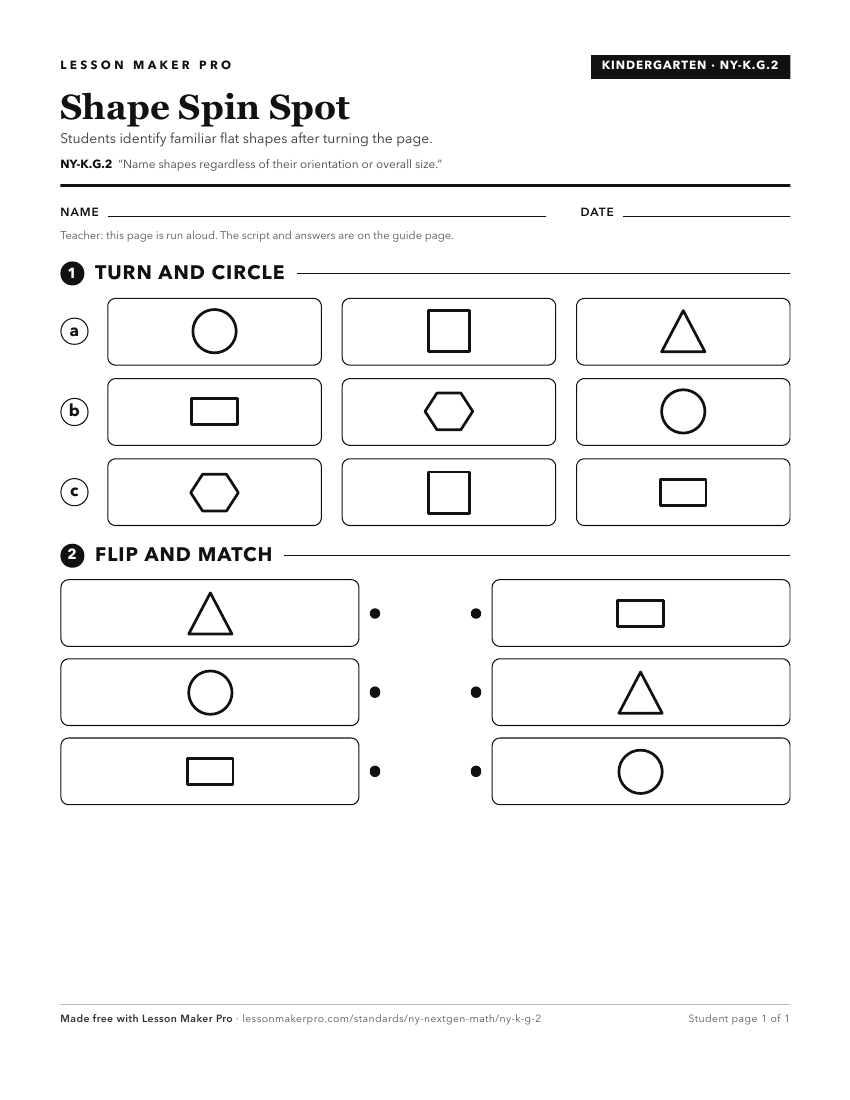
A ready-to-print activity worksheet aligned to NY-K.G.2, with an answer key for the teacher on its own page. No account needed.
PDF, US Letter, prints cleanly in black and white.
Download the worksheetKeep exploring
Related Standards
- NY-1.G.1
Distinguish between defining attributes versus non-defining attributes for a wide variety of shapes. Build and/or draw shapes to possess defining attributes.
- NY-K.G.4
Analyze, compare, and sort two-and three-dimensional shapes, in different sizes and orientations, using informal language to describe their similarities, differ...
Turn this exact standard into a lesson
Grade, subject, topic, and the complete standard are prefilled. Create one free, no account needed.
Also for this standard:Make a WorksheetMake a QuizMake a Sub Lesson