NY Next Generation Math NY-K.CC.2
The Standard
Count to 100 by ones beginning from any given number (instead of beginning at 1).
New York State Next Generation Mathematics Learning Standards
Teacher's field guide
What This Standard Means
What Students Need to Do
- Students begin with any given number below 100 and continue counting by ones to 100. They keep the sequence accurate through each change to a new decade.
What Mastery Looks Like
- Given 47, a student says every next number through 100 without restarting at 1. The student moves correctly from 59 to 60, 69 to 70, and through later decade changes.
Common Misconceptions
- Students may restart at 1, repeat the starting number, or skip a number when the tens digit changes. They may also stop at a familiar benchmark such as 50 or 90.
How to Assess It
- Tell the student to begin at 68 and count by ones to 100. Note any restart, skip, repeat, or incorrect decade change.
Lesson moves
Ways to Teach It
Lay number cards from 40 to 100 with selected cards missing, then start at a chosen card and fill gaps while counting.
Ask, "What number comes after 79, and what changes in the number name when we reach it?"
Play start-and-pass, where one child draws a starting number and classmates continue the sequence around the circle.
Begin an inventory at 63 classroom items, add one item at a time, and continue the running count to 100.
Free download
Printable NY-K.CC.2 Worksheet
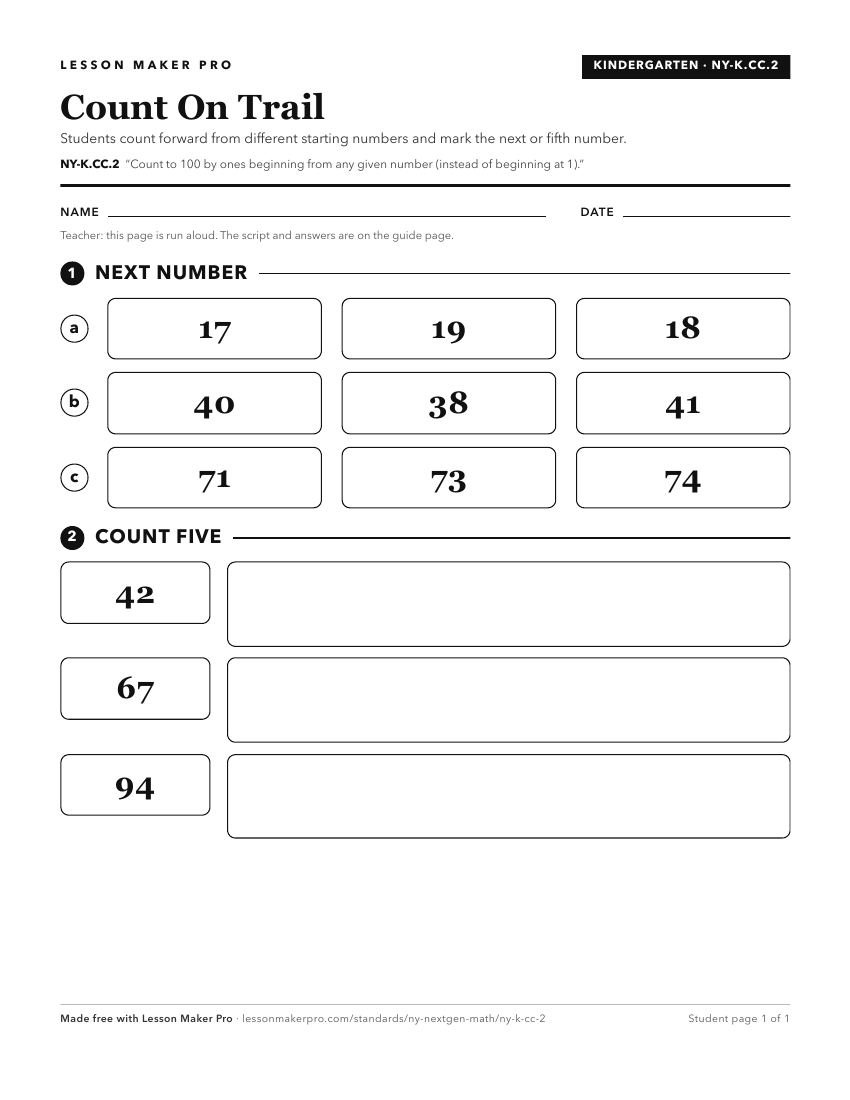
A ready-to-print activity worksheet aligned to NY-K.CC.2, with an answer key for the teacher on its own page. No account needed.
PDF, US Letter, prints cleanly in black and white.
Download the worksheetKeep exploring
Related Standards
- NY-1.NBT.1
Count to 120, starting at any number less than 120. In this range, read and write numerals and represent a number of objects with a written numeral.
- NY-K.CC.1
Count to 100 by ones and by tens.
- NY-2.NBT.2
Count within 1000; skip-count by 5s, 10s, and 100s.
- NY-K.NBT.1
Compose and decompose the numbers from 11 to 19 into ten ones and one, two, three, four, five, six, seven, eight, or nine ones.
Turn this exact standard into a lesson
Grade, subject, topic, and the complete standard are prefilled. Create one free, no account needed.
Also for this standard:Make a WorksheetMake a QuizMake a Sub Lesson