NY Next Generation Math NY-8.EE.6
The Standard
Use similar triangles to explain why the slope m is the same between any two distinct points on a non-vertical line in the coordinate plane; derive the equation y = mx for a line through the origin and the equation y = mx + b for a line intercepting the vertical axis at b.
New York State Next Generation Mathematics Learning Standards
Teacher's field guide
What This Standard Means
What Students Need to Do
- Students use similar right triangles along a nonvertical line to explain why its slope stays constant. They connect constant slope to equations for lines through the origin and lines with a vertical intercept.
What Mastery Looks Like
- The student draws two slope triangles and uses proportional side lengths to show equal rise-to-run ratios. The student derives y = mx or y = mx + b from the graph.
Common Misconceptions
- Students may invert rise and run or include the intercept in the slope calculation. They may assume slope triangles are congruent rather than similar.
How to Assess It
- Give a nonvertical line with points (1, 3), (3, 7), and (5, 11). Ask students to compare two slope triangles and write the equation.
Lesson moves
Ways to Teach It
Draw multiple right triangles on one line using grid transparencies, then compare their rise-to-run ratios.
Ask students to explain how similar triangles guarantee the same slope between any two points on a line.
Play equation match with line graphs, slope triangles, and y = mx + b cards.
Model a constant taxi rate with a starting fee, then connect the rate and fee to m and b.
Free download
Printable NY-8.EE.6 Worksheet
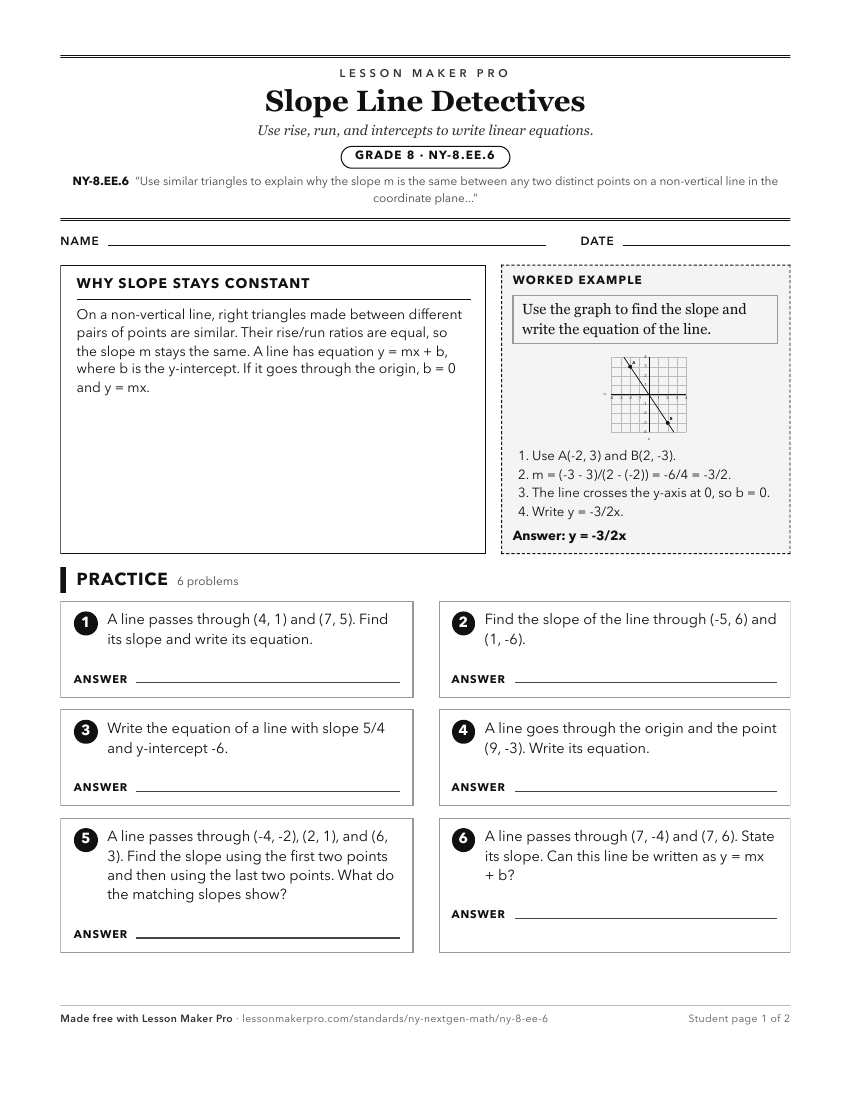
A ready-to-print activity worksheet aligned to NY-8.EE.6, with an answer key for the teacher on its own page. No account needed.
PDF, US Letter, prints cleanly in black and white.
Download the worksheetKeep exploring
Related Standards
- NY-8.F.3
Interpret the equation y = mx + b as defining a linear function, whose graph is a straight line. Recognize examples of functions that are linear and non-linear.
- NY-8.SP.3
Use the equation of a linear model to solve problems in the context of bivariate measurement data, interpreting the slope and intercept.
- NY-5.G.1
Use a pair of perpendicular number lines, called axes, to define a coordinate system, with the intersection of the lines (the origin) arranged to coincide with ...
Turn this exact standard into a lesson
Grade, subject, topic, and the complete standard are prefilled. Create one free, no account needed.
Also for this standard:Make a WorksheetMake a QuizMake a Sub Lesson