NY Next Generation Math NY-6.SP.1.c
The Standard
Understand that the method and sample size used to collect data for a particular question is intended to reduce the difference between a population and a sample taken from the population so valid inferences can be drawn about the population. Generate multiple samples (or simulated samples) of the same size to recognize the variation in estimates or predictions.
New York State Next Generation Mathematics Learning Standards
Teacher's field guide
What This Standard Means
What Students Need to Do
- Students explain how sampling method and sample size affect how well a sample represents a population. They generate multiple equal-sized random or simulated samples and compare the resulting estimates.
What Mastery Looks Like
- The student identifies simple or systematic random sampling as more representative than convenience or online polling. The student recognizes variation across repeated samples without treating one estimate as exact.
Common Misconceptions
- Students may assume a larger biased sample becomes representative automatically. They may expect repeated random samples of the same size to produce identical estimates.
How to Assess It
- Give a school survey using only one lunch table and a simple random sample of 40 students. Ask which is more representative and why.
Lesson moves
Ways to Teach It
Draw several equal-sized random samples of colored cubes from a bag and compare estimated color proportions.
Ask students why an online poll can remain biased even with many responses.
Play Sampling Method Sort with simple random, systematic, convenience, and voluntary-response scenarios.
Design a representative survey sample for estimating how students travel to school.
Free download
Printable NY-6.SP.1.c Worksheet
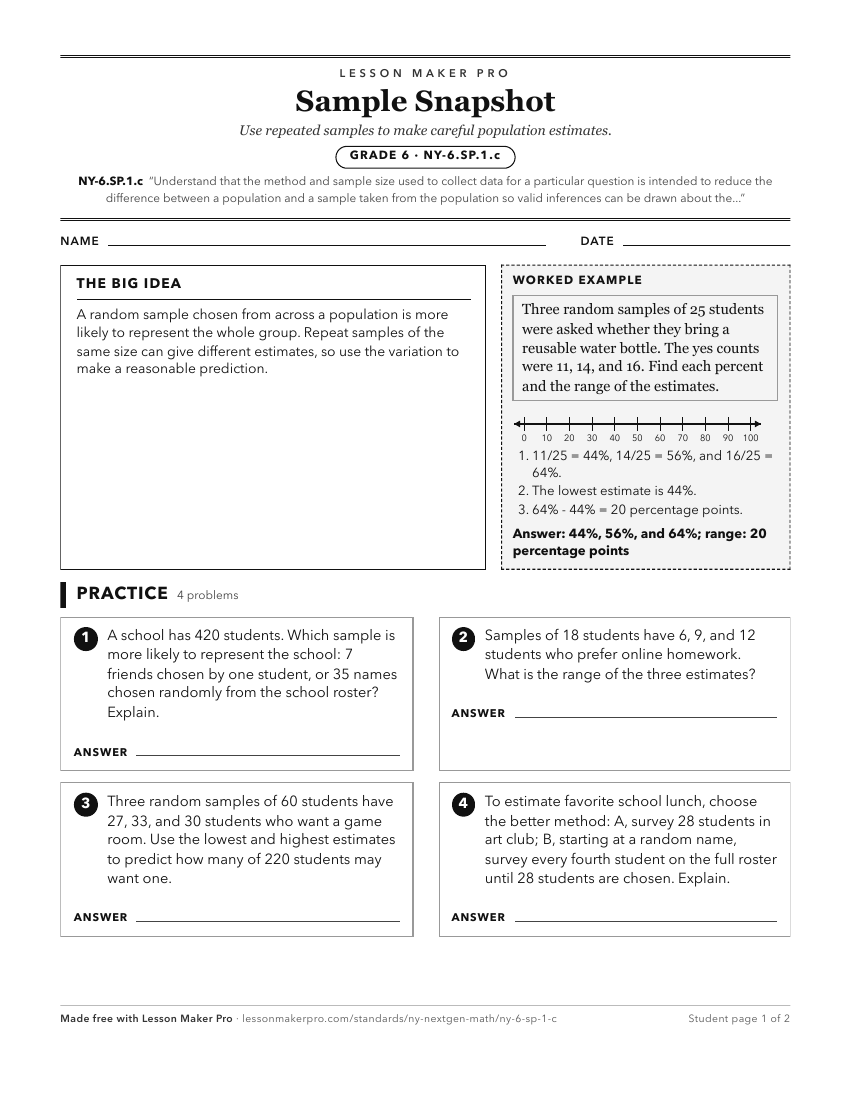
A ready-to-print activity worksheet aligned to NY-6.SP.1.c, with an answer key for the teacher on its own page. No account needed.
PDF, US Letter, prints cleanly in black and white.
Download the worksheetKeep exploring
Related Standards
- NY-6.SP.1.a
Recognize that a statistical question is one that anticipates variability in the data related to the question and accounts for it in the answers.
- NY-7.SP.4
Use measures of center and measures of variability for quantitative data from random samples or populations to draw informal comparative inferences about the po...
- NY-6.SP.1.b
Understand that statistics can be used to gain information about a population by examining a sample of the population; generalizations about a population from a...
Turn this exact standard into a lesson
Grade, subject, topic, and the complete standard are prefilled. Create one free, no account needed.
Also for this standard:Make a WorksheetMake a QuizMake a Sub Lesson