NY Next Generation Math NY-5.MD.3.b
The Standard
Recognize that a solid figure which can be packed without gaps or overlaps using n unit cubes is said to have a volume of n cubic units.
New York State Next Generation Mathematics Learning Standards
Teacher's field guide
What This Standard Means
What Students Need to Do
- Students connect the number of unit cubes filling a solid to its volume in cubic units. They check that the cubes fill the solid without gaps or overlaps.
What Mastery Looks Like
- The student states that a solid packed with 24 unit cubes has a volume of 24 cubic units. The student explains why gaps or overlapping cubes make the count invalid.
Common Misconceptions
- Students may count visible cubes and miss hidden cubes inside a solid. They may accept a packing with gaps or overlaps as a valid volume model.
How to Assess It
- Show a box holding 18 unit cubes with one unit-cube gap. Ask whether 18 cubic units is the box's volume and require an explanation.
Lesson moves
Ways to Teach It
Pack small boxes with linking cubes, checking each layer for gaps before recording the total cubic units.
Ask students to explain why two overlapping cubes cannot count as two cubic units of filled space.
Show layered cube drawings and have partners count the complete packing, including cubes hidden from view.
Estimate and then pack a small container with equal cubes to connect cubic units to storage space.
Free download
Printable NY-5.MD.3.b Worksheet
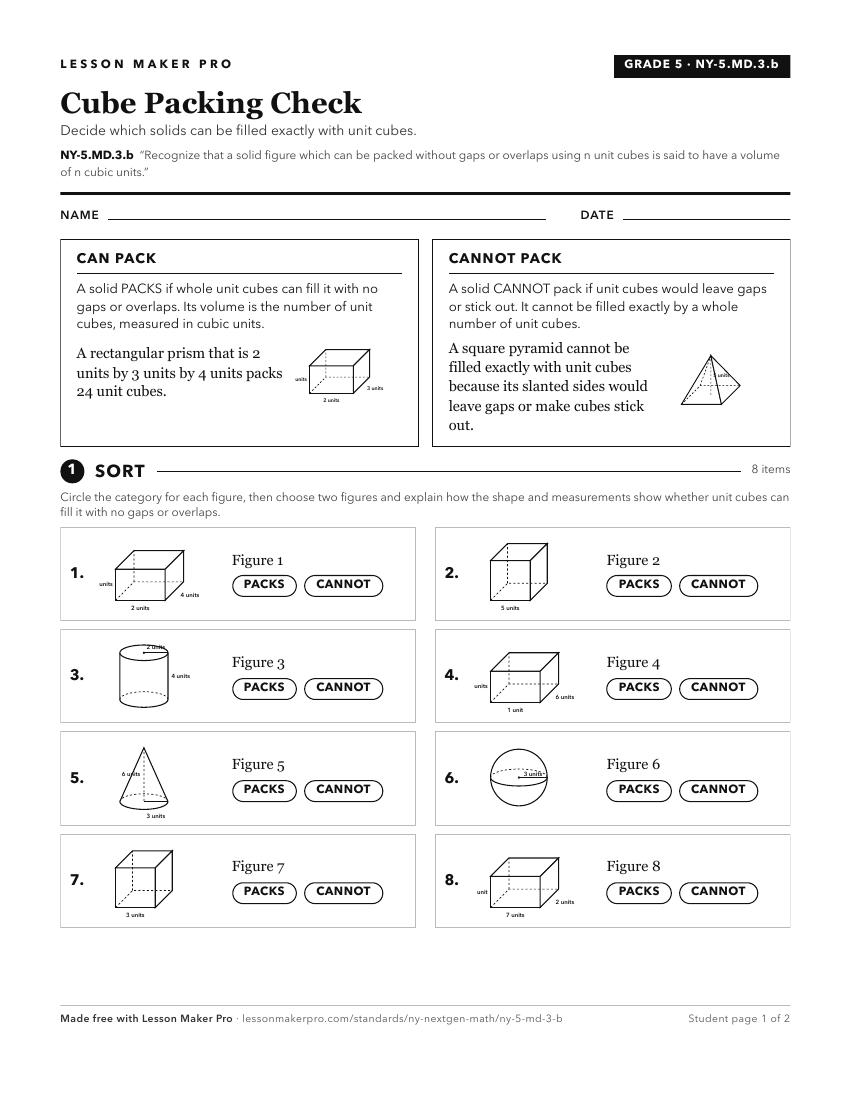
A ready-to-print activity worksheet aligned to NY-5.MD.3.b, with an answer key for the teacher on its own page. No account needed.
PDF, US Letter, prints cleanly in black and white.
Download the worksheetKeep exploring
Related Standards
- NY-5.MD.5.c
Recognize volume as additive. Find volumes of solid figures composed of two non-overlapping right rectangular prisms by adding the volumes of the non-overlappin...
- NY-5.MD.3
Recognize volume as an attribute of solid figures and understand concepts of volume measurement.
- NY-3.MD.5.b
Recognize a plane figure which can be covered without gaps or overlaps by n unit squares is said to have an area of n square units.
- NY-5.MD.3.a
Recognize that a cube with side length 1 unit, called a "unit cube," is said to have "one cubic unit" of volume, and can be used to measure volume.
Turn this exact standard into a lesson
Grade, subject, topic, and the complete standard are prefilled. Create one free, no account needed.
Also for this standard:Make a WorksheetMake a QuizMake a Sub Lesson