NY Next Generation Math NY-4.G.3
The Standard
Recognize a line of symmetry for a two-dimensional figure as a line across the figure such that the figure can be folded along the line into matching parts. Identify line-symmetric figures and draw lines of symmetry.
New York State Next Generation Mathematics Learning Standards
Teacher's field guide
What This Standard Means
What Students Need to Do
- Students recognize a line of symmetry as a line that divides a figure into matching reflected parts. They identify symmetric figures and draw every valid line of symmetry.
What Mastery Looks Like
- A student folds a rectangle along a valid symmetry line and shows that the two parts match. The student identifies figures with no symmetry and figures with more than one symmetry line.
Common Misconceptions
- Students may draw any line through the center or accept parts with equal area but different shapes. They may find one symmetry line and stop when the figure has others.
How to Assess It
- Show a square, a scalene triangle, and a non-square rectangle. Ask students to draw all symmetry lines and explain one figure with none.
Lesson moves
Ways to Teach It
Fold and trace paper figures along proposed lines, checking whether every edge and vertex matches after folding.
Ask students why equal-area halves do not always make a line of symmetry.
Play symmetry-line hunt with shapes that have zero, one, two, or several valid lines.
Examine logos, tiles, and signs and sketch any lines that divide each design into matching parts.
Free download
Printable NY-4.G.3 Worksheet
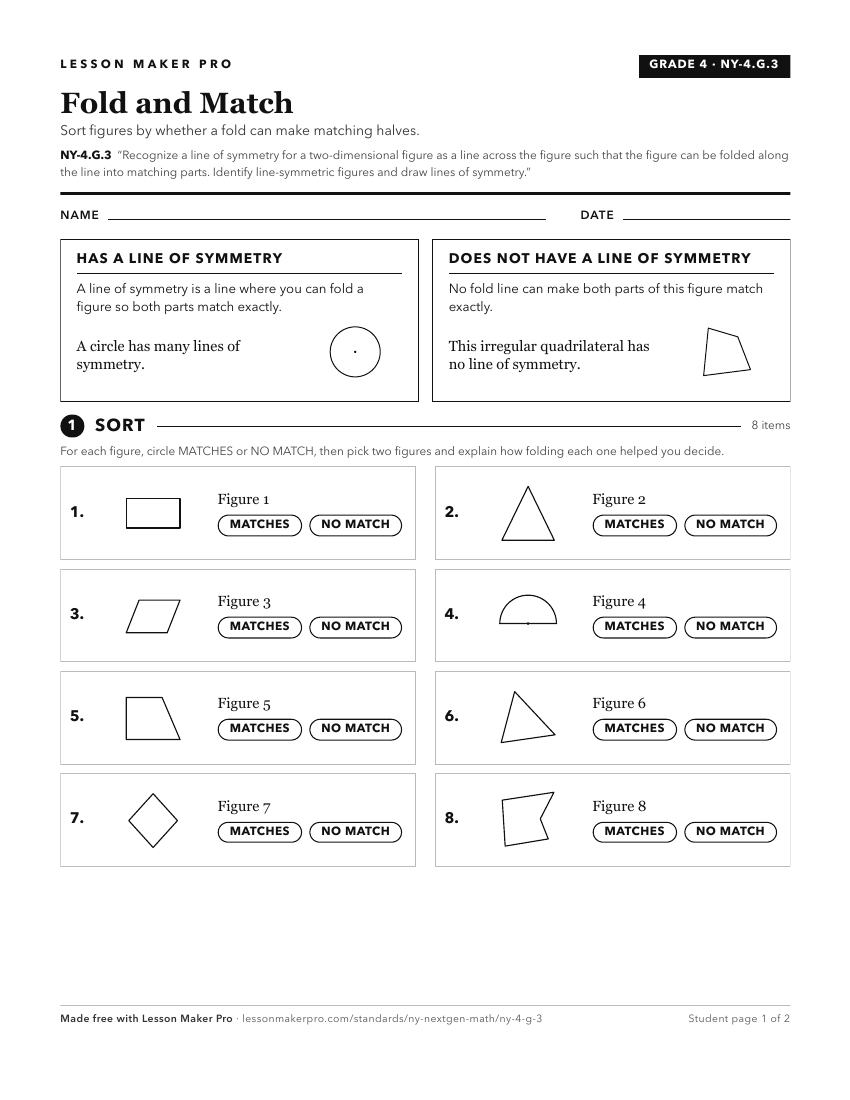
A ready-to-print activity worksheet aligned to NY-4.G.3, with an answer key for the teacher on its own page. No account needed.
PDF, US Letter, prints cleanly in black and white.
Download the worksheetKeep exploring
Related Standards
- NY-4.G.1
Draw points, lines, line segments, rays, angles (right, acute, obtuse), and perpendicular and parallel lines. Identify these in two-dimensional figures.
- NY-8.G.4
Know that a two-dimensional figure is similar to another if the corresponding angles are congruent and the corresponding sides are in proportion. Equivalently, ...
- NY-8.G.2
Know that a two-dimensional figure is congruent to another if the corresponding angles are congruent and the corresponding sides are congruent. Equivalently, tw...
Turn this exact standard into a lesson
Grade, subject, topic, and the complete standard are prefilled. Create one free, no account needed.
Also for this standard:Make a WorksheetMake a QuizMake a Sub Lesson