NY Next Generation Math NY-3.G.1
The Standard
Recognize and classify polygons based on the number of sides and vertices (triangles, quadrilaterals, pentagons, and hexagons). Identify shapes that do not belong to one of the given subcategories.
New York State Next Generation Mathematics Learning Standards
Teacher's field guide
What This Standard Means
What Students Need to Do
- Students classify polygons by counting sides and matching vertices, including triangles, quadrilaterals, pentagons, and hexagons. They also identify polygons and non-polygons outside those named groups.
What Mastery Looks Like
- A student names a five-sided polygon as a pentagon even when its sides are unequal or it is rotated. The student can explain why an eight-sided polygon is not one of the four named subcategories.
Common Misconceptions
- Students may classify by overall appearance instead of counting sides and vertices. They may think every quadrilateral is a square, reject irregular polygons, or miscount a vertex where two sides meet.
How to Assess It
- Give the student a set of varied figures to classify, including one polygon outside the four named groups and one non-polygon. Ask for reasons.
Lesson moves
Ways to Teach It
Build polygons with sticks and clay vertices, then sort them by matching counts of sides and vertices.
Ask students whether every four-sided polygon is a square and have them use examples to support the answer.
Play polygon mystery by revealing clues about side and vertex counts until partners name or draw a matching category.
Survey tile, sign, and package shapes, then record each polygon's side count and category in a class chart.
Free download
Printable NY-3.G.1 Worksheet
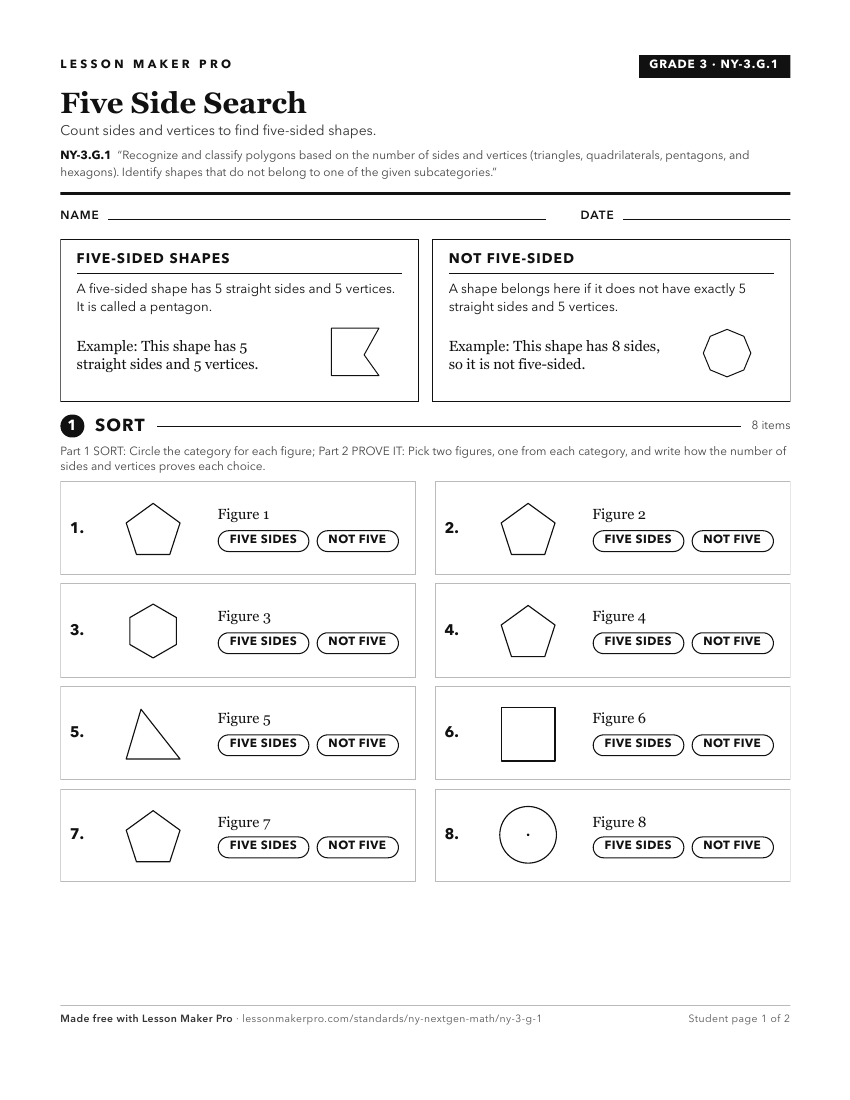
A ready-to-print activity worksheet aligned to NY-3.G.1, with an answer key for the teacher on its own page. No account needed.
PDF, US Letter, prints cleanly in black and white.
Download the worksheetKeep exploring
Related Standards
Turn this exact standard into a lesson
Grade, subject, topic, and the complete standard are prefilled. Create one free, no account needed.
Also for this standard:Make a WorksheetMake a QuizMake a Sub Lesson