NY Next Generation Math NY-2.G.1
The Standard
Classify two-dimensional figures as polygons or non-polygons.
New York State Next Generation Mathematics Learning Standards
Teacher's field guide
What This Standard Means
What Students Need to Do
- Students decide whether a flat figure is a polygon by checking its boundary. They look for a closed figure made only of straight line segments.
What Mastery Looks Like
- A student classifies regular, irregular, and rotated polygons correctly. The student rejects figures with a gap, a curved side, or a boundary that is not made from line segments and explains why.
Common Misconceptions
- Students may call every familiar shape a polygon, including circles, or reject an unfamiliar irregular polygon. They may overlook a small gap or mistake a curved edge for a straight side.
How to Assess It
- Show six figures with varied sizes, orientations, curves, and gaps. Ask the student to sort them and justify each non-polygon with one boundary feature.
Lesson moves
Ways to Teach It
Build closed and open figures with craft sticks and pipe cleaners, then sort them by whether every side is straight.
Ask students whether a shape can be a polygon if one side is curved, and have them defend the answer.
Play polygon detective with cards showing regular figures, irregular figures, circles, open paths, and figures with one curved edge.
Search package labels and road signs for polygons, sketch each outline, and explain why it qualifies.
Free download
Printable NY-2.G.1 Worksheet
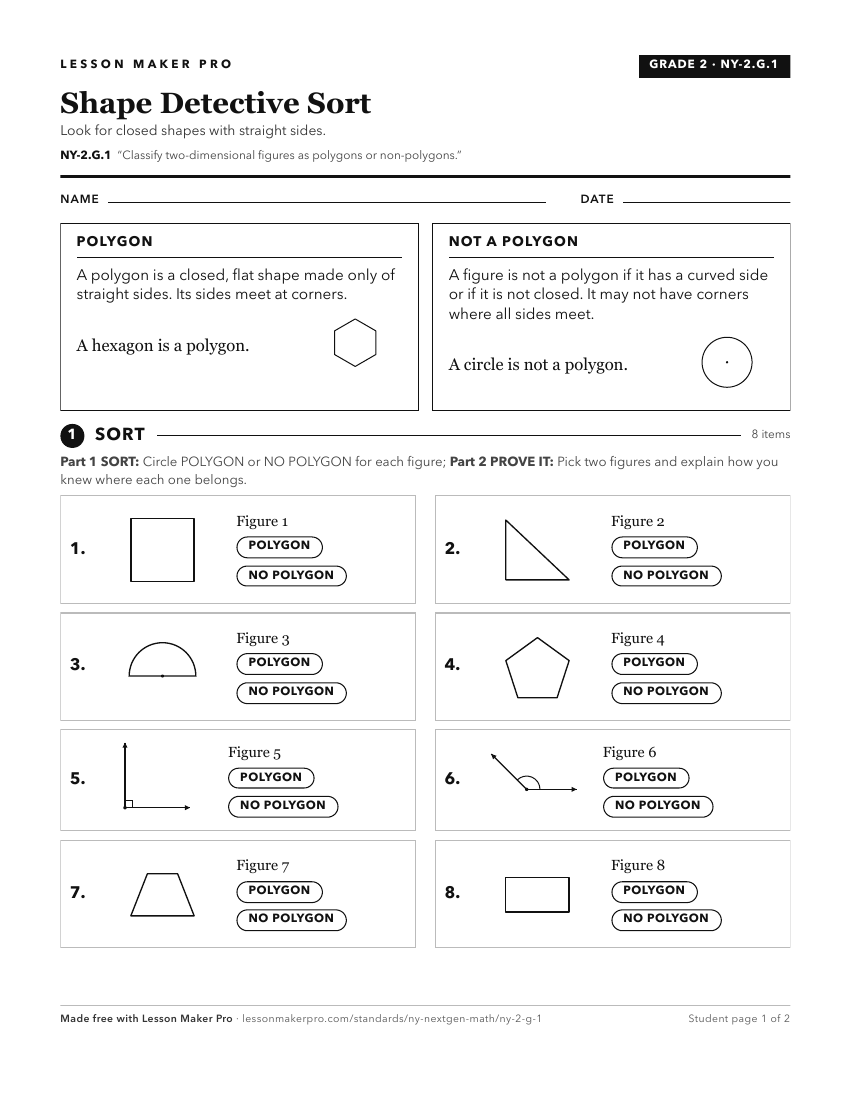
A ready-to-print activity worksheet aligned to NY-2.G.1, with an answer key for the teacher on its own page. No account needed.
PDF, US Letter, prints cleanly in black and white.
Download the worksheetKeep exploring
Related Standards
Turn this exact standard into a lesson
Grade, subject, topic, and the complete standard are prefilled. Create one free, no account needed.
Also for this standard:Make a WorksheetMake a QuizMake a Sub Lesson