NY Next Generation Math NY-2.NBT.1.a
The Standard
Understand 100 can be thought of as a bundle of ten tens, called a "hundred."
New York State Next Generation Mathematics Learning Standards
Teacher's field guide
What This Standard Means
What Students Need to Do
- Students compose ten tens into one larger unit called a hundred. They connect ten ten-sticks, one hundred-flat, and 100 individual ones as equal quantities.
What Mastery Looks Like
- A student counts ten groups of ten and trades them for one hundred-flat. The student explains that one hundred contains ten tens and 100 ones.
Common Misconceptions
- Students may call ten tens “ten” because they count the groups instead of their value. They may think a hundred-flat has a different amount from ten ten-sticks.
How to Assess It
- Give the student ten ten-sticks. Ask the student to name their total, trade them for a hundred-flat, and explain why the trade is equal.
Lesson moves
Ways to Teach It
Bundle ten groups of ten straws, then combine the bundles to build and label one hundred.
Ask students how ten objects can represent 100 when each object is one ten.
Play place-value trading by exchanging ten ones for a ten and ten tens for a hundred.
Package 100 classroom items as ten groups of ten for storage or inventory.
Free download
Printable NY-2.NBT.1.a Worksheet
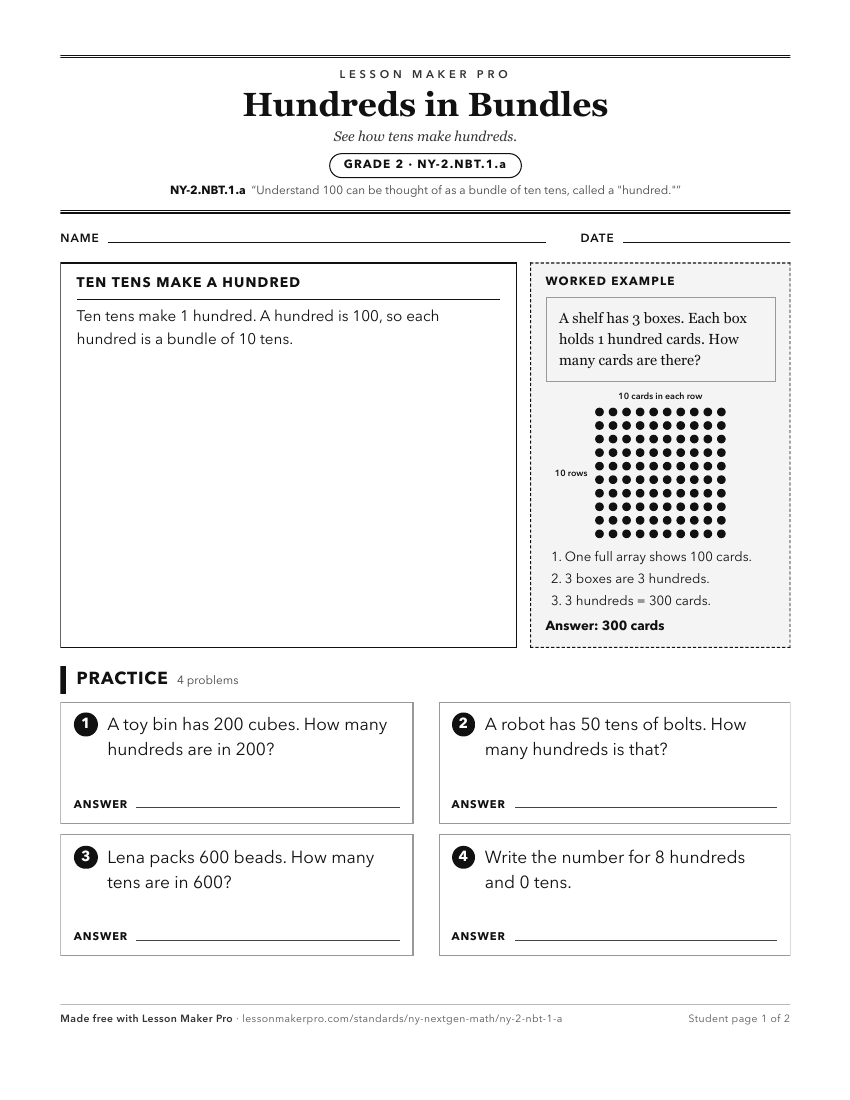
A ready-to-print activity worksheet aligned to NY-2.NBT.1.a, with an answer key for the teacher on its own page. No account needed.
PDF, US Letter, prints cleanly in black and white.
Download the worksheetKeep exploring
Related Standards
- NY-1.NBT.2.c
Understand the numbers 10, 20, 30, 40, 50, 60, 70, 80, 90 refer to one, two, three, four, five, six, seven, eight, or nine tens (and 0 ones).
- NY-2.NBT.1
Understand that the digits of a three-digit number represent amounts of hundreds, tens, and ones.
- NY-1.NBT.2.a
Understand 10 can be thought of as a bundle of ten ones, called a "ten".
- NY-2.NBT.1.b
Understand the numbers 100, 200, 300, 400, 500, 600, 700, 800, 900 refer to one, two, three, four, five, six, seven, eight, or nine hundreds (and 0 tens and 0 o...
Turn this exact standard into a lesson
Grade, subject, topic, and the complete standard are prefilled. Create one free, no account needed.
Also for this standard:Make a WorksheetMake a QuizMake a Sub Lesson