NY Next Generation Math GEO-G.SRT.5.b
The Standard
Prove relationships in geometric figures.
New York State Next Generation Mathematics Learning Standards
Teacher's field guide
What This Standard Means
What Students Need to Do
- Students prove relationships in geometric figures using triangle congruence and similarity. They build a logical chain from given information through justified corresponding-part results.
What Mastery Looks Like
- The student identifies useful triangles, proves them congruent or similar, and applies the result to the target relationship. Each statement has a valid geometric reason.
Common Misconceptions
- Students may assume the relationship they need to prove or cite corresponding parts before establishing congruence or similarity. They may overlook shared sides or vertical angles.
How to Assess It
- Give a diagram with two triangles and a target segment or angle relationship. Ask students to write a short proof with every reason named.
Lesson moves
Ways to Teach It
Cut and annotate a complex figure to reveal triangle pairs, shared parts, and possible proof paths.
Ask which fact establishes the triangle relationship before corresponding parts can be used.
Play proof-order scramble with givens, triangle criteria, corresponding parts, and conclusion cards.
Prove a structural brace or repeated design feature has equal or proportional parts.
Free download
Printable GEO-G.SRT.5.b Worksheet
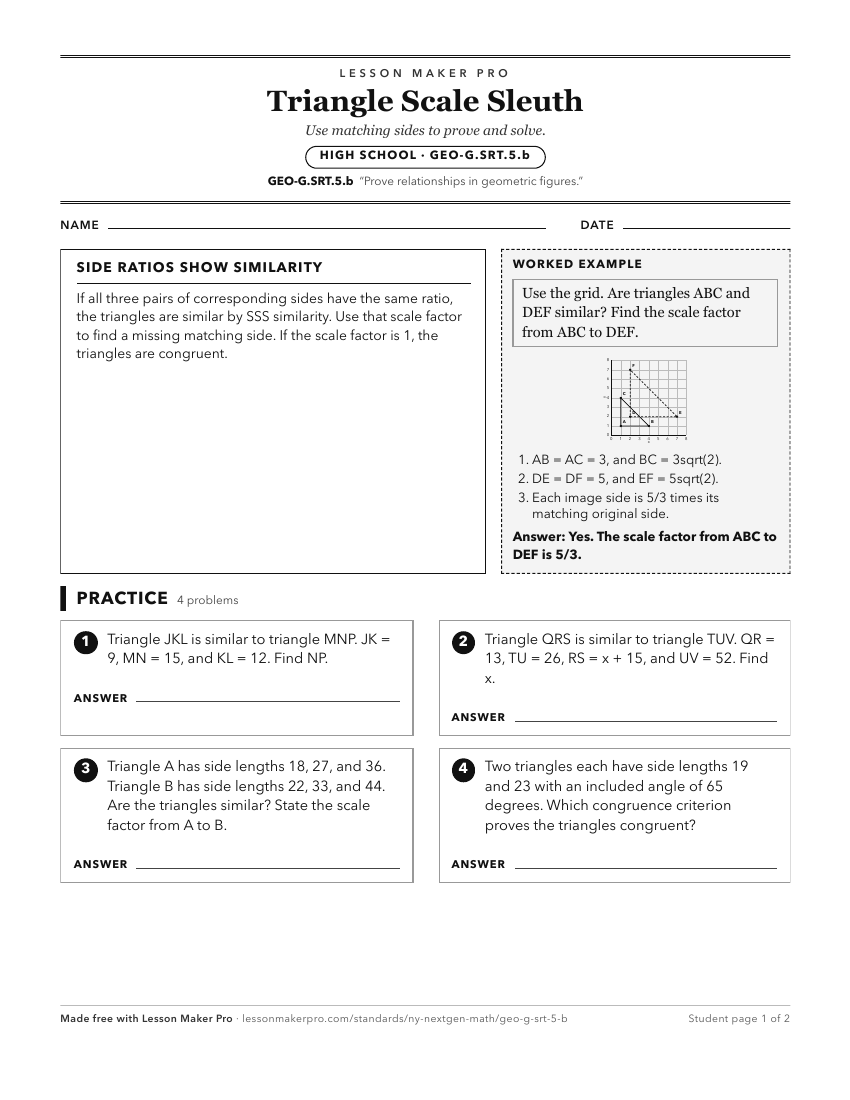
A ready-to-print activity worksheet aligned to GEO-G.SRT.5.b, with an answer key for the teacher on its own page. No account needed.
PDF, US Letter, prints cleanly in black and white.
Download the worksheetKeep exploring
Related Standards
Turn this exact standard into a lesson
Grade, subject, topic, and the complete standard are prefilled. Create one free, no account needed.
Also for this standard:Make a WorksheetMake a QuizMake a Sub Lesson