NY Next Generation Math AII-S.ID.4.b
The Standard
If appropriate, determine population percentages using a graphing calculator for an appropriate normal curve.
New York State Next Generation Mathematics Learning Standards
Teacher's field guide
What This Standard Means
What Students Need to Do
- Students use a graphing calculator to find population percentages under an appropriate normal curve. They translate contextual cutoffs into lower, upper, or between-area calculations.
What Mastery Looks Like
- The student enters the correct mean, standard deviation, and bounds and reports a percentage in context. A sketch confirms the requested shaded region.
Common Misconceptions
- Students may use a normal model without first checking appropriateness or reverse the requested tail. They may report a decimal as a percent incorrectly.
How to Assess It
- Give a suitable normal model and two contextual cutoffs. Ask students to sketch the region and calculate the percentage between them.
Lesson moves
Ways to Teach It
Shade paper normal curves for lower, upper, and between questions before entering calculator bounds.
Ask how a sketch can reveal a reversed tail or unreasonable calculator answer.
Play bound-entry match with context prompts, shaded curves, and calculator input cards.
Calculate the percentage of manufactured parts falling within a stated tolerance range.
Free download
Printable AII-S.ID.4.b Worksheet
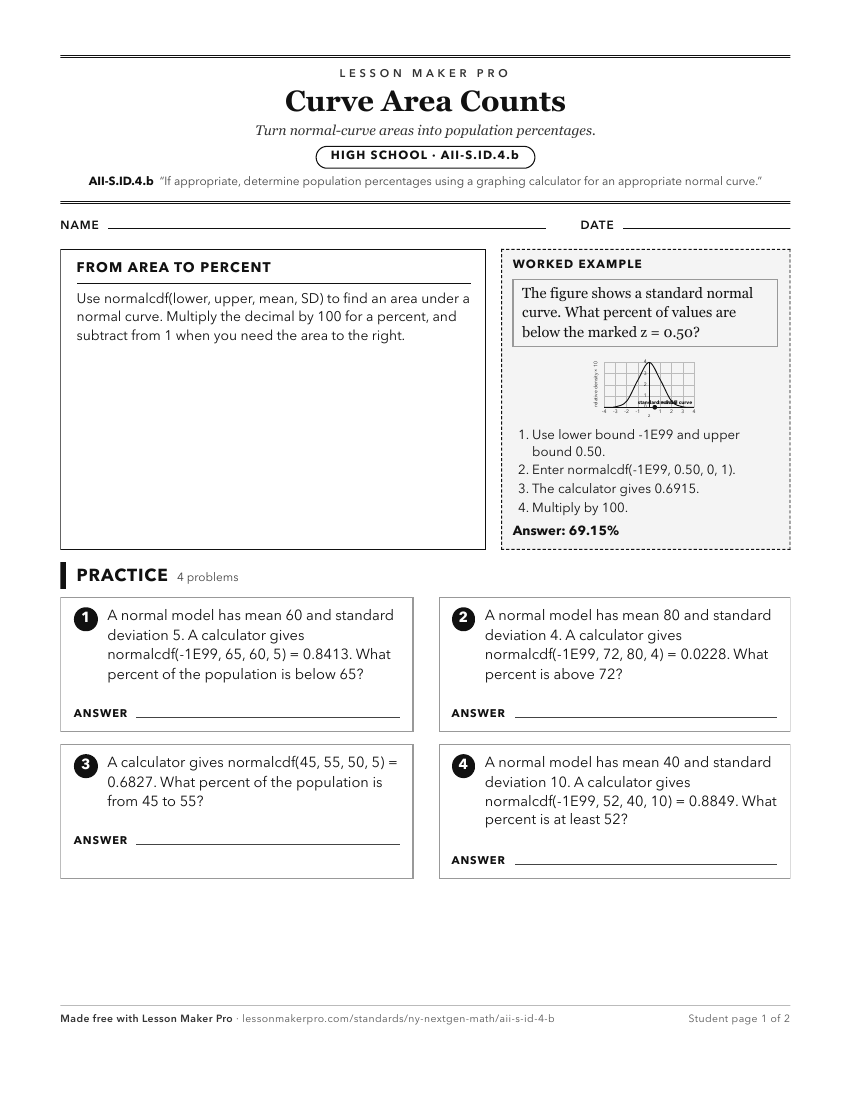
A ready-to-print activity worksheet aligned to AII-S.ID.4.b, with an answer key for the teacher on its own page. No account needed.
PDF, US Letter, prints cleanly in black and white.
Download the worksheetKeep exploring
Related Standards
- AII-F.IF.7
Graph functions and show key features of the graph by hand and using technology when appropriate.
- AII-S.ID.4.a
Recognize whether or not a normal curve is appropriate for a given data set.
- AI-F.IF.7
Graph functions and show key features of the graph by hand and by using technology where appropriate.
- NY-7.RP.3
Use proportional relationships to solve multistep ratio and percent problems.
Turn this exact standard into a lesson
Grade, subject, topic, and the complete standard are prefilled. Create one free, no account needed.
Also for this standard:Make a WorksheetMake a QuizMake a Sub Lesson