NY Next Generation Math AI-S.ID.7
The Standard
Interpret the slope (rate of change) and the intercept (constant term) of a linear model in the context of the data.
New York State Next Generation Mathematics Learning Standards
Teacher's field guide
What This Standard Means
What Students Need to Do
- Students interpret slope and intercept of an Algebra I linear model using the data context. They name the rate, starting value, quantities, and units.
What Mastery Looks Like
- The student explains slope as output change per input unit and the intercept as the predicted output at input zero. Interpretations address whether zero is meaningful in the observed context.
Common Misconceptions
- Students may swap slope and intercept, omit units, or describe slope as a value rather than a rate. They may interpret an intercept even when input zero lies far outside relevant data.
How to Assess It
- A model predicts plant height h equals 1.8w plus 7, with w in weeks and h in centimeters. Ask students to interpret both parameters and their limits.
Lesson moves
Ways to Teach It
Attach quantity and unit cards to a model's slope and intercept, then trace them on its graph.
Ask students when an intercept is mathematically valid but contextually unhelpful.
Play parameter match with linear equations, scatter plots, slopes, intercepts, and contextual interpretations.
Interpret rate and starting value in a cost, growth, distance, or temperature model.
Free download
Printable AI-S.ID.7 Worksheet
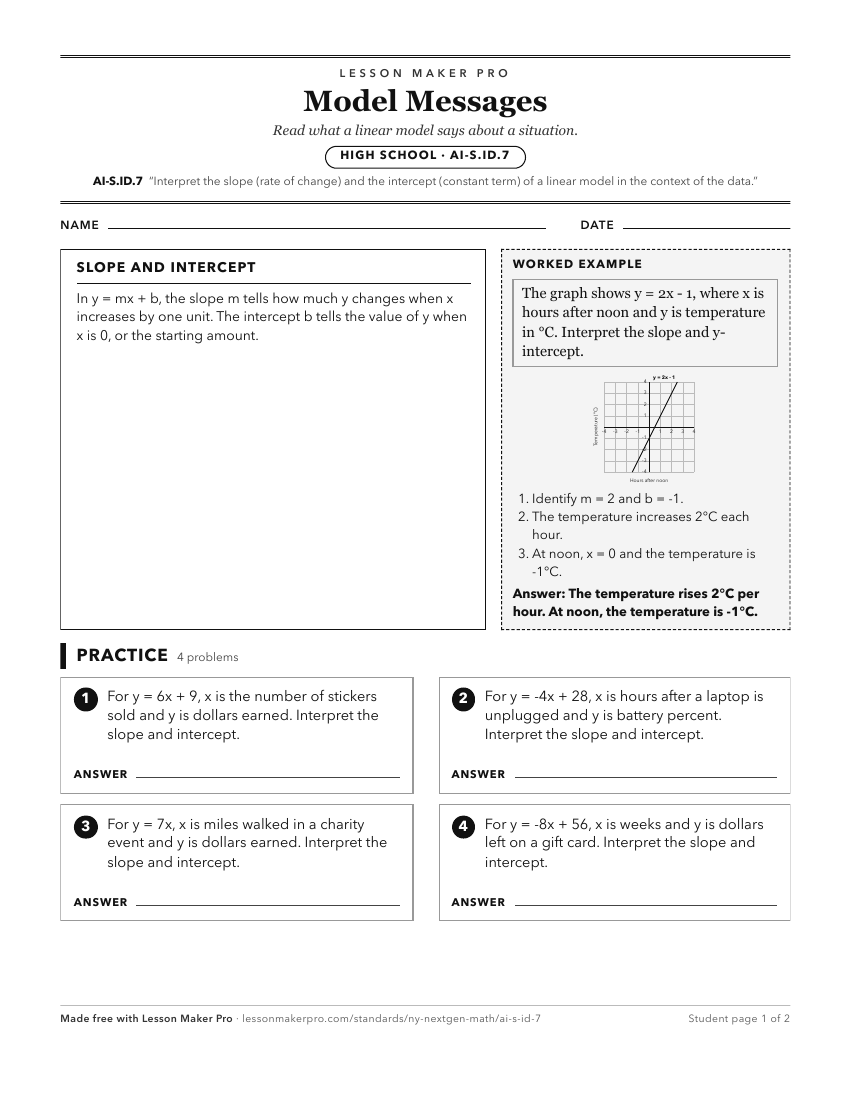
A ready-to-print activity worksheet aligned to AI-S.ID.7, with an answer key for the teacher on its own page. No account needed.
PDF, US Letter, prints cleanly in black and white.
Download the worksheetKeep exploring
Related Standards
- AII-F.LE.5
Interpret the parameters in a linear or exponential function in terms of a context.
- NY-8.F.4
Construct a function to model a linear relationship between two quantities. Determine the rate of change and initial value of the function from a description of...
- AI-F.LE.1.b
Recognize situations in which one quantity changes at a constant rate per unit interval relative to another, and therefore can be modeled linearly.
- NY-8.SP.3
Use the equation of a linear model to solve problems in the context of bivariate measurement data, interpreting the slope and intercept.
Turn this exact standard into a lesson
Grade, subject, topic, and the complete standard are prefilled. Create one free, no account needed.
Also for this standard:Make a WorksheetMake a QuizMake a Sub Lesson