Montana Math MT.K.CC.4
The Standard
Understand the relationship between numbers and quantities and connect counting to cardinality by recognizing that each successive number name refers to a quantity that is one larger within a normal counting sequence.
2026 Montana Mathematics Content Standards
Teacher's field guide
What This Standard Means
What Students Need to Do
- Students count objects and connect each number they say to the amount in the group. When one object is added, they say the next counting number and know the amount is one more.
What Mastery Looks Like
- A student counts five counters, adds one, and says there are six without starting over. They can show that six is one more than five.
Common Misconceptions
- Some students can say the counting numbers in order but do not connect them to the objects. Others skip a number or count the same object twice, so their spoken number does not match the amount.
How to Assess It
- Give a student four counters and ask them to add one. Ask, 'How many now, and how do you know?'
Lesson moves
Ways to Teach It
Give pairs five linking cubes to build a tower, then have them add one cube and say how the count changes.
Ask partners, 'Why does six come after five when we add one counter?' Have each explain using counters.
Show a number card from 1 to 9 and have students find the card for one more.
Set four cups for lunch, seat one more child, and have students add a cup and say how many are needed.
Free download
Printable MT.K.CC.4 Worksheet
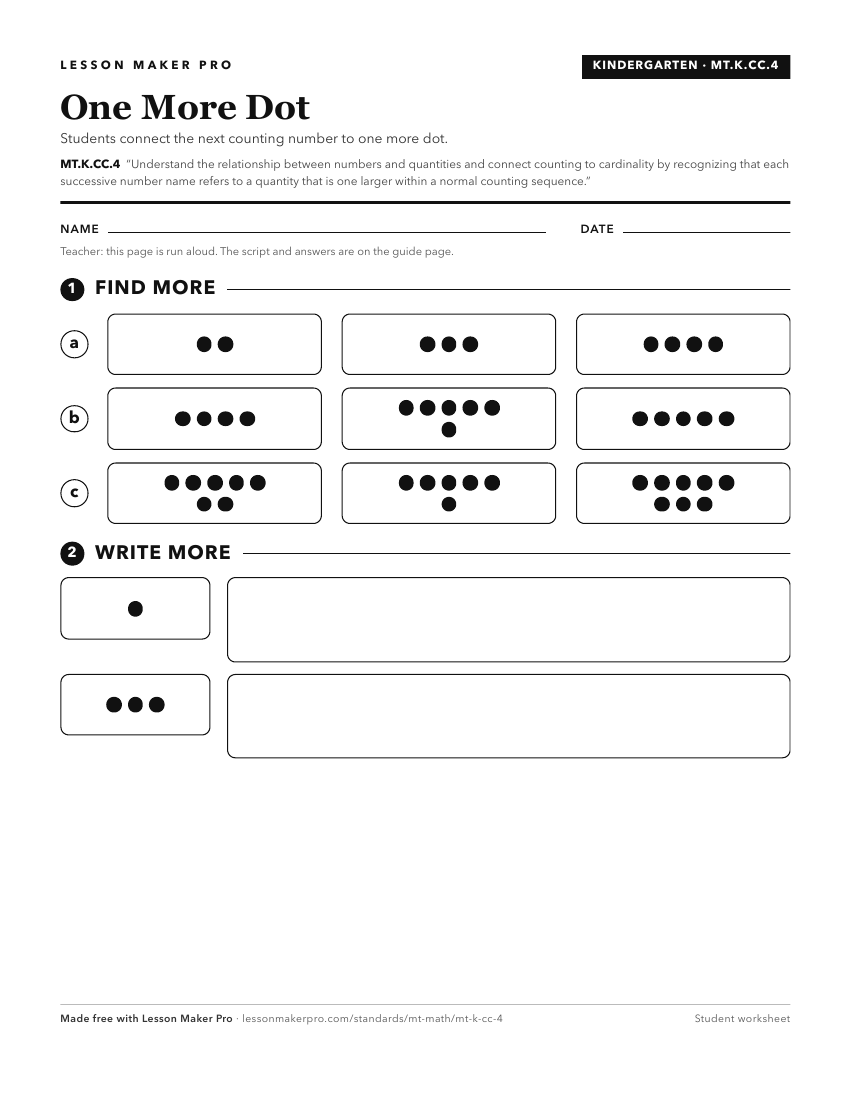
A ready-to-print activity worksheet aligned to MT.K.CC.4, with an answer key for the teacher on its own page. No account needed.
PDF, US Letter, prints cleanly in black and white.
Download the worksheetKeep exploring
Related Standards
Turn this exact standard into a lesson
Grade, subject, topic, and the complete standard are prefilled. Create one free, no account needed.
Also for this standard:Make a WorksheetMake a QuizMake a Sub Lesson