Montana Math MT.CORE.GEOM.ARG.1.a
The Standard
- MT.CORE.GEOM.ARG.1
- Investigate, conjecture, prove theorems, and communicate the proofs in a variety of ways by: Proving theorems about lines and angles. Theorems include: vertical angles are congruent, when a transversal crosses parallel lines alternate interior angles are congruent and corresponding angles are congruent, and the points on the perpendicular bisector of a line segment are those equidistant from the segment's endpoints, Proving theorems about triangles. Theorems include: the sum of the measures of the interior angles of a triangle is 180˚, the Pythagorean Theorem, the base angles of isosceles triangles are congruent, and a line parallel to one side of a triangle divides the other two sides proportionally, Proving theorems about parallelograms and other quadrilaterals. Theorems include: necessary and sufficient conditions for rectangles, parallelograms, rhombi, and kites, and Proving theorems about circles. Theorems include: the relationship between central, inscribed, and circumscribed angles, inscribed angles on a diameter are right angles, and the radius of a circle is perpendicular to the tangent where the radius intersects the circle.
Investigate, conjecture, prove theorems, and communicate the proofs in a variety of ways by: Proving theorems about lines and angles. Theorems include: vertical angles are congruent, when a transversal crosses parallel lines alternate interior angles are congruent and corresponding angles are congruent, and the points on the perpendicular bisector of a line segment are those equidistant from the segment's endpoints,
2026 Montana Mathematics Content Standards · Geometric Reasoning
Teacher's field guide
What This Standard Means
What Students Need to Do
- Students test angle and distance patterns with sketches, then explain why they always hold. They use straight angles, parallel lines, and congruent triangles to build proofs.
What Mastery Looks Like
- Given a diagram, a student labels matching angles and gives a reason for each claim without measuring. They can also prove both directions of the relationship between equal distances from a segment's endpoints and its perpendicular bisector.
Common Misconceptions
- Students may assume angle pairs match when a transversal crosses any two lines, even if the lines are not parallel. They may confuse adjacent angles with opposite angles at an intersection. They may prove only one direction of a claim or treat measurements as proof.
How to Assess It
- Draw intersecting lines with a 70° angle, parallel lines cut by a transversal with a 70° angle, and segment AB with PA = PB. Ask students to find the opposite angle and an alternate interior angle, then use triangles to explain why P lies on the perpendicular bisector of AB.
Lesson moves
Ways to Teach It
Fold a paper strip so endpoints A and B meet, mark three points on the crease, and check their distances to A and B with string.
Show two lines cut by a transversal without parallel marks and ask, 'Can you claim these angles match? What must be given?'
Give partners proof cards with diagrams and missing reasons for vertical and alternate interior angles; have them fill the blanks and trade cards to check.
Draw two houses on a map, construct their perpendicular bisector with a ruler and compass, and choose a bus stop on it.
Free download
Printable MT.CORE.GEOM.ARG.1.a Worksheet
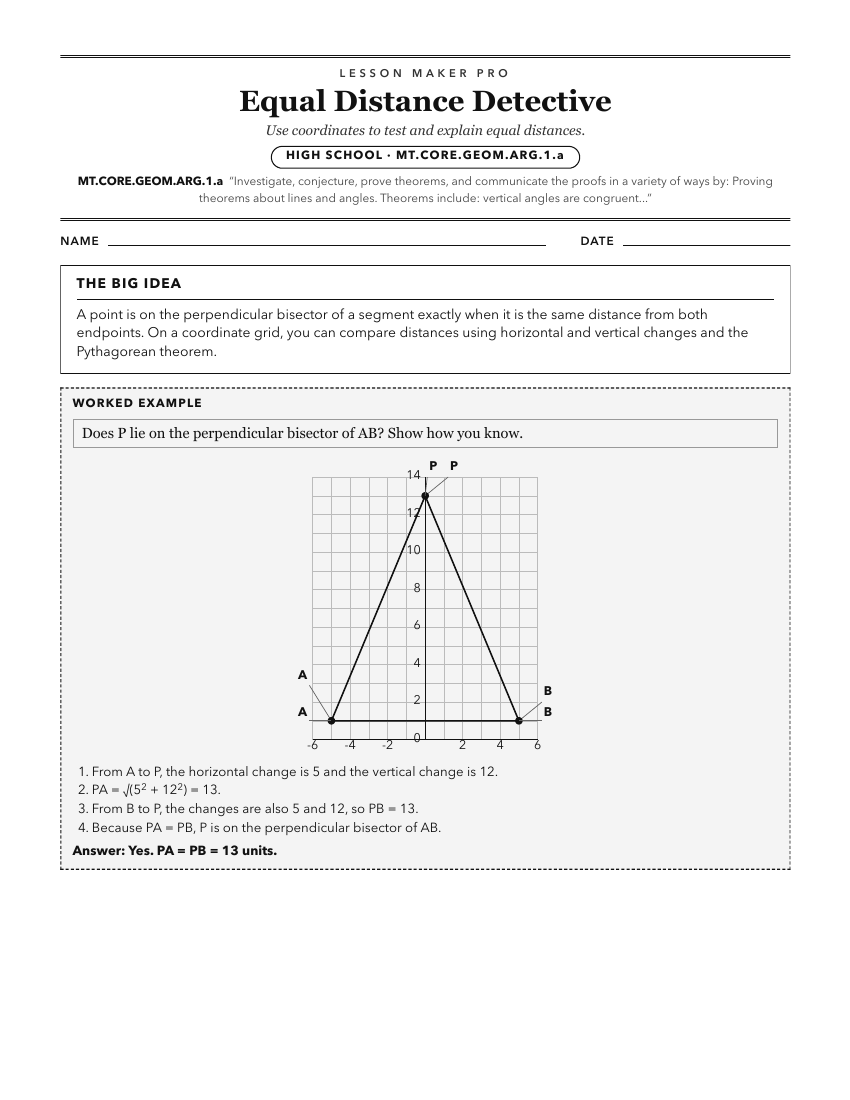
A ready-to-print activity worksheet aligned to MT.CORE.GEOM.ARG.1.a, with an answer key for the teacher on its own page. No account needed.
PDF, US Letter, prints cleanly in black and white.
Download the worksheetKeep exploring
Related Standards
- MT.CORE.GEOM.ARG.1.b
Proving theorems about triangles. Theorems include: the sum of the measures of the interior angles of a triangle is 180˚, the Pythagorean Theorem, the base angl...
- MT.CORE.GEOM.ARG.1.c
Proving theorems about parallelograms and other quadrilaterals. Theorems include: necessary and sufficient conditions for rectangles, parallelograms, rhombi, an...
- MT.CORE.GEOM.ARG.1
Investigate, conjecture, prove theorems, and communicate the proofs in a variety of ways by: Proving theorems about lines and angles. Theorems include: vertical...
Turn this exact standard into a lesson
Grade, subject, topic, and the complete standard are prefilled. Create one free, no account needed.
Also for this standard:Make a WorksheetMake a QuizMake a Sub Lesson