Montana Math MT.CORE.ALG.QUAD.3
Standard Cluster
Understand that quadratic expressions can be represented in multiple forms and the specific features of each form by: Choosing the form strategically when writing an expression based on given information and intended use, Converting between factored, standard, and vertex forms symbolically and using representations, Understanding the relationship between factored form and the zeros of the function, and Understanding the relationship between vertex form and the vertex of the function.
2026 Montana Mathematics Content Standards · Algebraic and Functional Reasoning
Cluster contents
Standards in This Cluster
MT.CORE.ALG.QUAD.3 is a cluster heading. These are the individual standards under it.
- MT.CORE.ALG.QUAD.3.a
Choosing the form strategically when writing an expression based on given information and intended use,
- MT.CORE.ALG.QUAD.3.b
Converting between factored, standard, and vertex forms symbolically and using representations,
- MT.CORE.ALG.QUAD.3.c
Understanding the relationship between factored form and the zeros of the function, and
- MT.CORE.ALG.QUAD.3.d
Understanding the relationship between vertex form and the vertex of the function.
Teacher's field guide
What This Cluster Means
What Students Need to Do
- Students rewrite quadratics in factored, standard, and vertex form. They use each form, along with a graph, to find zeros, the vertex, or the y-intercept.
What Mastery Looks Like
- Given y=(x-2)(x-6), a student finds zeros of 2 and 6 and rewrites it as y=(x-4)²-4 and y=x²-8x+12. They identify the vertex (4, -4) and y-intercept 12, and explain which form made each feature easiest to find.
Common Misconceptions
- Students may read (x-2) as a zero at -2, or read the vertex of (x-4)²-4 as (-4, -4). They may think expanding changes the graph, or mistake the constant in vertex form for the y-intercept.
How to Assess It
- Exit ticket: Given y=(x-2)(x-6), rewrite it in standard and vertex form. Find its zeros, vertex, and y-intercept, and circle the form you used for each.
Lesson moves
Ways to Teach It
Give pairs algebra tiles for x²+6x+8; have them build a rectangle and write its dimensions and factored form.
Ask students to compare y=(x-3)(x+5) and y=x²+2x-15: Which shows the zeros, and which shows the y-intercept?
Play a matching game with cards showing y=x²-6x+8, y=(x-2)(x-4), y=(x-3)²-1, and their shared graph.
Show a ball-height model h(t)=-(t-2)²+9; ask when the ball peaks and when it hits the ground.
Free download
Printable MT.CORE.ALG.QUAD.3 Worksheet
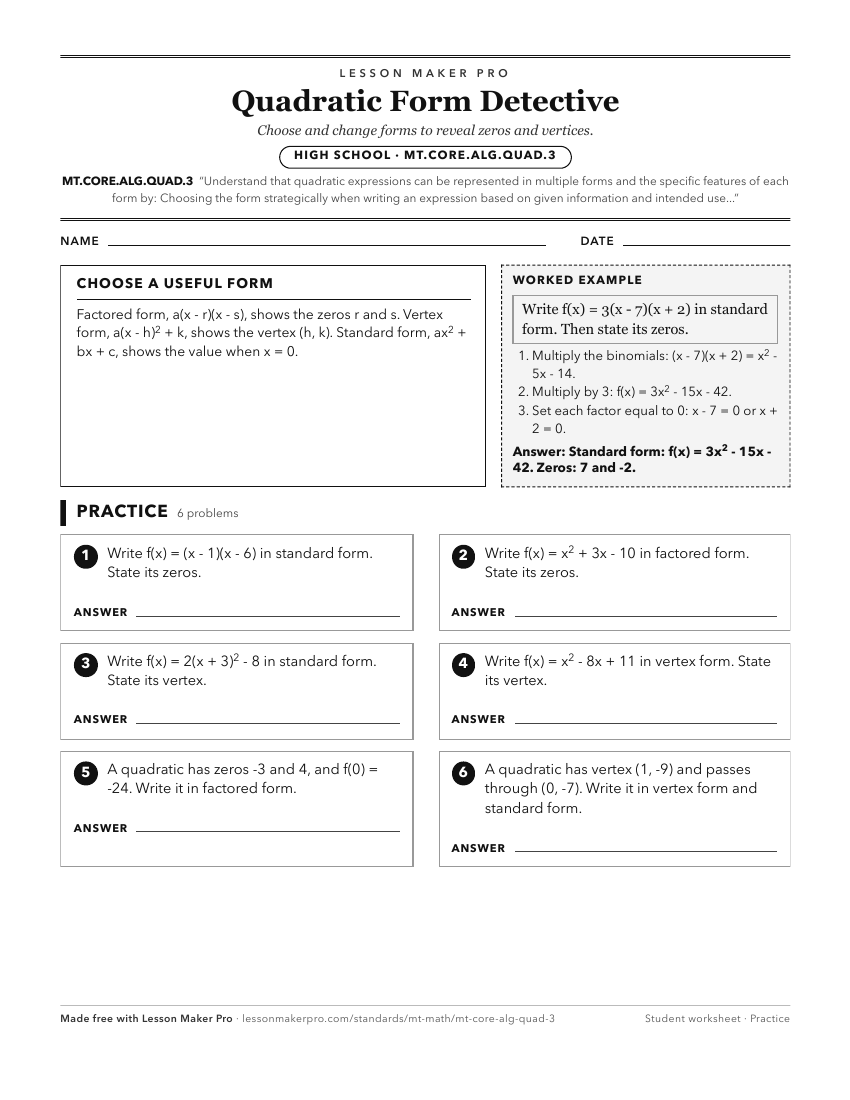
A ready-to-print activity worksheet aligned to MT.CORE.ALG.QUAD.3, with an answer key for the teacher on its own page. No account needed.
PDF, US Letter, prints cleanly in black and white.
Download the worksheetKeep exploring
Related Standards
- MT.PLUS.ALG.POLY.2
Understand that polynomial expressions can be represented in both factored and standard form, and the specific features of each form by: Choosing the form strat...
- MT.CORE.ALG.LIN.4
Understand that linear equations can be represented in multiple forms and the specific features of each form by: Choosing the form strategically when writing an...
Turn this cluster into a lesson
Grade, subject, topic, and the complete cluster are prefilled. Create one free, no account needed.
Also for this cluster:Make a WorksheetMake a QuizMake a Sub Lesson