Montana Math MT.8.EE.3
The Standard
Represent very large or very small quantities using scientific notation, limited to a single digit times an integer power of ten.
2026 Montana Mathematics Content Standards
Teacher's field guide
What This Standard Means
What Students Need to Do
- Students write large and small numbers as one nonzero digit times a power of ten. They use positive exponents for large numbers and negative exponents for numbers between 0 and 1.
What Mastery Looks Like
- A student writes 50,000,000 as 5 × 10^7 and 0.00008 as 8 × 10^-5. They can turn both expressions back into decimals.
Common Misconceptions
- Students may write a positive exponent for 0.00008 or think a negative exponent makes the number negative. Some write 50 × 10^6 instead of using a single-digit coefficient.
How to Assess It
- On an exit ticket, ask students to write 70,000,000 and 0.00009 using powers of ten and explain how they chose each exponent.
Lesson moves
Ways to Teach It
Use a place-value chart and counters to build 6,000,000 and 0.00006, then write each as a digit times a power of ten.
Ask partners to write why 8 × 10^-5 is positive but less than 1, then check by writing its decimal form.
Give pairs cards showing 2,000,000, 0.00003, 2 × 10^6, and 3 × 10^-5; have them match equivalent values.
Show a microscope label for a bacterium measuring 0.000002 meters; ask students to rewrite its length using a power of ten.
Free download
Printable MT.8.EE.3 Worksheet
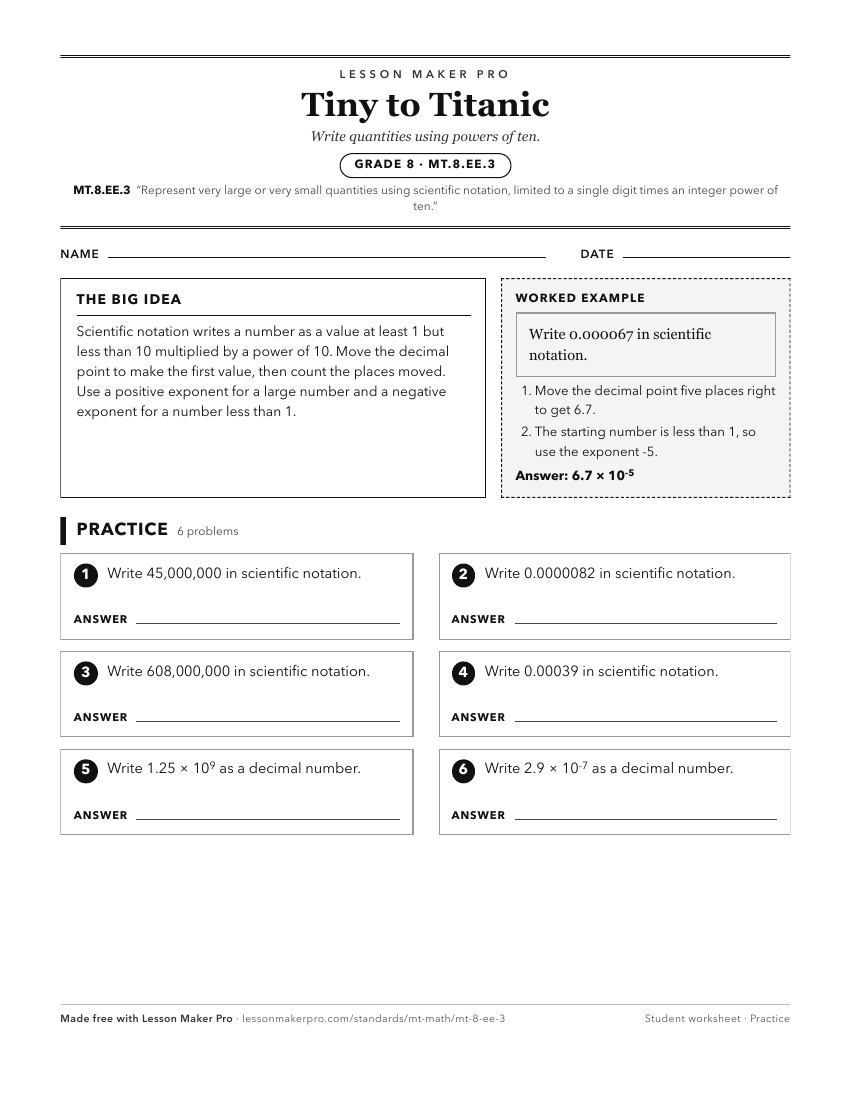
A ready-to-print activity worksheet aligned to MT.8.EE.3, with an answer key for the teacher on its own page. No account needed.
PDF, US Letter, prints cleanly in black and white.
Download the worksheetKeep exploring
Related Standards
Turn this exact standard into a lesson
Grade, subject, topic, and the complete standard are prefilled. Create one free, no account needed.
Also for this standard:Make a WorksheetMake a QuizMake a Sub Lesson