Montana Math MT.4.NF.1
The Standard
Explain why a fraction a/b is equivalent to a fraction (n × a)/(n × b) by using visual fraction models and use this principle to recognize and generate equivalent fractions.
2026 Montana Mathematics Content Standards
Teacher's field guide
What This Standard Means
What Students Need to Do
- Students draw or use fraction models to show that two fractions cover the same amount of the same whole. They make equivalent fractions by multiplying the numerator and denominator by the same number.
What Mastery Looks Like
- A student can draw same-size bars to show that 2/3 and 4/6 cover the same amount. They can explain that splitting each third into two equal pieces doubles both the shaded pieces and the total pieces.
Common Misconceptions
- Students may multiply only the numerator, changing the amount. They may also compare drawings with different-size wholes and conclude the fractions are not equal.
How to Assess It
- Ask students to draw same-size bars showing 2/3 and 4/6. Have them write one more equivalent fraction and explain how they made it.
Lesson moves
Ways to Teach It
Have students line up paper fraction strips marked in halves, fourths, and sixths to find pieces that cover the same length.
Show drawings of 2/3 and 4/6 on same-size bars, then ask students to write why doubling both numbers keeps the shaded amount equal.
Give pairs cards labeled 1/2, 2/4, 2/3, 4/6, 3/4, and 6/8; have them match equivalent fractions and sketch one match.
Fill a 1/2-cup measure with two 1/4-cup scoops of rice, then have students explain why both amounts are equal.
Free download
Printable MT.4.NF.1 Worksheet
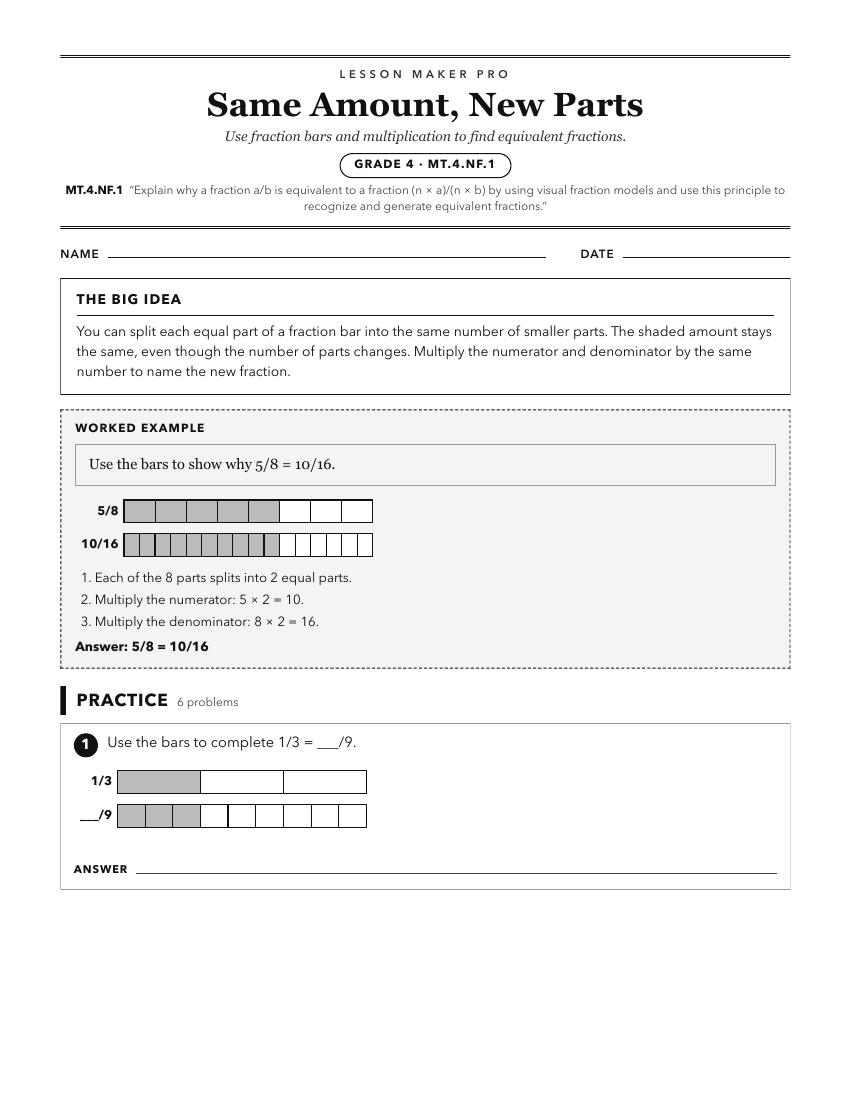
A ready-to-print activity worksheet aligned to MT.4.NF.1, with an answer key for the teacher on its own page. No account needed.
PDF, US Letter, prints cleanly in black and white.
Download the worksheetKeep exploring
Related Standards
- MT.5.NF.4
Apply and extend previous understandings of multiplication to multiply a fraction or whole number by a fraction by: Expressing the product a/b × q as "a" parts ...
- MT.4.NF.3
Understand a fraction a/b with a > 1 as a sum of fractions 1/b by: Understanding addition and subtraction of fractions as joining and separating parts referring...
- MT.3.NF.3
Understand the equivalence of fractions in special cases and compare fractions by reasoning about their size by: Understanding two fractions as equivalent if th...
Turn this exact standard into a lesson
Grade, subject, topic, and the complete standard are prefilled. Create one free, no account needed.
Also for this standard:Make a WorksheetMake a QuizMake a Sub Lesson