Montana Math MT.4.G.3
The Standard
Recognize a line of symmetry for a two-dimensional figure as a line across the figure such that the figure can be folded along the line into matching parts, identify line-symmetric figures, and draw lines of symmetry. This standard should incorporate designs and cultural context relating to Montana Indigenous Peoples and local communities.
2026 Montana Mathematics Content Standards
Teacher's field guide
What This Standard Means
What Students Need to Do
- Students check whether a flat shape can be folded into matching halves. They draw lines where the fold works. They also examine a Montana tribal flag and local signs without assuming either is symmetric.
What Mastery Looks Like
- A student can fold a paper shape on a drawn line and show that its edges match. They can draw all four lines of symmetry on a square and explain why a scalene triangle has none.
Common Misconceptions
- Students may think any line through the center is a line of symmetry. Some think every shape has a vertical line, or that equal-sized halves must match when folded.
How to Assess It
- Give students a printed square and scalene triangle. Ask them to draw every line of symmetry, write 'none' where needed, and explain one choice using a fold.
Lesson moves
Ways to Teach It
Give pairs paper squares, rectangles, and uneven shapes to fold; have them mark only creases where both halves match.
Show the Blackfeet Nation flag and your school logo; ask, 'Which details would match across a fold, and which would not?'
Have pairs sort shape cards into 'has a symmetry line' and 'has none,' then draw the lines to check their choices.
Look at the school entrance and a local sign; sketch each and mark any line that makes matching halves.
Free download
Printable MT.4.G.3 Worksheet
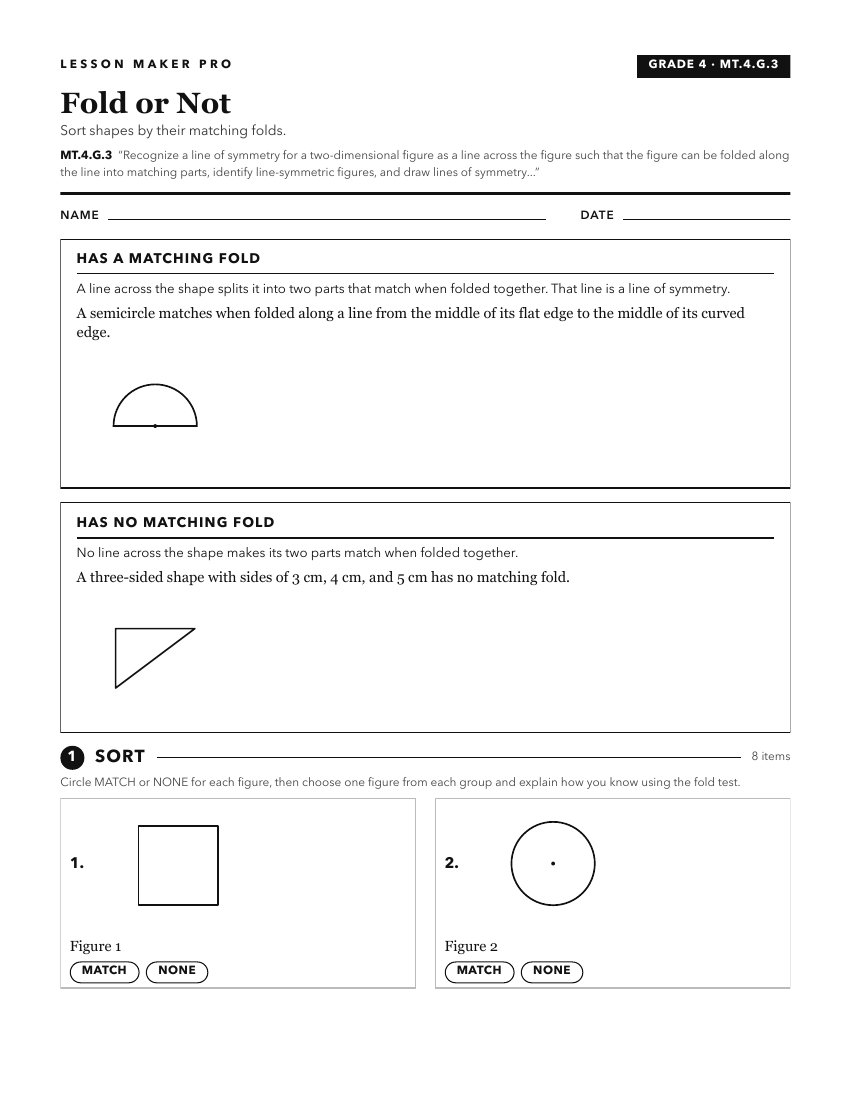
A ready-to-print activity worksheet aligned to MT.4.G.3, with an answer key for the teacher on its own page. No account needed.
PDF, US Letter, prints cleanly in black and white.
Download the worksheetKeep exploring
Related Standards
- MT.8.G.3
Describe the effect of dilations, translations, rotations, and reflections on two-dimensional figures using coordinates. This standard should incorporate cultur...
- MT.8.G.1
Verify experimentally the properties of rotations, reflections, and translations and understand that these are rigid transformations, lines are taken to lines, ...
- MT.6.G.4
Represent three-dimensional figures using nets made up of rectangles and triangles and use the nets to find the surface area of these figures in problems includ...
Turn this exact standard into a lesson
Grade, subject, topic, and the complete standard are prefilled. Create one free, no account needed.
Also for this standard:Make a WorksheetMake a QuizMake a Sub Lesson