Montana Math MT.3.MD.2
The Standard
Measure and estimate liquid volumes and masses of objects using customary and metric units by adding, subtracting, multiplying, and dividing to solve one-step problems in context that involve masses or volumes that are given in the same units.
2026 Montana Mathematics Content Standards
Teacher's field guide
What This Standard Means
What Students Need to Do
- Students estimate and measure liquids in cups and milliliters and objects in ounces and grams. They add, subtract, multiply, or divide amounts in the same unit to solve one-step problems.
What Mastery Looks Like
- A student chooses a measuring cup for juice and a scale for rice. They make a reasonable estimate, measure the amount, and choose the right operation for a story problem. They label the answer with its unit.
Common Misconceptions
- Some students choose grams for liquid volume or cups for an object's mass. Others multiply when an amount is shared equally, or leave the unit off their answer.
How to Assess It
- Use a two-question exit ticket: A bottle holds 800 mL of water, and you pour out 300 mL. How much remains? A 600 g bag of rice fills 3 jars equally. How many grams go in each jar?
Lesson moves
Ways to Teach It
Pairs estimate 200 mL of water and 100 g of beans, then measure both with a graduated cup and kitchen scale.
Ask: 'A pitcher holds 6 cups of juice. Each glass gets 2 cups. How many glasses? Explain your operation.'
Race through cards: '100 g rice plus 200 g,' '500 mL juice minus 100 mL,' '3 bags at 200 g,' '600 g split three ways.'
Bring a soup recipe calling for 2 cups of broth per pot; ask how many cups are needed for 3 pots.
Free download
Printable MT.3.MD.2 Worksheet
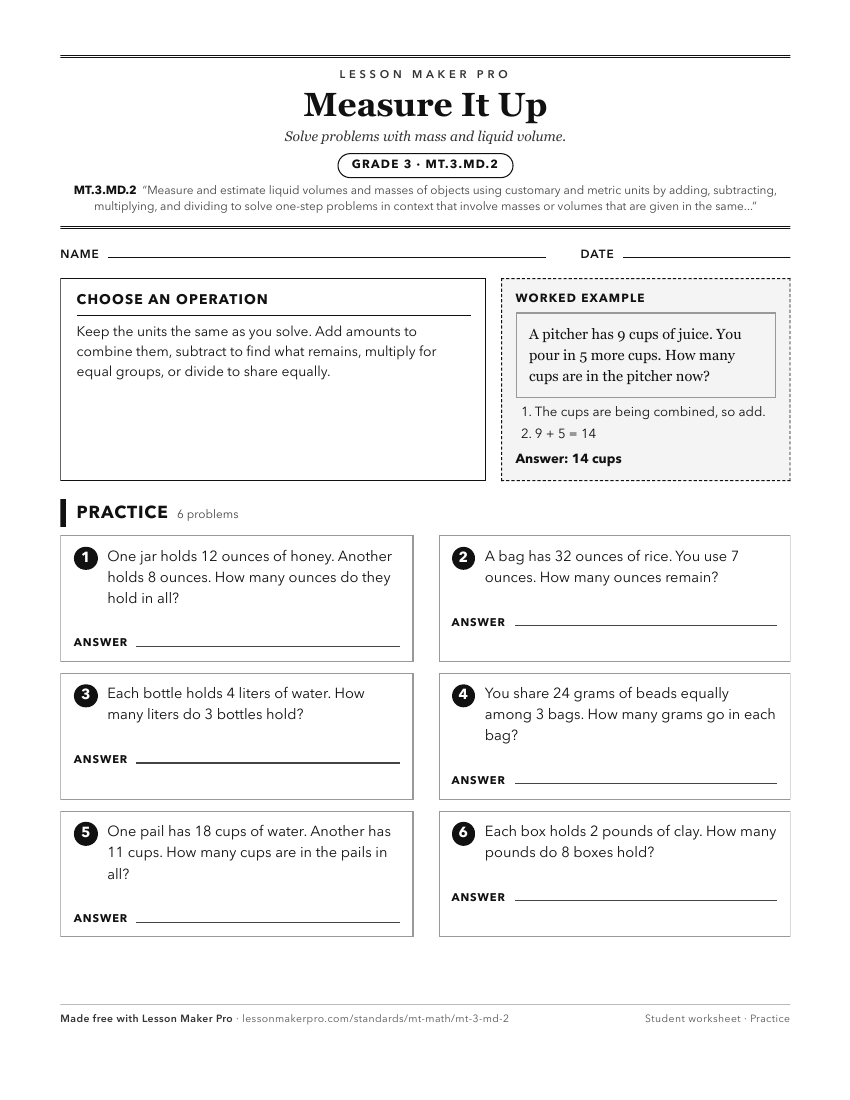
A ready-to-print activity worksheet aligned to MT.3.MD.2, with an answer key for the teacher on its own page. No account needed.
PDF, US Letter, prints cleanly in black and white.
Download the worksheetKeep exploring
Related Standards
- MT.2.MD.3
Estimate lengths using units of common measurement.
- MT.4.MD.2
Use the four operations to solve problems in context using distances, intervals of time, liquid volumes, masses of objects, and money, including problems with s...
- MT.2.MD.2
Understand the relationship between unit sizes and number of units by measuring a single object using two different units of common measurement.
Turn this exact standard into a lesson
Grade, subject, topic, and the complete standard are prefilled. Create one free, no account needed.
Also for this standard:Make a WorksheetMake a QuizMake a Sub Lesson