Montana Math MT.1.MD.4
The Standard
Identify the value of coins.
2026 Montana Mathematics Content Standards
Teacher's field guide
What This Standard Means
What Students Need to Do
- Students name pennies, nickels, dimes, and quarters and tell how many cents each is worth. They use size, color, and markings to tell the coins apart.
What Mastery Looks Like
- Given real coins or pictures, a student identifies each coin and gives its value: 1, 5, 10, or 25 cents. They recognize a dime even though it is smaller than a nickel.
Common Misconceptions
- Students may think a bigger coin is always worth more, so they say a nickel is worth more than a dime. They may confuse a nickel with a quarter or give a coin's name instead of its value.
How to Assess It
- Show pictures of a penny, nickel, dime, and quarter in mixed order. Have students write each coin's value in cents beside its picture.
Lesson moves
Ways to Teach It
Give pairs real or plastic coins to sort, then have them label each group with its cent value.
Hold up a dime and a nickel. Ask, 'Which is worth more, and how can you tell?'
Play memory with coin picture cards and cent-value cards; students say each matched value aloud.
Set a pencil's price at 25 cents on a pretend school store shelf and ask students to pick one coin that pays exactly.
Free download
Printable MT.1.MD.4 Worksheet
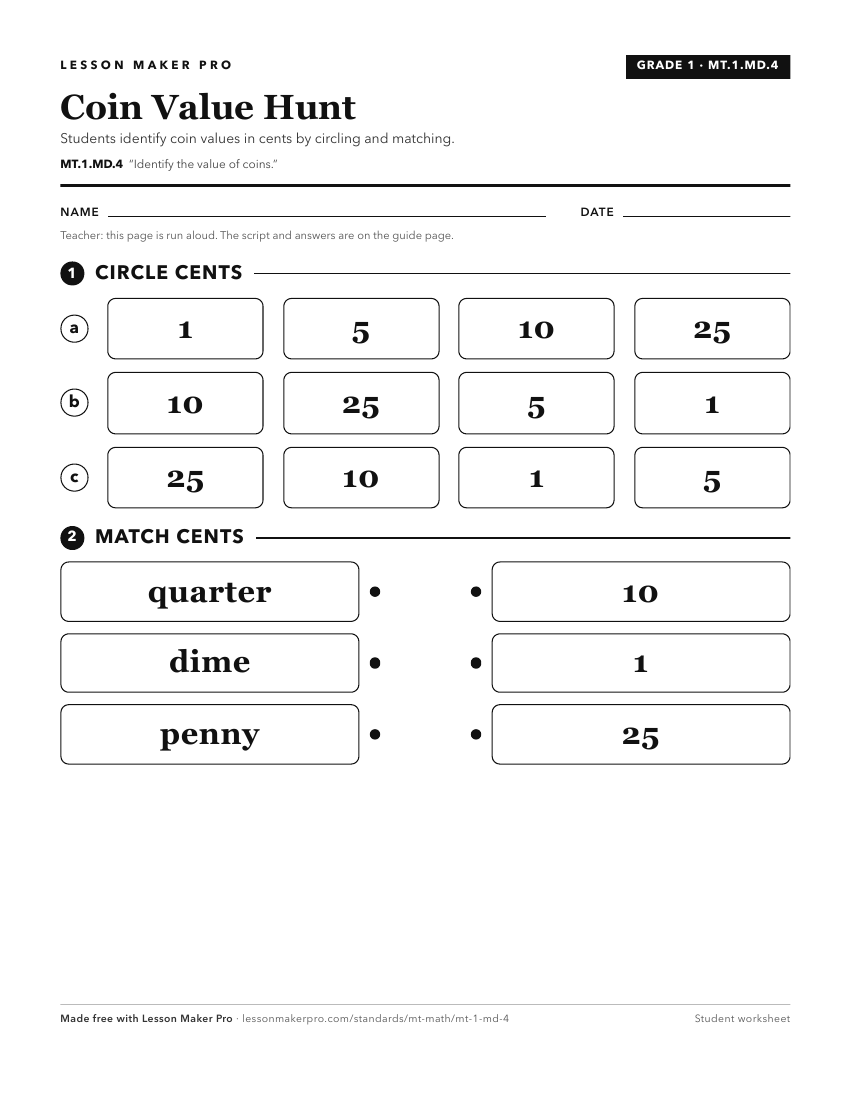
A ready-to-print activity worksheet aligned to MT.1.MD.4, with an answer key for the teacher on its own page. No account needed.
PDF, US Letter, prints cleanly in black and white.
Download the worksheetKeep exploring
Related Standards
Turn this exact standard into a lesson
Grade, subject, topic, and the complete standard are prefilled. Create one free, no account needed.
Also for this standard:Make a WorksheetMake a QuizMake a Sub Lesson