Mississippi Science ENV.3.3
The Standard
- ENV.3
- Students will discuss the direct and indirect impacts of certain types of human activities on the Earth’s climate.
Use satellite imagery and other resources to analyze changes in biomes over time (e.g., glacial retreat, deforestation, desertification) and propose strategies to reduce the impact of human activities leading to these issues.
2026 Mississippi College- and Career-Readiness Standards for Science · Human Activities and Climate Change
Teacher's field guide
What This Standard Means
What Students Need to Do
- Students compare dated satellite images of the same place to measure changes in forest, ice, or dryland cover. They use maps or land-use records to investigate likely causes, then propose a way to reduce a human impact.
What Mastery Looks Like
- A student identifies the area that changed and gives an estimate with dates. They use another source to support a likely cause, suggest an action that targets it, and explain how to track the result.
Common Misconceptions
- Students may compare images from different seasons and mistake seasonal color changes for permanent loss. They may assume every change is human-caused or that an image alone proves why trees disappeared.
How to Assess It
- Show two dated satellite images of the same forest and a land-use map. Ask students to mark where trees disappeared, name a likely cause supported by the map, and propose an action they could check next year.
Lesson moves
Ways to Teach It
Place a 5-by-5 grid over two printed, same-season satellite images of one forest and count squares with tree cover in each.
Ask pairs: “Does the image alone prove why trees disappeared?” Have them name one record that could test their explanation.
Give teams image pairs, land-use cards, and action cards; have them match each change to a likely cause and a targeted response.
Open Google Earth Timelapse over a nearby forest, note any clearing, and check a local land-use map for a possible cause.
Free download
Printable ENV.3.3 Worksheet
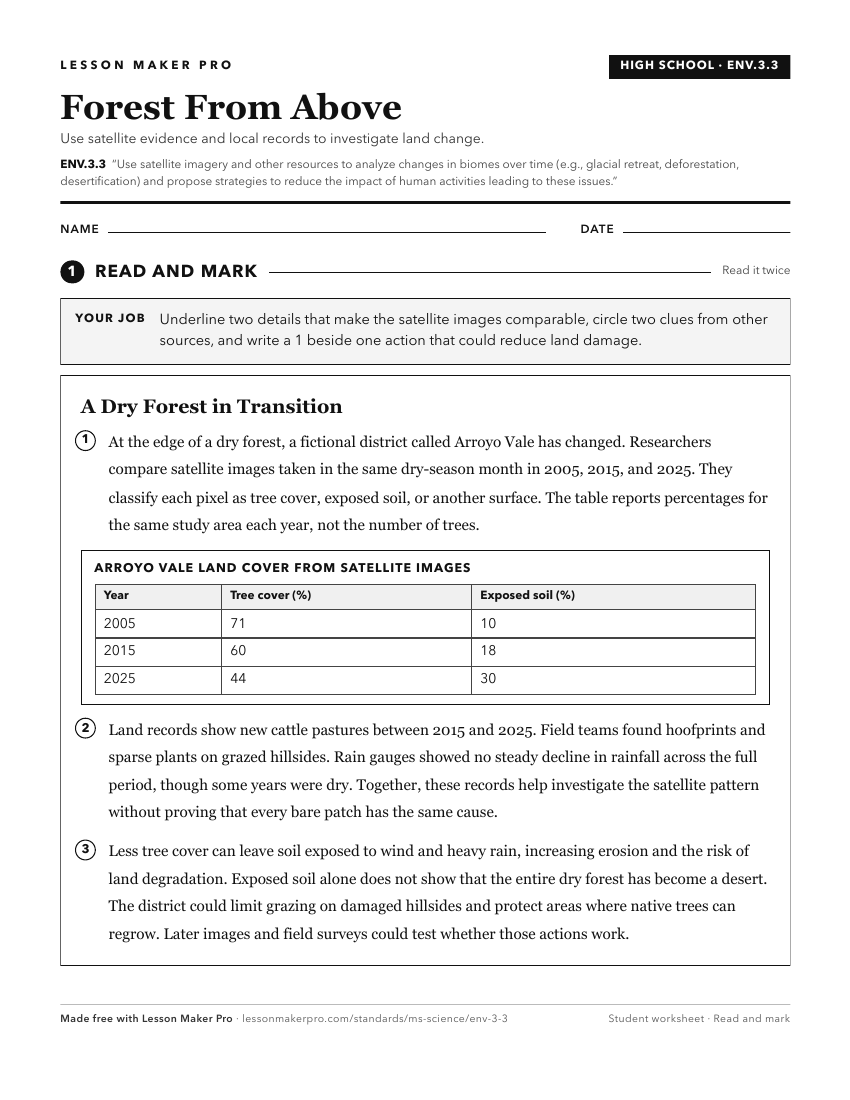
A ready-to-print activity worksheet aligned to ENV.3.3, with an answer key for the teacher on its own page. No account needed.
PDF, US Letter, prints cleanly in black and white.
Download the worksheetKeep exploring
Related Standards
- FB.6.4
Develop and use models to discuss the climate, flora, and fauna of the terrestrial and aquatic biomes of the world.
- ENV.1.1
Identify, investigate, and evaluate the interactions of the abiotic and biotic factors that determine the types of organisms that live in major biomes.
- ENV.1.9
Evaluate and communicate data that explains how human activity may impact biodiversity (e.g., introduction, removal, and reintroduction of an organism within an...
- ENV.4.2
Evaluate data and other information to explain how key natural resources (e.g., water sources, fertile soils, concentrations of minerals, and fossil fuels), nat...
Turn this exact standard into a lesson
Grade, subject, topic, and the complete standard are prefilled. Create one free, no account needed.
Also for this standard:Make a WorksheetMake a QuizMake a Sub Lesson