Mississippi Science E.4.9C.3
The Standard
- E.4.9C
- Students will demonstrate an understanding of how natural processes and human activities affect the features of Earth's landforms and oceans.
Construct scientific arguments from evidence to support claims that human activities, such as conservation efforts or pollution, affect the land, oceans, and atmosphere of Earth.
2026 Mississippi College- and Career-Readiness Standards for Science · Earth’s Systems and Cycles
Teacher's field guide
What This Standard Means
What Students Need to Do
- Students make a claim about how litter, exhaust, or conservation affects land, ocean water, or air. They use a count, photo, or simple test as evidence and explain how it supports the claim.
What Mastery Looks Like
- Given litter counts from before and after a cleanup, a student claims the cleanup left less trash on the ground and cites both numbers. They explain that the counts show a local change, not that all pollution disappeared.
Common Misconceptions
- Students may say all litter beside a drain reaches the ocean, even when they do not know where the drain leads. They may offer an opinion, such as “pollution is bad,” instead of evidence.
How to Assess It
- Exit ticket: “A class counted 18 pieces of litter near a drain on Monday and 5 after a cleanup on Tuesday. Make a claim about litter on the ground, use both counts, and explain your reasoning.”
Lesson moves
Ways to Teach It
Pour equal amounts of water over bare soil and grass sod in two trays, then compare the muddy runoff collected in cups.
Give students a chart of bus idling times and a fact card about exhaust; ask what claim they can support about air pollution.
Play claim-evidence match using cards about trash pickup, car exhaust, and soil runoff; partners explain why each evidence card fits.
Count litter near a school storm drain, then write a claim about what rain might carry into it, using the count.
Free download
Printable E.4.9C.3 Worksheet
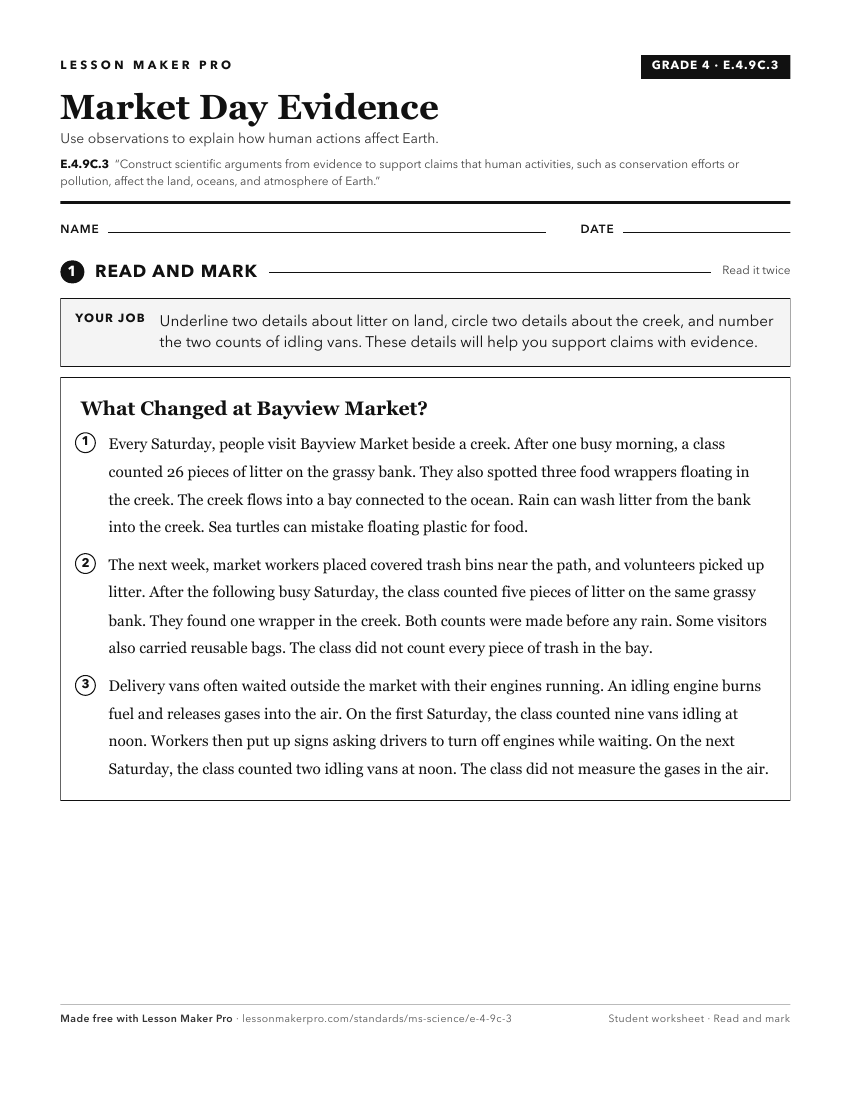
A ready-to-print activity worksheet aligned to E.4.9C.3, with an answer key for the teacher on its own page. No account needed.
PDF, US Letter, prints cleanly in black and white.
Download the worksheetKeep exploring
Related Standards
- L.3.4.5
Construct scientific arguments using evidence from fossils of plants and animals that lived long ago to infer the characteristics of early environments (e.g., m...
- L.2.3A.2
Construct scientific arguments to explain how animals can make major changes (e.g., beaver dams obstruct streams, or large deer populations destroying crops) an...
- L.8.2C.2
Construct scientific arguments from evidence to support claims about the potentially harmful, beneficial, or neutral effects of genetic mutations on organisms.
- ESS.3.6
Construct an explanation from data sets to obtain and evaluate scientific information to construct scientific arguments on changes in climate caused by various ...
Turn this exact standard into a lesson
Grade, subject, topic, and the complete standard are prefilled. Create one free, no account needed.
Also for this standard:Make a WorksheetMake a QuizMake a Sub Lesson