Mississippi Science E.3.7A.3
The Standard
- E.3.7A
- Students will demonstrate an understanding of the various processes involved in the rock cycle, superposition of rock layers, and fossil formation.
Ask questions to generate testable hypotheses regarding the formation and location of fossil types, including their presence in some sedimentary rock.
2026 Mississippi College- and Career-Readiness Standards for Science · Earth’s Structure and History
Teacher's field guide
What This Standard Means
What Students Need to Do
- Students ask how shells, leaves, and other remains can leave fossils in buried sediment. They predict which fossils they might find in different rock layers and say how they could check.
What Mastery Looks Like
- Given a photo of layered rock, a student asks whether one layer has more shell fossils than another. They predict a result and explain how they would count the fossils. They know some sedimentary layers have no fossils.
Common Misconceptions
- Some students think all fossils are dinosaur bones or that every rock contains fossils. Others think a print becomes a fossil as soon as it forms in mud, without being buried and preserved. They may make a guess without saying how to test it.
How to Assess It
- Show photos of layered sedimentary rock and granite. Ask: "Where would you look for shell fossils? Write a question you could test, your prediction, and how you would check it."
Lesson moves
Ways to Teach It
Press shells and leaves into damp clay and loose sand, then compare which material holds clearer prints after the objects are removed.
Ask pairs: "Why might one rock layer have shell fossils and another have leaf fossils?" Have them name evidence they would look for.
Give teams picture cards of shells, leaf prints, layered rock, and granite; have them sort likely fossil finds and write a testable prediction.
Show a photo of a highway roadcut; students circle layers they would search for shell fossils and plan a fossil count by layer.
Free download
Printable E.3.7A.3 Worksheet
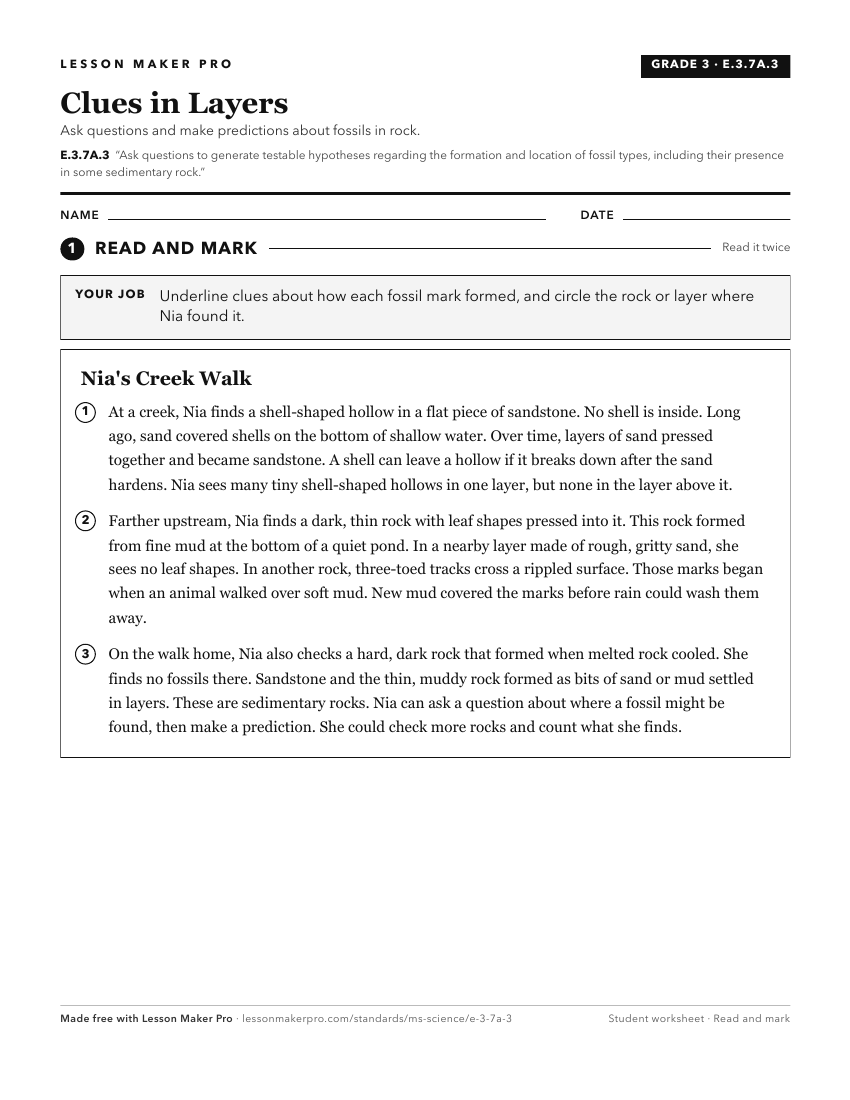
A ready-to-print activity worksheet aligned to E.3.7A.3, with an answer key for the teacher on its own page. No account needed.
PDF, US Letter, prints cleanly in black and white.
Download the worksheetKeep exploring
Related Standards
- E.3.7A.1
Plan and conduct controlled scientific investigations to identify the processes involved in forming the three major types of rock, and investigate common techni...
- E.8.7.2
Create a model of the processes involved in the rock cycle and relate it to the fossil record.
- FB.5.2
Analyze and interpret data to support claims that different types of fossils provide evidence of the diversity of life that has existed on Earth and of the rela...
- E.3.7A.2
Develop and use models to demonstrate the processes involved in the development of various rock formations, including superposition, and how those formations ca...
Turn this exact standard into a lesson
Grade, subject, topic, and the complete standard are prefilled. Create one free, no account needed.
Also for this standard:Make a WorksheetMake a QuizMake a Sub Lesson