Mississippi Math G-GMD.1
The Standard
Give an informal argument for the formulas for the circumference of a circle, area of a circle, volume of a cylinder, pyramid, and cone. Use dissection arguments, Cavalieri’s principle, and informal limit arguments.
2025 Mississippi College- and Career-Readiness Standards for Mathematics · Explain Volume Formulas and Use Them to Solve Problems
Teacher's field guide
What This Standard Means
What Students Need to Do
- Students explain where the formulas for circle circumference and area come from. They use cuts, stacked slices, and shapes with more and more sides to explain the volume formulas for cylinders, pyramids, and cones.
What Mastery Looks Like
- A student can show how narrow circle sectors form a near rectangle with area πr², and explain why circumference is π times the diameter. They can use stacked disks to explain cylinder volume and a cube split into three pyramids to explain the one-third factor. They can compare a cone and pyramid with equal base areas and heights, showing that their slices have equal areas at every height.
Common Misconceptions
- Students may use πr² for circumference or 2πr for area. Some leave out the one-third in pyramid and cone volume because those shapes also have a base and height. Others think equal base areas alone mean equal volumes, even when the heights differ.
How to Assess It
- Give students a circle divided into 16 equal sectors. Ask: "Sketch how you could rearrange the sectors to explain the circle’s area formula. Label the approximate base and height of the new shape."
Lesson moves
Ways to Teach It
Cut a paper circle into 16 sectors, alternate the pieces into a near rectangle, and label its base and height.
Draw horizontal slices of a cone and pyramid with equal base areas and heights; ask students why the volumes match.
Give pairs five formula cards and picture cards showing circle string, sector strips, stacked disks, cube thirds, and cone slices; match and justify.
Compare a cone-shaped popcorn holder with a straight cup of the same radius and height; predict and measure how many conefuls fill the cup.
Free download
Printable G-GMD.1 Worksheet
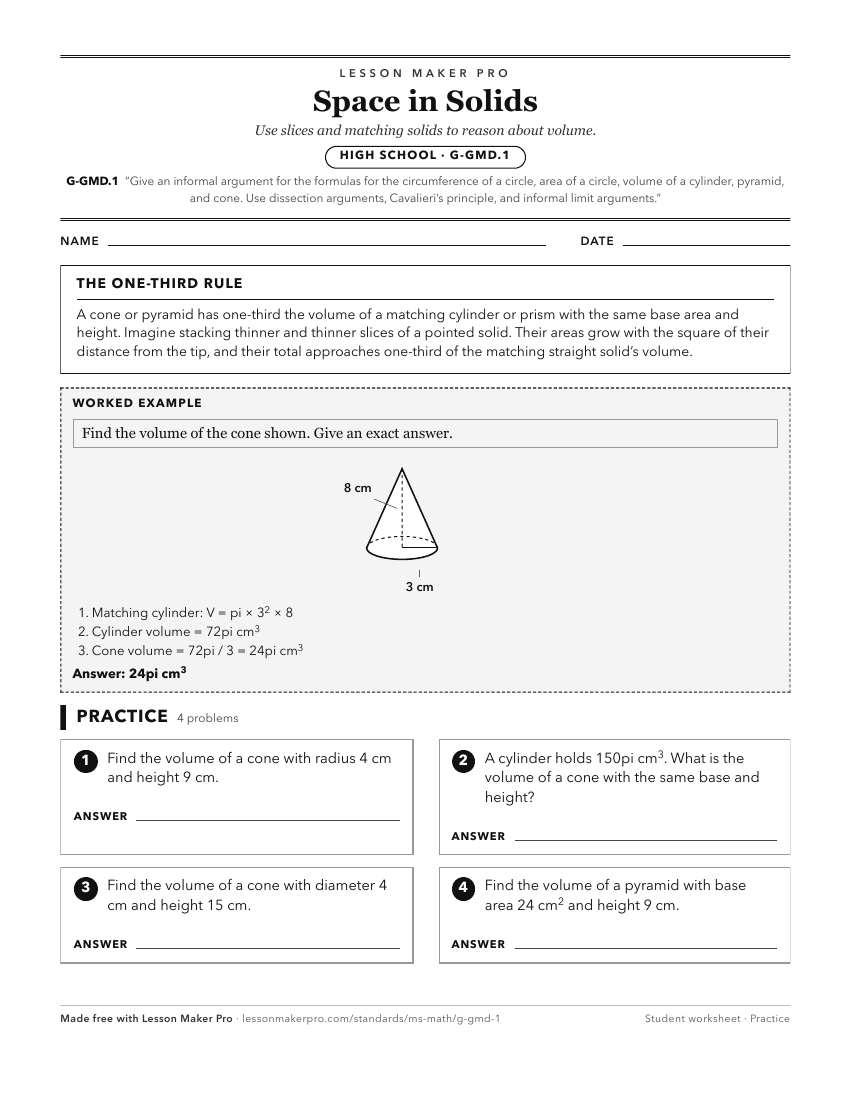
A ready-to-print activity worksheet aligned to G-GMD.1, with an answer key for the teacher on its own page. No account needed.
PDF, US Letter, prints cleanly in black and white.
Download the worksheetTurn this exact standard into a lesson
Grade, subject, topic, and the complete standard are prefilled. Create one free, no account needed.
Also for this standard:Make a WorksheetMake a QuizMake a Sub Lesson