Mississippi Math FA.A.34
The Standard
Justify why some polynomials are prime over the rational number system.
2025 Mississippi College- and Career-Readiness Standards for Mathematics
Teacher's field guide
What This Standard Means
What Students Need to Do
- Students decide whether a polynomial can be written as a product of lower-degree polynomials with rational coefficients. They justify a prime claim with a method that fits the degree.
What Mastery Looks Like
- A student tests ±1 and ±2 as the only possible rational roots of x²−2, then explains why no rational root means this quadratic is prime. They factor x²−4 as (x−2)(x+2).
Common Misconceptions
- Students may think x²−2 factors over the rationals because its roots, ±√2, are real. They may also think no rational roots proves a fourth-degree polynomial is prime.
How to Assess It
- Exit ticket: Is x²−2 prime over the rationals? List and test every possible rational root, then explain why that settles the quadratic case.
Lesson moves
Ways to Teach It
Give students cards labeled x²−2, x²−4, ±1, and ±2; have them match possible roots and calculate each substitution.
Ask: Is x⁴−4 prime because it has no rational roots? Factor it and explain your answer.
Run a discriminant sort with x²−2, x²−4, and x²+1; students label each prime or factorable over the rationals.
Give students a square garden with area 2 m²; have them write x²−2=0 and explain why no rational side length works.
Free download
Printable FA.A.34 Worksheet
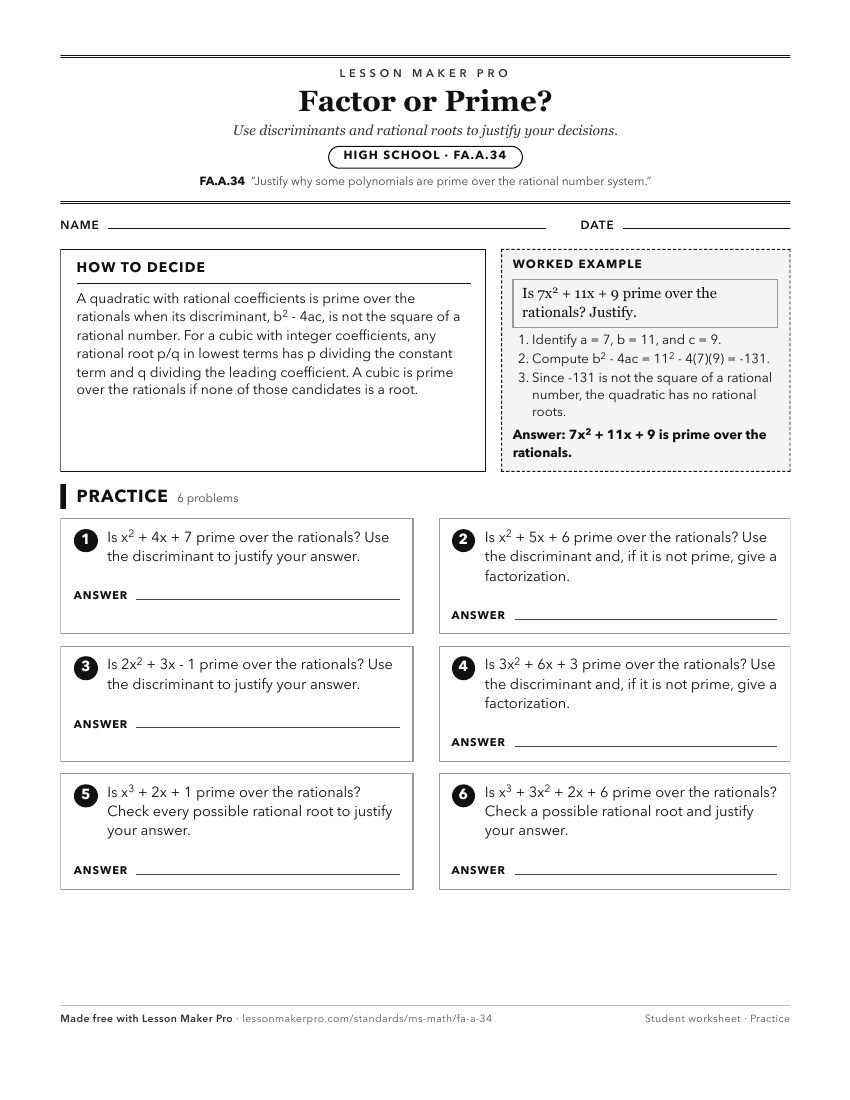
A ready-to-print activity worksheet aligned to FA.A.34, with an answer key for the teacher on its own page. No account needed.
PDF, US Letter, prints cleanly in black and white.
Download the worksheetKeep exploring
Related Standards
Turn this exact standard into a lesson
Grade, subject, topic, and the complete standard are prefilled. Create one free, no account needed.
Also for this standard:Make a WorksheetMake a QuizMake a Sub Lesson